



# 24306
Mendes Pinto, Fernão (d. 1583); Cogan, Henry (translator)
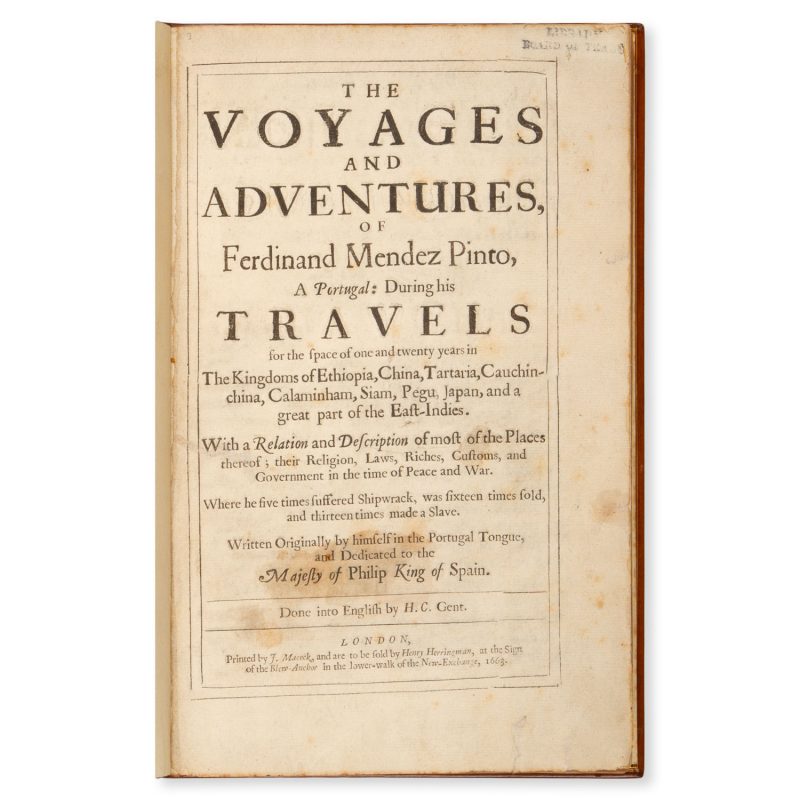
The voyages and adventures of Ferdinand Mendez Pinto, a Portugal, during his travels for the space of one and twenty years in the Kingdoms of Ethiopia, China, Tartaria, Cauchinchina, Calaminham, Siam, Pegu, Japan, and a great part of the East-Indies.
$9,500.00 AUD
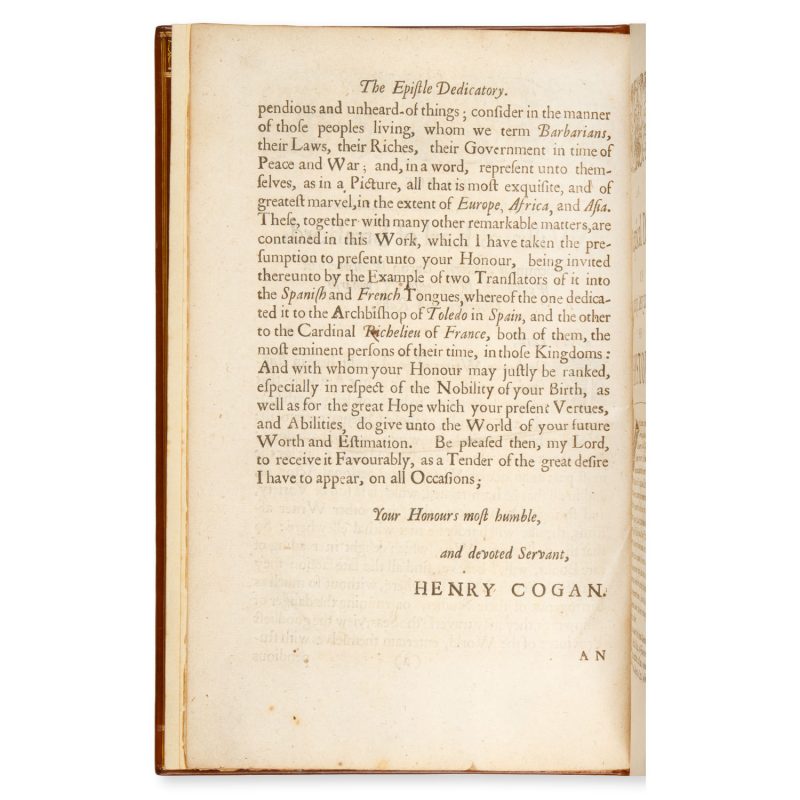
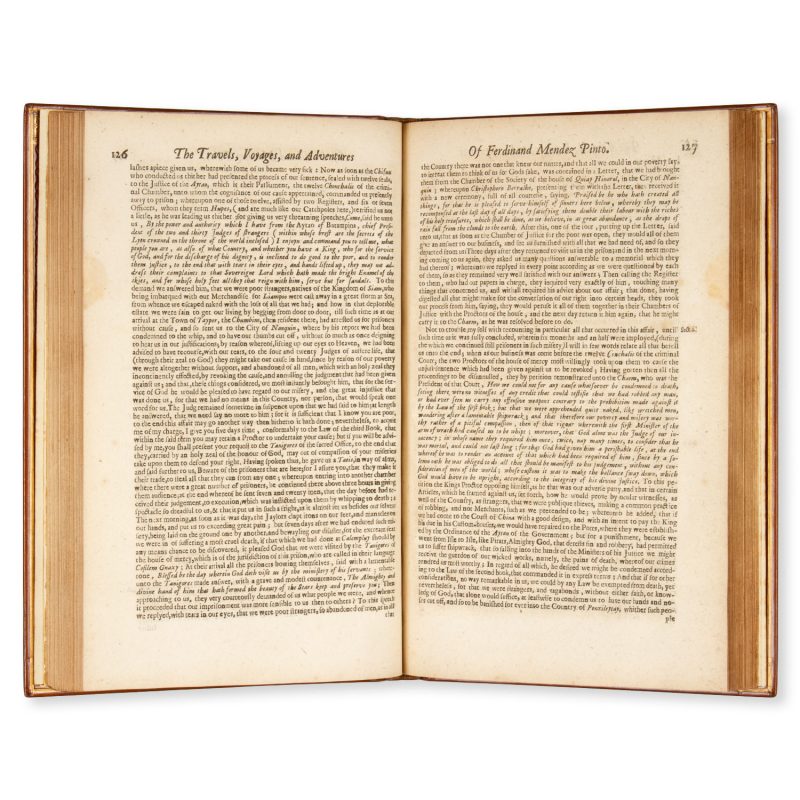
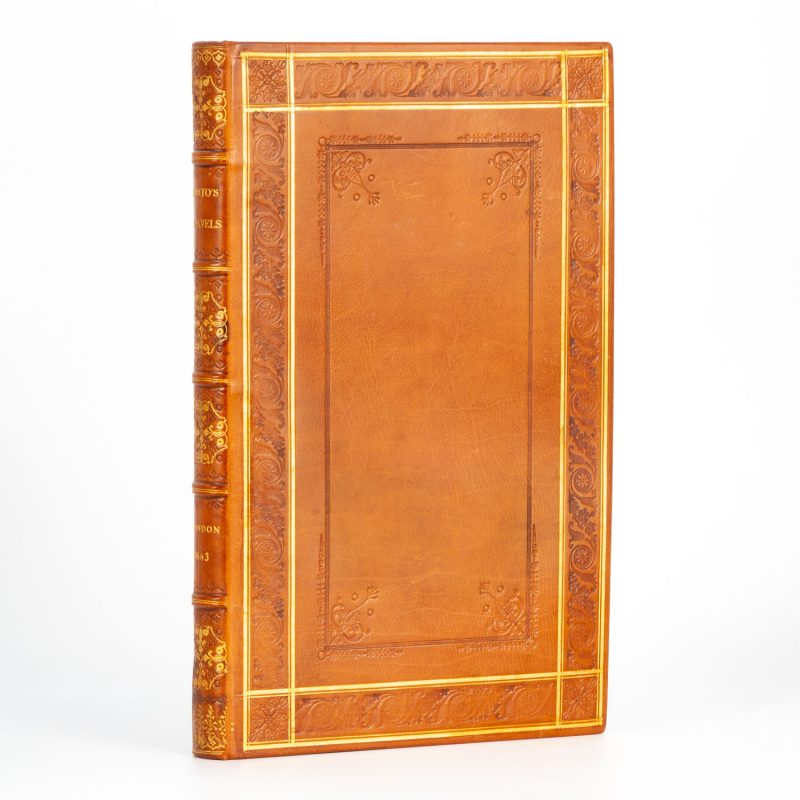
With a relation and description of most of the places thereof ; their religion, laws, riches, customs, and government in time of peace and war : where he five times suffered shipwrack, was sixteen times sold, and thirteen times made a slave : written originally by himself in the Portugal tongue and dedicated to the Majesty of Philip King of Spain ; done into English by H.C. Gent. London : Printed by J. Macock, and are to be sold by Henry Herringman, at the Sign of the Blew-Anchor, in the lower-walk of the New Exchange, 1663. Small folio, panelled calf ruled in gilt, spine with raised bands and gilt lettering and ornament; pp [xiv], 326; woodcut head-pieces and decorative initials; title page with some light stains, expertly repaired tear at bottom edge and old wet stamp of the Board of Trade Library; very occasional marginal spotting, else clean and crisp throughout.
The second English edition of Henry Cogan’s translation of the Peregrinação, originally published in Lisbon in 1614.
Pinto’s work, first published more than 30 years after his death, is a narrative of his two-decade voyage which commenced in Portugal in 1537 in a fleet under the command of the son of Vasco da Gama, and ended with his return in 1558. It contains some of the earliest eyewitness accounts by a Westerner of the Malay Peninsula, Siam, Cochin-China, China and Japan. Indeed, Pinto claimed to be the first European to set foot on Japanese soil.
Pinto was admitted to the Society of Jesus in 1554. A close acquaintance of Francis Xavier, he contributed to various missions in Japan, a country which he visited four times during his travels. The Peregrinação was enormously successful, and by 1700 had been published in nineteen editions in six languages. According to Catz, it rivalled Cervantes’ Don Quixote in popularity: “It is, in fact, an exotic and imaginative composite of fact and fiction, at once a picaresque prose epic and an authentic picture of sixteenth-century Asia.” (Rebecca D. Catz, The Travels of Mendes Pinto, 15).
Pinto’s voyages took place prior to the colonisation of the Philippine Islands by the Spanish, which began in 1565 with Lezgapi’s settlement in Cebu. but his narrative contains brief mentions of earlier Spanish expeditions such as those led by Ruy López de Villalobos and García Jofre de Loaísa, whose ships made landfall on several islands including Samar, Leyte and Mindanao. There are also occasional references to encounters with merchant-mariners from Luzon (Luções in Portuguese) in Malacca and other places, who were conducting overseas commerce in the region long before the arrival of the Spanish. He also describes being shipwrecked in the waters north of Luzon. However, it should be noted that the validity of much of Pinto’s narrative has long been the subject of conjecture: it is often perceived (cf. Catz’s comment above) as a tapestry of accounts woven together from disparate sources, some more reliable than others.
Hill 1146; Cordier, Japonica, 40, Sinica, 2068-2069; Lust 346; Wing M1706

