# 47061
HARDY, Thomas
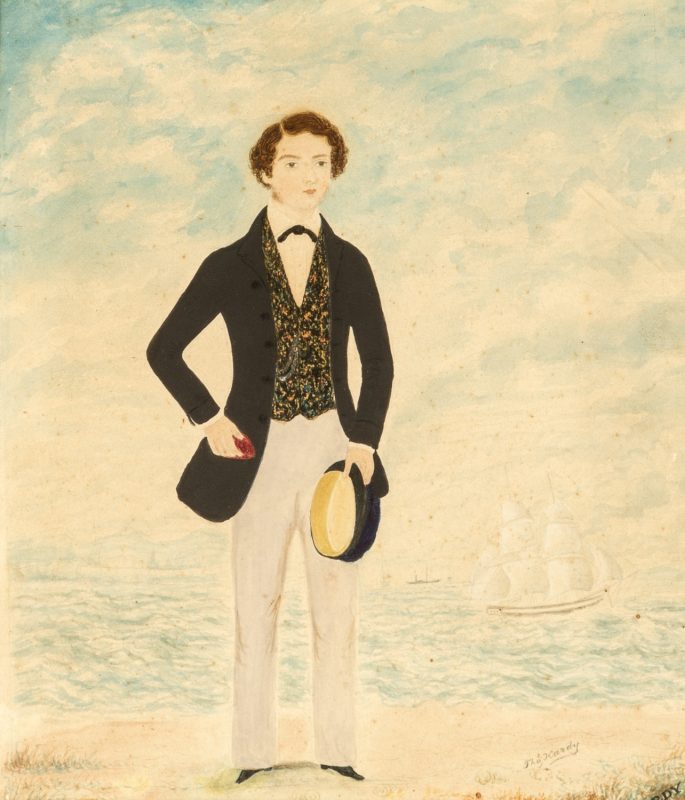
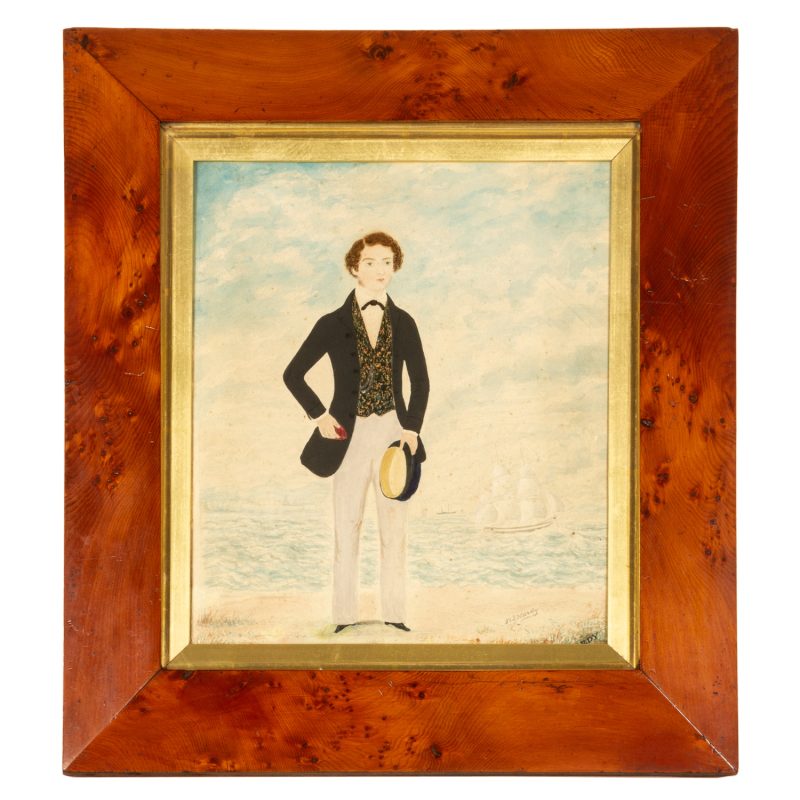
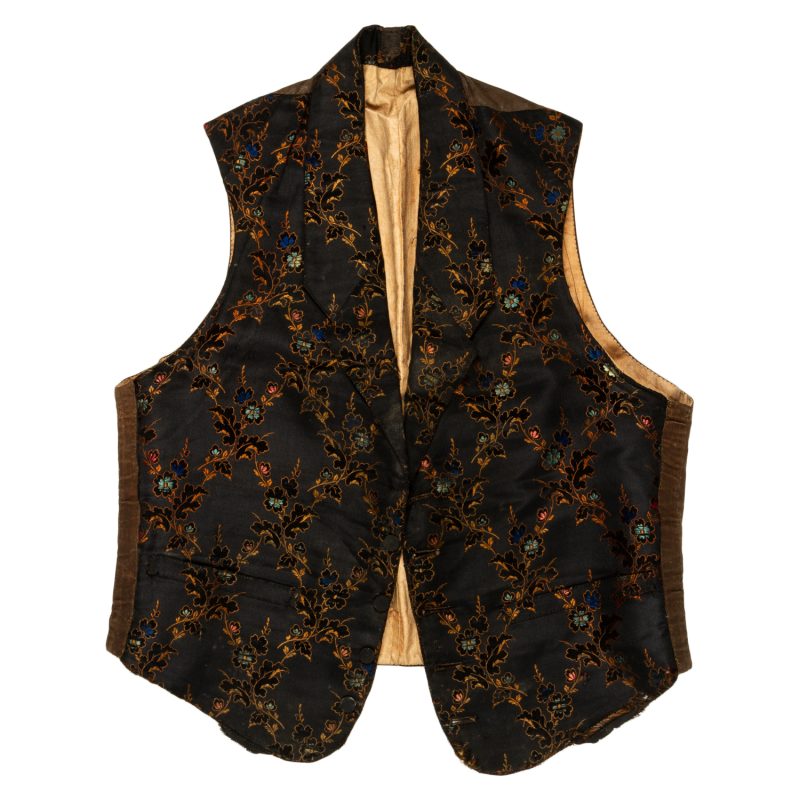
Portrait of Henry Daniel Skinner, painted just before his departure from England for Port Phillip in 1852; accompanied by his waistcoat (as worn in the portrait).
$9,500.00 AUD
Gouache and watercolour on paper, 24.0 x 20.5 cm (sight), signed by the artist l.r.; in fine condition, housed in a nineteenth-century bird’s-eye maple frame with original cover glass; [ACCOMPANIED BY] the embroidered silk waistcoat worn by Skinner in the portrait, approx. 50 x 40 cm (irregular), remarkably well preserved.
Souvenirs of a young Englishman’s emigration to Australia at the height of the Victorian gold rushes.
A biographical sketch of Henry Daniel Skinner (1831-1907):
Henry was born on 27 February 1831 in Stepney, London – which means he was a true Cockney – and baptised at St. Giles in the Fields, Holborn on 24 April 1831. On 4 February 1847, at the age of 16, he was indentured for four years as an apprentice in the merchant navy. His master was Robert Trace, of Liverpool. Young Henry was assigned to the sailing ship Pemberton, 1253 tons. During the Earl Grey Emigration Scheme of 1848-50, when children orphaned in the Irish Famine were shipped out to Australia, the Pemberton left Plymouth on 29 January 1849, bound for Port Phillip, carrying no fewer than 305 barefoot female orphans from Irish workhouses. Henry’s ship arrived in Melbourne on 14 May 1849, discharging most of its human cargo there before sailing on to Portland in Victoria’s far southwest, where it delivered another 37 orphans.
On completion of his apprenticeship, and after news of the discovery of gold in Victoria had reached England, Henry decided that he would seek his fortune in Australia. Before he left his native country – which he would never see again – he had his portrait painted, and posed for it in his most treasured piece of apparel: a beautifully embroidered silk waistcoat. Indeed, he cuts a dashing figure in this charmingly naive marine portrait by artist Thomas Hardy, standing on the shore with a sailing ship on the choppy sea behind him. Soon after this, Henry sailed for Port Phillip for a second time, arriving in Melbourne from Liverpool on the Ellen early in October 1852. His occupation is listed in the ship’s record as mariner. Henry was still only 21, and was about to begin a new life on the other side of the world.
On the voyage out in the Ellen, Henry had struck up a romantic relationship with a young emigrant from London named Mary Ann Edmonds (1832-1917), who was roughly his own age. After a period of courtship in Melbourne, the pair were married in St. James Old Cathedral, William Street, on 21 June 1853. We know that in 1853 the couple had lodgings in Collins Street, between Swanston and Elizabeth Street. (This was not yet the fashionable precinct it would later become in the last quarter of the century). Henry was a working-class lad with a strong work ethic: unlike so many others, he decided not to attempt to get ahead by trying his luck on the diggings, but rather through honest (yet humble) employment. In 1859 he is listed as a labourer, living with his family in Collingwood; in 1867, he is still a labourer at the same address; but by 1870, an entrepreneurial streak in him had begun to shine through, as we find him listed as a cordial manufacturer.
From then on, he and his family were relatively prosperous: they moved out of Collingwood and across to the slightly fresher air and more salubrious neighbourhood of Carlton North. At the time of Henry’s death in 1907, at the family home Kingsland at the top end of Drummond Street, he was listed as ‘gentleman’. His not inconsiderable estate – mostly property assets – was valued at £4000. Henry was survived by his wife Mary Ann, a fellow Cockney who had been baptised at Christ Church, Spitalfields in 1835. Mary Ann had grown up with her parents, John (a coppersmith) and Sarah Edmonds, in the East End’s Kingsland Road – hence the nostalgic name of the Skinners’ Carlton North residence.
Provenance: Henry Daniel Skinner (1831-1907), Melbourne; thence by descent.