


# 48371
PELSAERT, Francois (c.1595-1630)
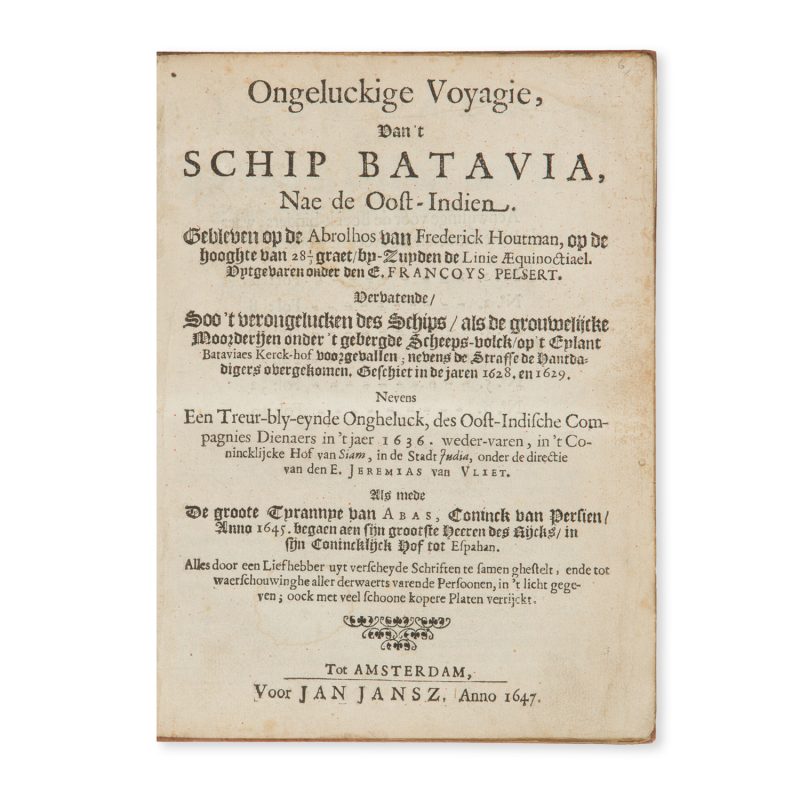
Ongeluckige voyagie, van’t schip Batavia, nae de Oost-Indien.
$200,000.00 AUD
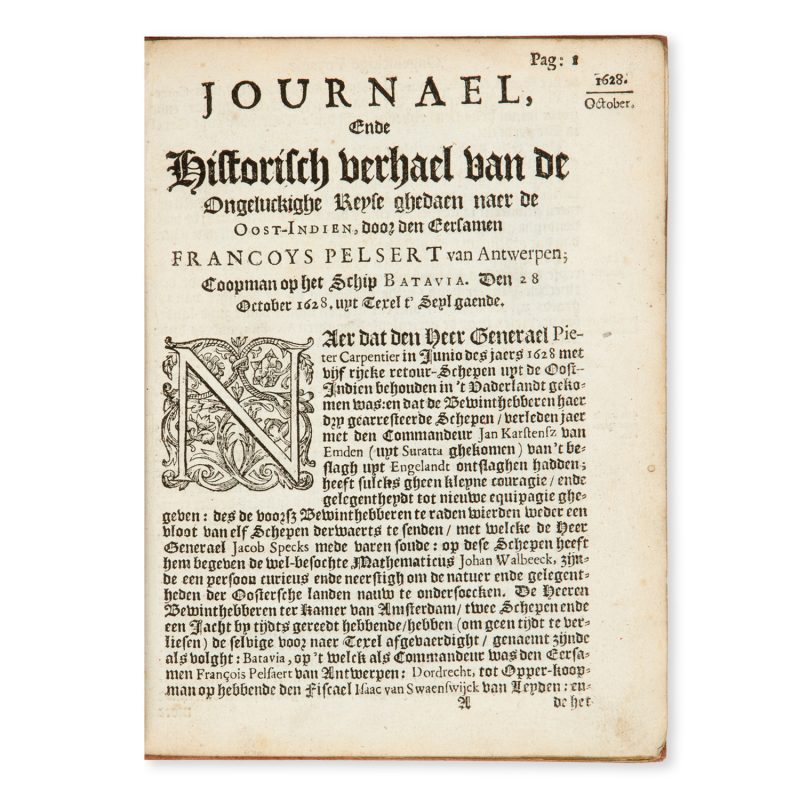
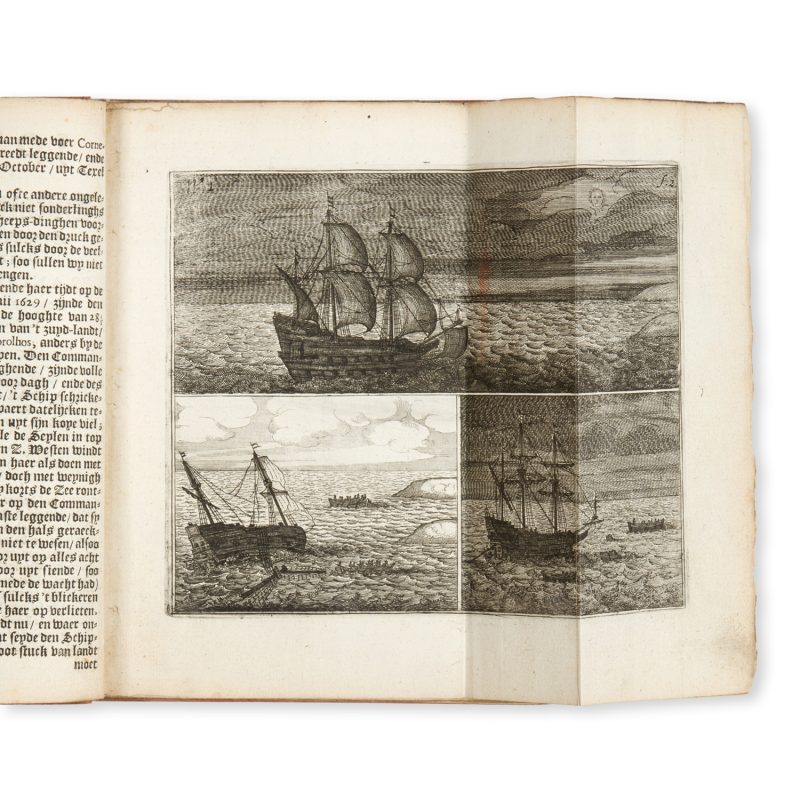
Amsterdam : Jan Jansz, 1647. First edition. Small quarto, papered boards, pp. [ii – title leaf], 118, lacking final blank (as in most copies); six folding copperplates (plate V provided in expert facsimile), some very pale marginal water stains, tiny worm hole to margin of first few leaves; a clean and well preserved copy housed in a gilt-lettered calf clamshell box.
The first full account of the wreck of the Batavia, with the first printed European images of Australia; ‘an especially outstanding rarity’ (Wantrup).
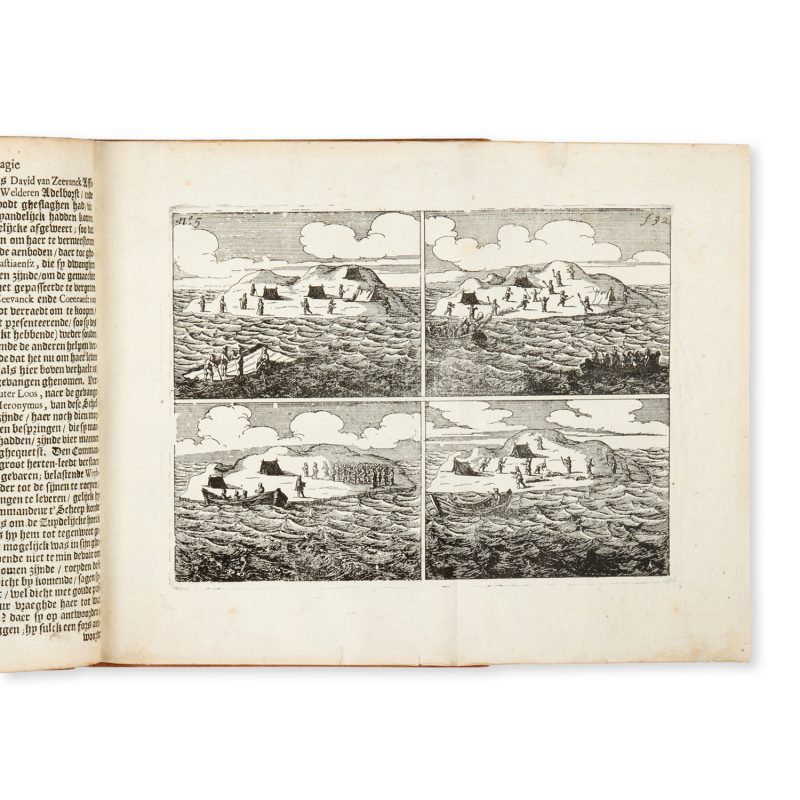
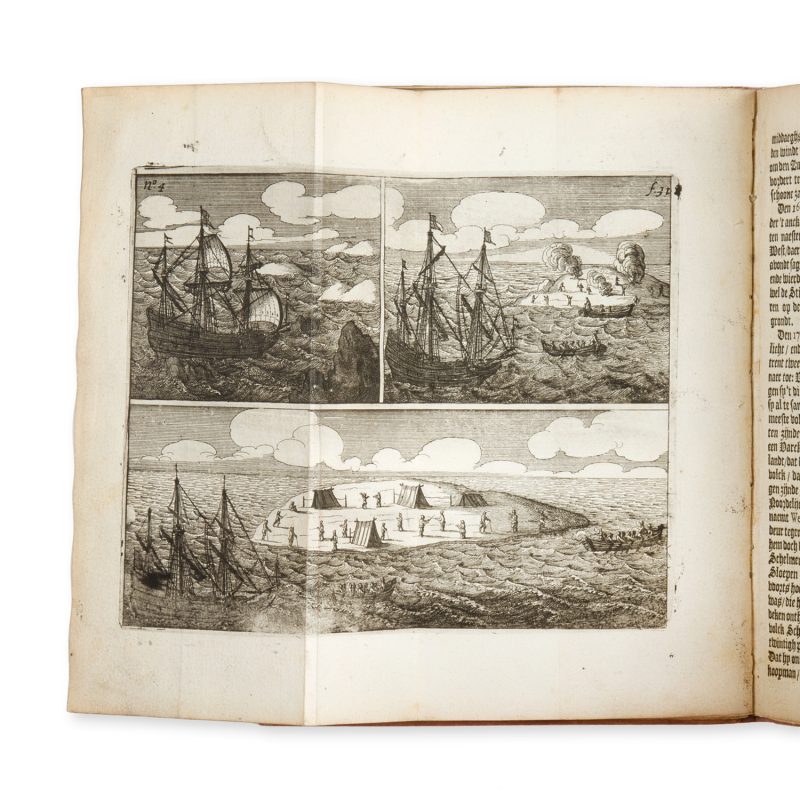
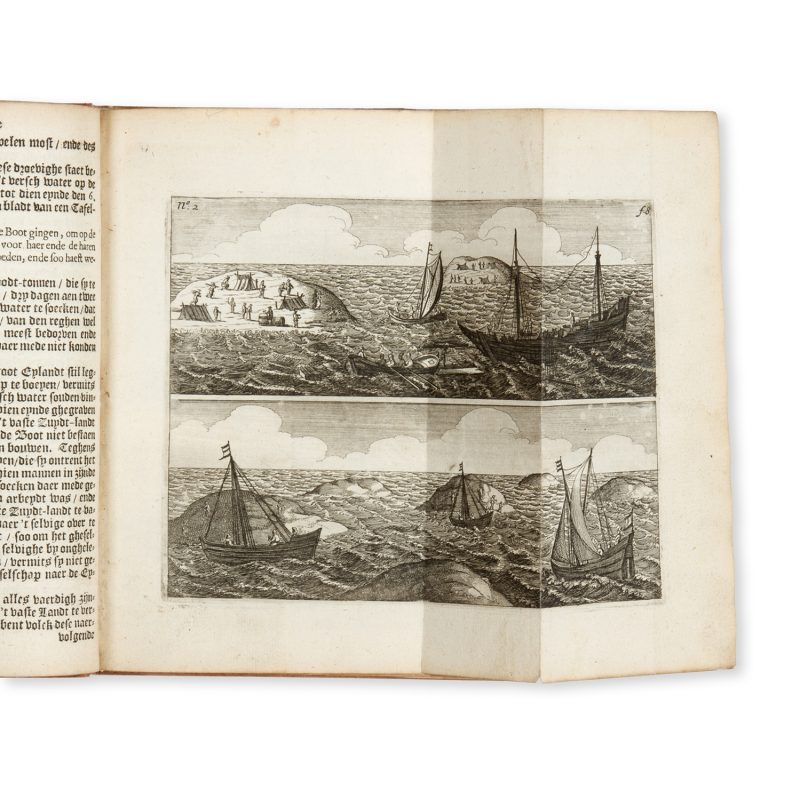
The story of the shipwreck of the Batavia remains one of the most gripping in all maritime history. In 1629, the VOC ship Batavia, under the command of François Pelsaert, was wrecked on Morning Reef on the Houtman Abrolhos off the West Australian coast during her maiden voyage from the Netherlands to Batavia, Java. There were over 300 passengers aboard, mainly settlers, merchants and their families, of whom 40 drowned while attempting to reach shore. The survivors were grouped on two small desolate islands, while Pelsaert and his crew searched the shore on the mainland for a fresh water supply, to no avail. Faced with disaster, Pelsaert and a few companions sailed by longboat along the West Australian coastline and north across the Indian Ocean to the settlement at Batavia, a remarkable feat of navigation which took 33 days and was achieved without fresh supplies.
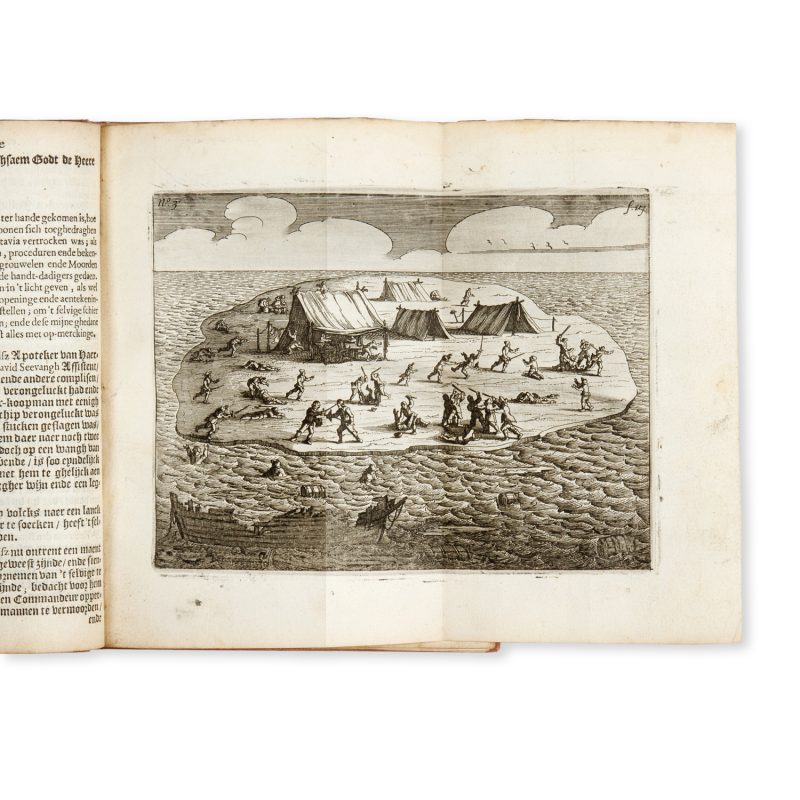
The Batavian Governor-General gave Pelsaert command of a rescue vessel, the Saardam, and he sailed back to the site of the wreck, arriving two months after his original departure. Pelsaert made the horrific discovery that a brutal and sustained massacre had taken place under the authority of Jeronimus Cornelisz, the apothecary he had left in charge in his absence. During the Batavia’s voyage Cornelisz had already entertained thoughts of mutiny, and these manifested themselves during Pelsaert’s absence. Cornelisz, together with a band of mutineers loyal to him, imposed a reign of terror over the other survivors. More than 110 men, women and children were murdered; the women were subjugated to sexual slavery by Cornelisz and his followers, and Cornelisz eliminated any perceived threats to his personal authority.
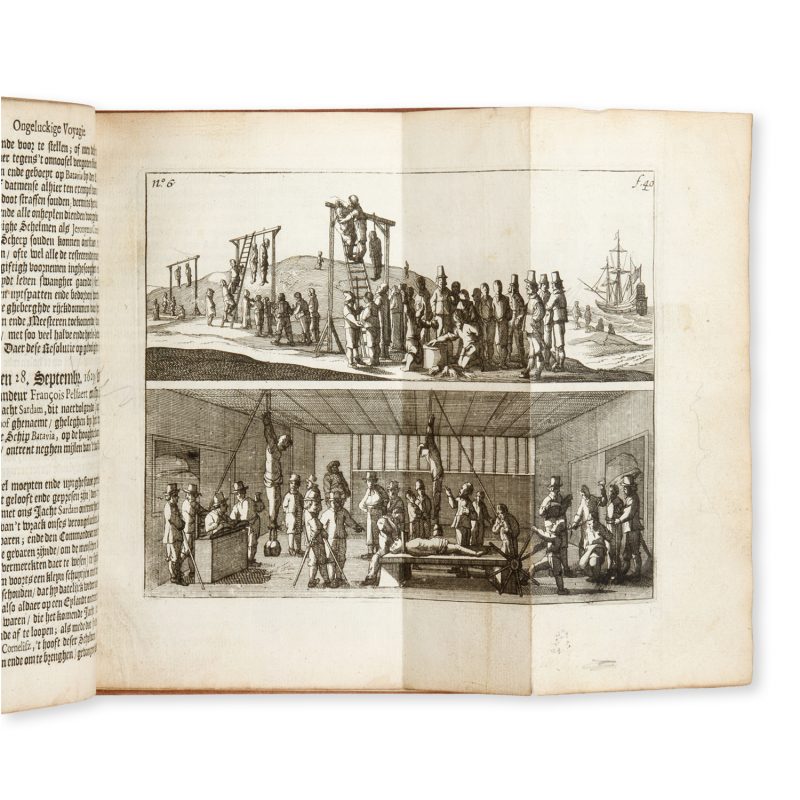
As part of his strategy to seize control, Cornelisz had sent a party of soldiers to a nearby island in search of water, only to abandon them there to perish. In an ironic twist, this island did hold good supplies of fresh water, and at the time of Pelsaert’s return, the abandoned soldiers were engaged in combat with the mutineers; the soldiers had managed to capture Cornelisz, and now held him hostage. As Pelsaert’s ship approached, both the mutineers and soldiers raced towards it; the soldier Wiebbe Hayes arrived first and was able to recount the grisly tale of Cornelisz’s brutality. The island despot and his main supporters were tried, tortured and executed, and the other mutineers were taken to Batavia for punishment. Before his hanging, Cornelisz’s arms were amputated by hammer and chisel, a scene depicted in one of the copperplates. Two offenders, Wouter Loos and a cabin boy, Jan Pelgrom de By, were left abandoned on the Australian mainland and never heard of again.
For many years, the 1647 edition of the wreck of the Batavia was considered the first printed book on Australia. Then, in 2017, an obscure Dutch pamphlet, Leyds veer-schuyts praetjen, tuschen een koopman ende borger van Leyden appeared at an auction in Belgium. This 1630 publication happened to contain a previously unrecognised and almost contemporary account of the wreck of the Batavia off the Australian coast, presented in the form of ‘gossip’ between a merchant and a citizen of Leiden on shipping matters. In 2021 the rare pamphlet found its way via the rare book trade into the collection of the State Library of New South Wales, where it rightly claims the title of the first printed book on Australia.
Notwithstanding the existence of the 1630 text, the 1647 edition of Pelsaert is one of the rarest of Dutch voyage accounts and remains not only a foundation book on Australia, but the earliest one procurable. It is ‘the first full account of the voyage’ (Wantrup), and contains the first printed views of Australia. Furthermore, ‘Pelsaert’s vivid account contains important descriptions of the Australian coast and even includes the first published description of the kangaroo’ (ibid.).
Five editions, including two pirated versions, were to follow in the seventeenth century, all of which are also considered rare.
Wantrup (2025) 1.04; Landwehr, VOC, 406; Tiele, Bibliography, 235; Tiele, Mémoire, 850.


