


# 48959
[MARTIN, William Alexander Parsons]
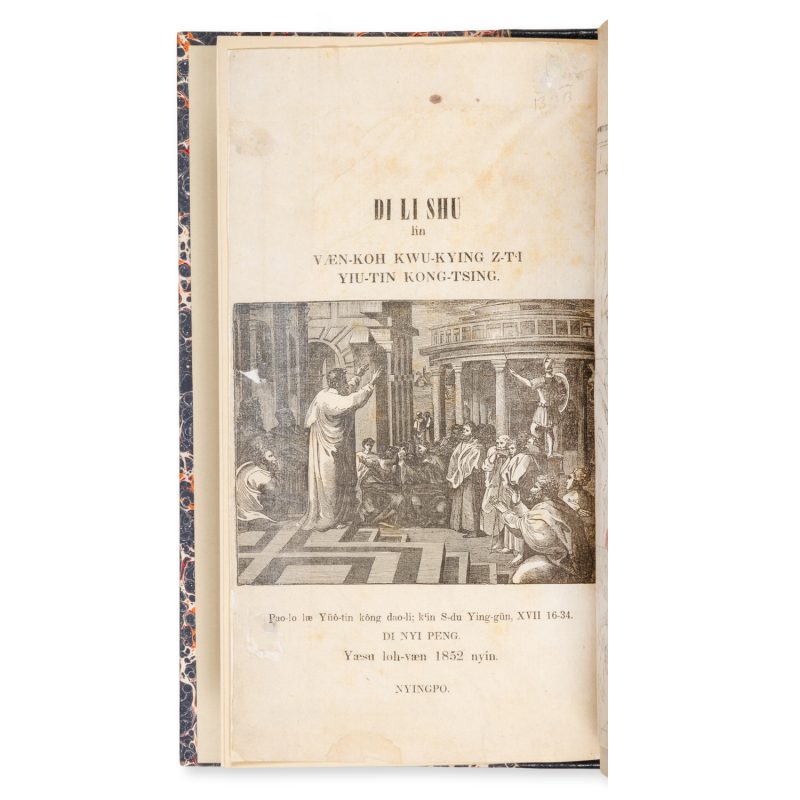
Di-li shü lin væn-koh kwu-kying z-tì yiu-tin kông-tsing. Di nyi peng.
$7,500.00 AUD
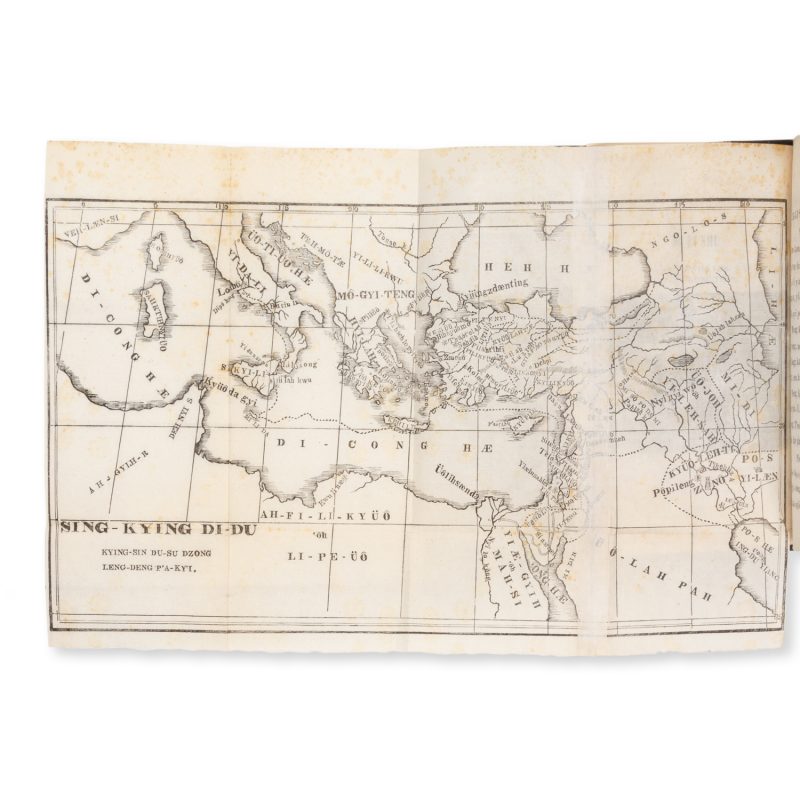
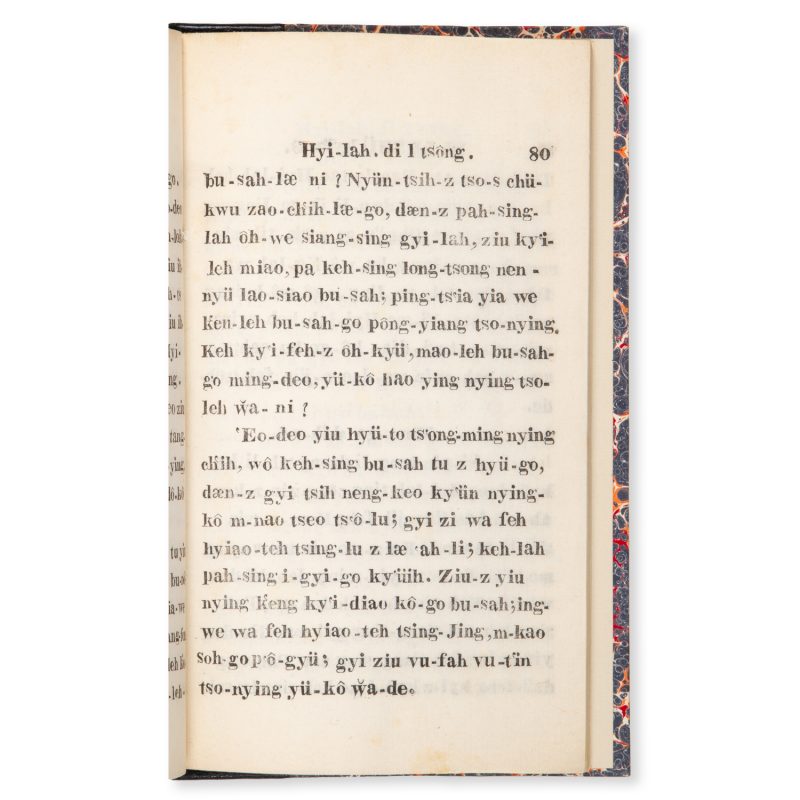
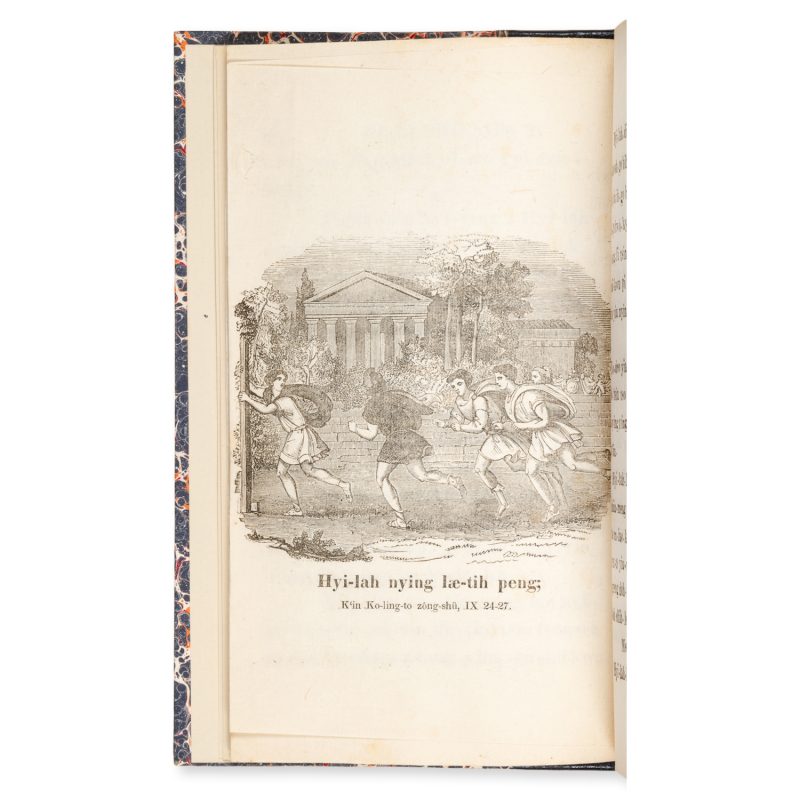
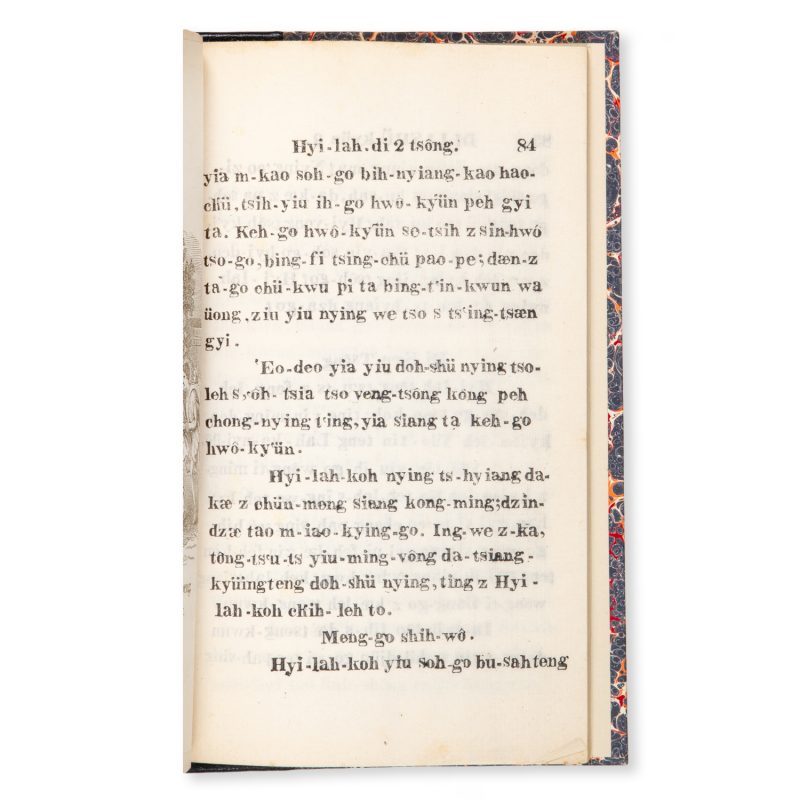
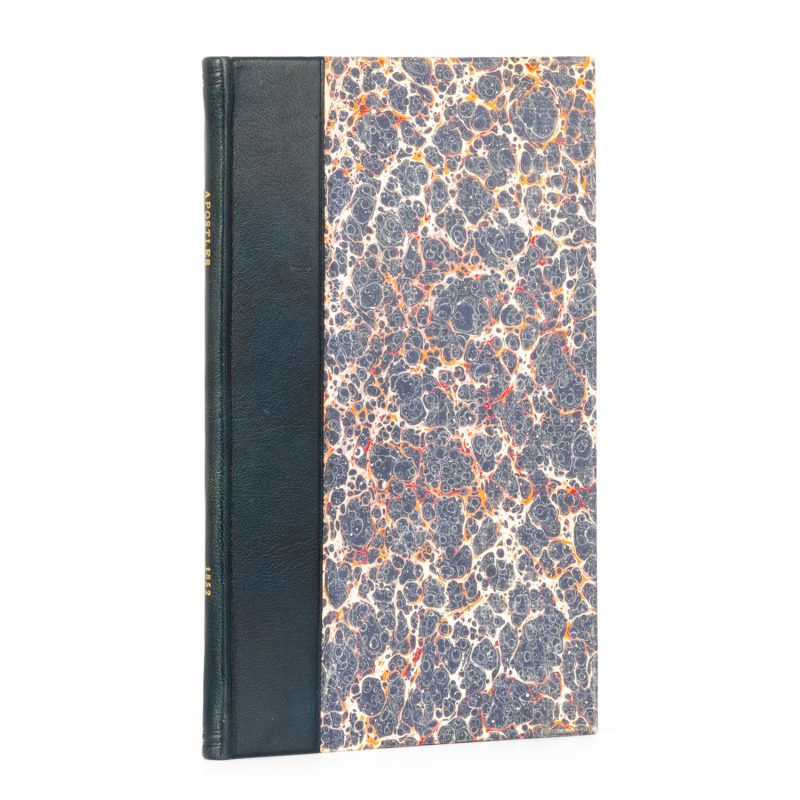
Nyingpo [Ningbo] : [Mission Press], 1852. Octavo, recent quarter calf over marbled papered boards, spine lettered in gilt ‘Apostles’; block-printed on rice paper in double leaves in romanized Ningbo colloquial dialect; title-leaf with woodcut after Raphael’s Saint Paul delivering the Areopagus Sermon in Athens illustrating Acts 17:16-34 (margins reinforced verso), frontispiece folding map of the Biblical world (essentially the Hellenistic world) showing the Mediterranean, North Africa, and the Middle East to the head of the Persian Gulf and the western shore of the Caspian Sea (lightly foxed, one fold strengthened with tissue), pp 76-120, woodcut plate illustrating a passage from the First Epistle of Paul to the Corinthians (1 Corinthians 9:24-27) bound in at page 83; occasional light spotting, a very good copy.
One of the first printings to use the phonetically-based, romanized system (pinyin) of the colloquial Ningbo dialect devised by American Presbyterian missionary and translator William Alexander Parsons Martin (1827-1916), also known as Ding Weiliang (丁韙良). It is the second volume, but the third part (Kyün 3) of an extremely rare four-part geography intended for native Ningbo speakers familiar with the Roman alphabet. Its seven chapters served as both an introduction to the Hellenistic world of the New Testament for Chinese converts, and as a reader for Ningbo speakers, young and old, many of whom were illiterate prior to being taught to read and write their own language using Martin’s pinyin system.
Having studied at Indiana University (Bloomington), Martin attended the New Albany Theological Seminary in preparation for ordination as a Presbyterian minister, and then applied to the Presbyterian Foreign Mission Board in January, 1849. He was ordained as a Teaching Elder in the Presbyterian church in October 1849, and was sent to China in 1850. Within six months of his arrival at Ningbo, where he would spend his first ten years in China, he had commenced work on developing his pinyin for the Ningbo dialect, having found that Chinese characters based on Mandarin pronunciation were unsuitable for rendering it in written form. Used throughout Zhejiang province in the east of China, the Ningbo dialect has altered markedly since the 1850s, and a clear comprehension of any of Martin’s transliterations into romanized script would present difficulties for the modern Ningbo speaker.
Martin was to spend most of the next 60 years in China. Working as a teacher, high-level interpreter and translator, he became a key figure in the introduction of Western science and ideas into Qing intellectual life. In 1854 he published his collected religious lectures as T’ien-tao su-yuan (Evidences of Christianity), which became the most successful Christian book printed in China; there followed in 1863 his highly important translation into Mandarin of Wheaton’s Elements of International Law, an educational treatise on natural philosophy (1866), a monograph on mathematical physics (1885), and numerous other works, both original and in translation, in the fields of education, history and Chinese social studies.
There are very few extant examples of any of the three volumes of Martin’s Di-li (geography), which were all printed at Ningbo in 1852. The first volume, which is devoted to the customs of Western nations (though seen through the eyes of a proselytising Christian) was reprinted in 1859.
OCLC locates only the following copies of the 1852 Ningbo imprints: Colgate Rochester Crozer Divinity School (Ambrose Swasey Library) (volumes 1-2-3); Universitäts- und Landesbibliothek Sachsen-Anhalt (volumes 1-2-3).
Other examples traced: Harvard University (Houghton Library) (volumes 1-2-3); Bodleian Library (volume 1 only); Collège de France (volume 3 only)
No auction result for any of the volumes on Rare Book Hub.


