# 49624
JANET, Pierre Claude Louis (1788 - 1840)
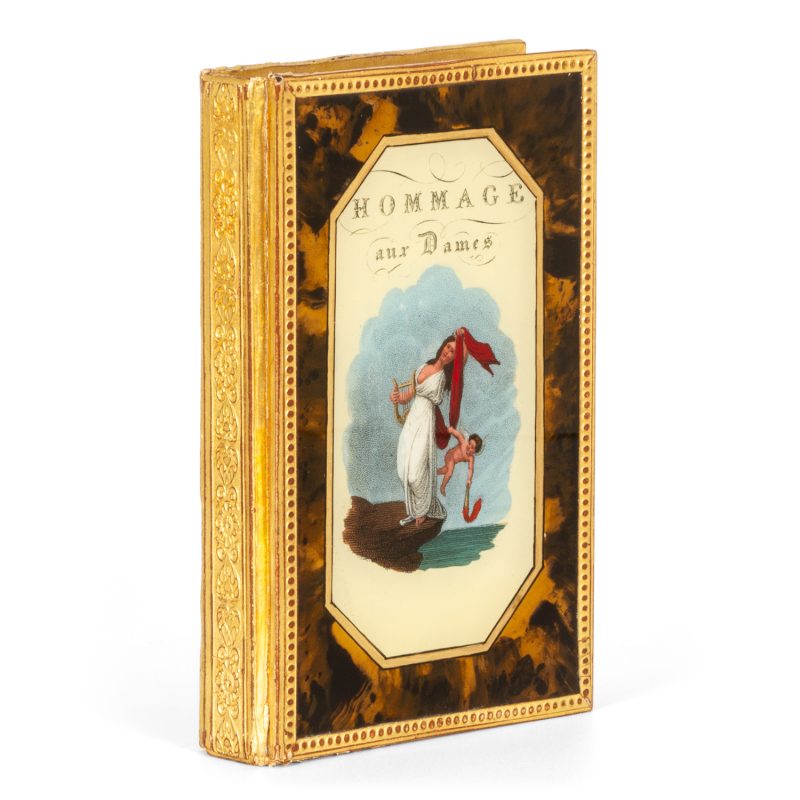
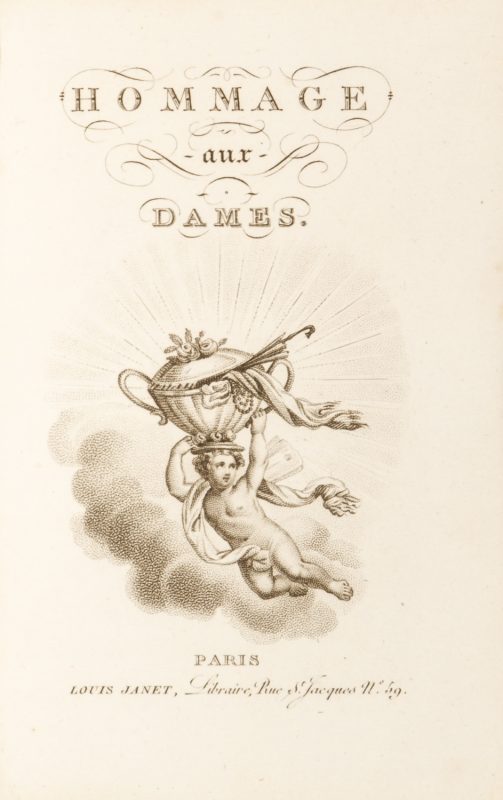
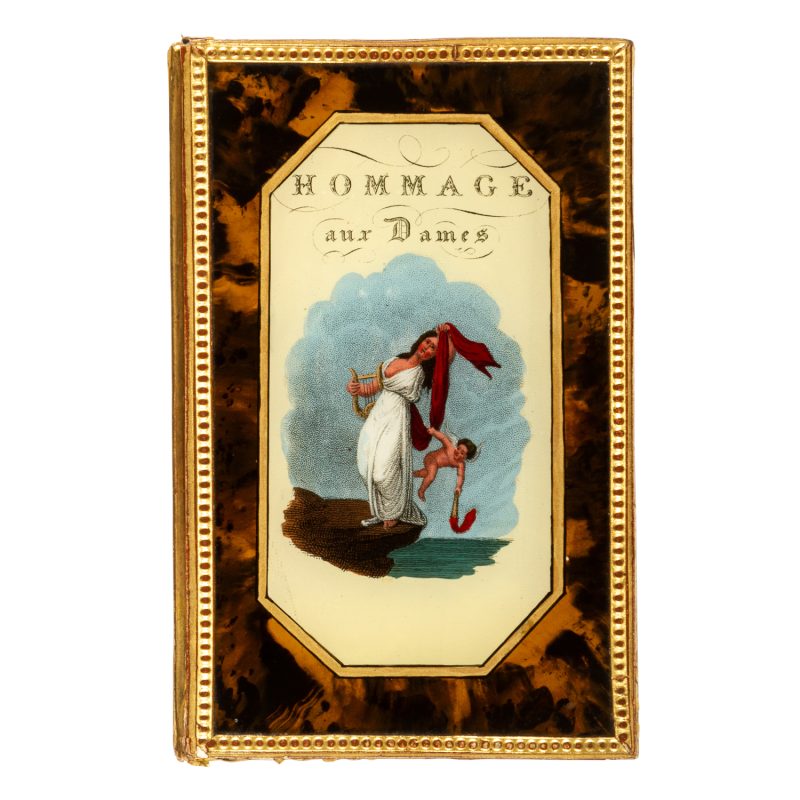
[REVERSE-GLASS BINDING]. Hommage aux dames.
$3,600.00 AUD
Paris : Louis Janet, 1830. Duodecimo (121 x 78 mm), in a rare contemporary binding consisting of a hand-coloured engraved title image, tortoiseshell-pattern border and lower panel, the upper and lower panels presented under glass; gilt and gauffred cartonnage edging, gilt spine with floral pattern; green endpapers; pp. [28], [14 – including a folding calendar with engraved images], engraved plates with tissue-guards; one section neatly loose, occasional light foxing.
A fine example of a rare reverse-glass binding by Louis Janet, publisher of luxury bindings and gift books.
An almanac for fashionable young French ladies, with texts by Marguerite Desbordes-Valmore, Alexandre Dumas (The Orchestra), and Clotilde de Surville, the legendary fifteenth-century French poet whose works are now widely thought to have been fabricated as a part of a literary hoax. The text of the almanac is followed by twelve blank pages on which the young owner could record her own thoughts (each of these pages has a vignette illustration representing one of the twelve months of the year), and a folding calendar.
Pierre-Claude-Louis Janet (1788-1840) started out his career as a satin-finisher and bookbinder. He became a licensed bookseller in Paris on 26 June 1821, succeeding his father Pierre-Étienne Janet (1746-1830), who passed his license on to him. Janet published a range of luxury gift books, almanacs and children’s books, often with elaborate decorated card bindings and hand-coloured illustrations. He declared bankruptcy on 6 July 1838, and died in Paris in January 1840.
The technique of fixé sous verre, or reverse painting on glass, involves either applying the paint to a thin tissue which is then placed onto the glass, or else directly onto the glass itself, but in reverse. The technique had been used for vignettes and medallions on bindings in the eighteenth century, but it was extended by Janet to be applied to engravings to encompass the entire surface of the boards.
Because of their inherent fragility, few examples of Janet’s glass bindings survive.
The Rakow Research Centre at the Corning Museum of Glass holds one example, Blanche Marguerite, 1829 (M1730 .B64 1829 O); the Graphic Arts Collection, Princeton University Library, holds another, Le Diable couleur de rose ou Le jeu à la mode.