


# 49803
EMBLING, Sabina Howitt [&] SINGLETON, Violet Etta
Commonplace book compiled by a young Melbourne woman (1867-78) with later entries by her daughter (1889-1890).
An astonishing artefact of Melbourne social history, in which the intimate voices of two young women – a mother and daughter from one of the city’s most elite families of the second half of the nineteenth century – cry, whisper and sing from the pages, after having been lost to history for over 130 years.
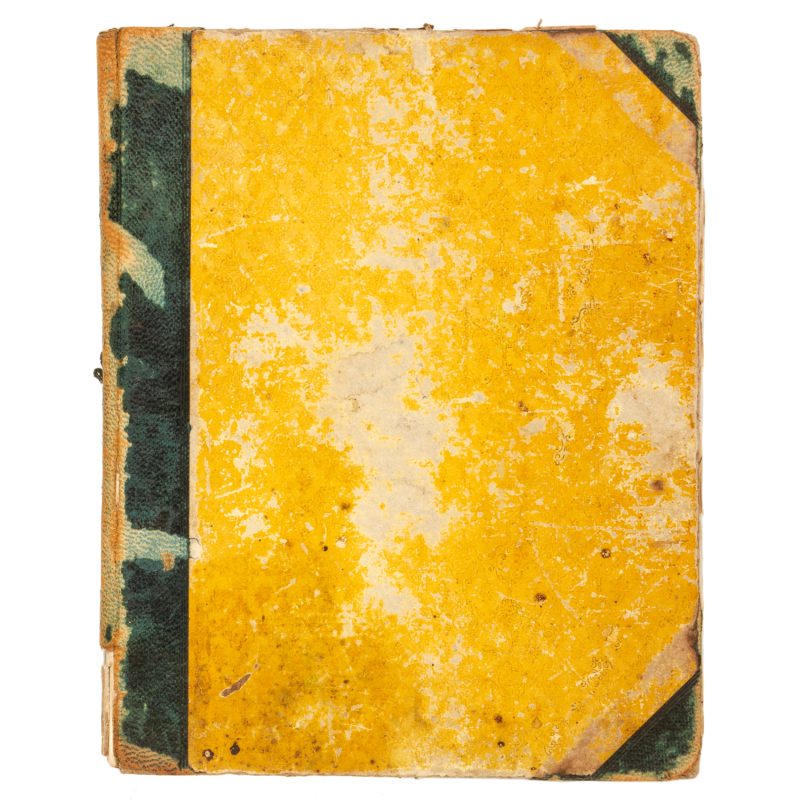
Mid-nineteenth-century album, small quarto (230 x 185 mm), original half dark green morocco over yellow papered boards (heavily rubbed, leather worn and with some loss at foot of backstrip); all edges gilt; [80] leaves, approximately half of which contain manuscript entries in ink (including original prose and poetry), original pencil sketches, mounted pressed flower and fern specimens, and mounted ephemera; mainly compiled by Sabina Howitt Embling of Fitzroy (later as Sabina Howitt Singleton, of Malvern) between 1867 and 1878, but with several additional entries by her teenage daughter Violet Etta Singleton (of Malvern) made in 1889-90, after Sabina’s death in 1887; several of the mounted specimen leaves with foxing and a few of the pressed specimens themselves with loss, otherwise clean and sound throughout.
The album’s first owner was the young Sabina Howitt Embling (1853-1887), whose earliest entry is dated 20 May 1867 – around her fourteenth birthday. Sabina was born in Melbourne to Dr. Thomas Embling (1814-1893), eminent medical practitioner, social reformer and parliamentarian, and his wife Jane Webb Chinnock (1821-1887). Her father’s first appointment after arriving in Port Phillip from England in 1851 was to the position of Resident Medical Officer at the Yarra Bend Lunatic Asylum, and for the remainder of his career he would strive to implement more ethical forms of treatment for the mentally ill. His compassion and humaneness are traits that shine through in the writing of both Sabina and his granddaughter, Violet Etta Singleton.
From 1854, the Emblings lived in a grand residence in Gore Street, Fitzroy. Around 1870, Dr. Embling moved with his family to Elsfield, in Cotham Road, Kew. Soon afterwards, on 24 August 1871, Sabina married Robert Singleton (1841-1914) of Haverbrack, Malvern, and Muyanato, Mt. Dandenong, at Trinity Church, Kew. She was just 18. Her husband was the son of prominent Anglican clergyman, Rev. William Singleton, who performed the ceremony. Robert was an accountant with the Victorian Railways, and would later be appointed its Chief Accountant. Robert had something of a daredevil streak: just prior to their marriage, he had appeared in the Hawthorn Court on the charge of ‘furious riding’ in a local street, and was fined 5 shillings. The couple had six children: Myra Daisy Sabina Singleton, who died at the age of two in 1875; Harold (1874-1890); Violet Etta (later Collins) (1877-1948); Stanley Robert Embling Singleton (1879-1957); Garnet Clive Singleton (1883-1957); and Aylmer Esmond Singleton (1886-1898).
Sabina died tragically early at the age of just 34, at Haverbrack on 17 June 1887, leaving behind four young children whose ages ranged from 1 to 13. Although we do not know the exact cause of her death, it was a slow and agonisingly painful one (possibly she had had consumption for years – see description of Leaf 60 below). Violet Etta, at the tender age of 10, witnessed it, and was profoundly traumatised by the passing of her mother, whom in her own words she ‘worshipped … above everything on this earth’.
Two years after Sabina’s death, Violet Etta began to make written entries in her beloved mother’s album, and continued to do so up until around the end of 1890. Confessional and intensely private in nature, these writings were made when she was still 12 or 13, and they express the innermost thoughts of a remarkably self-aware and articulate adolescent girl who was suffering from existential depression. Violet Etta was certainly well educated: her early schooling was through private tuition at home, and she later attended the nearby Hadleigh Methodist Ladies’ College in Stanhope Street, Malvern.
In 1901, Violet Etta Singleton would marry Edmund Collins, a Melbourne solicitor and businessman, with whom she had five children. Throughout her married life she was involved in charity and philanthropic work: she served as Life Governor of the Alfred Hospital, and as Vice-President of the Berry Street Foundling Hospital and Infants’ Home, as well as holding executive positions in various other organisations in Melbourne and in the Frankston area. Her final residence was Muyanato, Oliver’s Hill, Frankston – affectionately named after her father’s property at Mt. Dandenong, which she had adored so much in childhood. An obituary, published in the Frankston Standard, 8 January 1948, noted that Mrs. Violet Collins was ‘kind and understanding [and] gave freely to all deserving causes. A daughter of the famous Singleton family, Mrs. Collins was, in her young days a crack shot with gun and rifle and was also a celebrated horsewoman.’ The last-mentioned talents she may well have inherited from her father, Robert Singleton; but in reading Violet Etta’s entries in her mother Sabina’s album, it is obvious that even at a young age she already possessed the same deep empathy for others as her grandfather, Dr. Thomas Embling, whose path and concerns in life uncannily paralleled her own.
CONTENTS
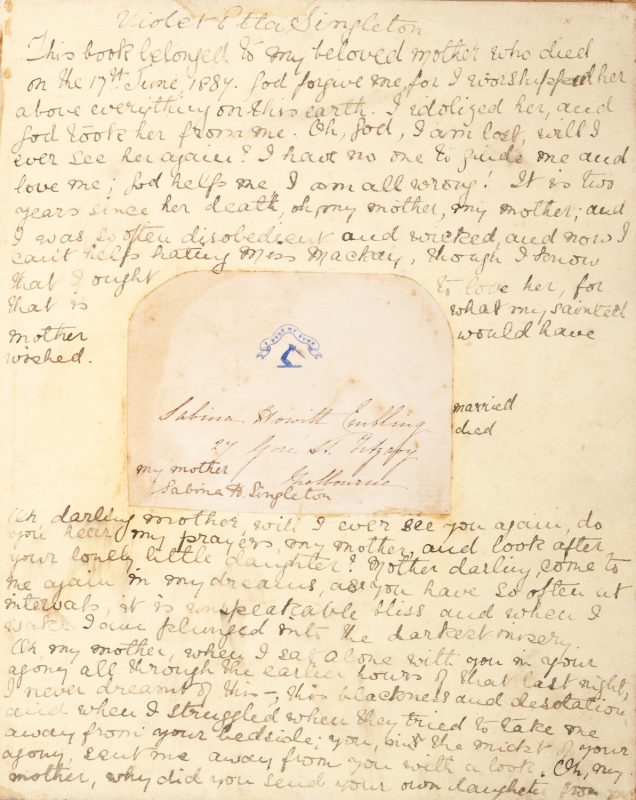
Leaf 1 recto. The first page in the album is occupied by a personal and moving manuscript entry written by 12 year-old Violet Etta Singleton, in which the history of the album is revealed:
‘This book belonged to my beloved mother who died on the 17th June 1887. God forgive me for I worshipped her above everything on this earth. I idolised her, and God took her from me. Oh, God, I am lost, will I ever see her again? I have no one to guide me and love me; God help me, I am all wrong! It is two years since her death, oh my mother, my mother; and I was so often disobedient and wicked and now I can’t help hating Miss Mackay, though I know that I ought to love her, for that is what my sainted mother would have wished … I never dreamt of this; this blackness and desolation, and when I struggled when they tried to take me away from your bedside, you, in the midst of your agony, sent me away from you with a look. Oh, my mother, why did you send your own daughter from you?’
Mounted in the centre of the page is a piece cut from the front of a mailed envelope (probably late 1860s in date), addressed to ‘Sabina Howitt Embling, 27 Gore St., Fitzroy, Melbourne’. It is annotated by Violet: ‘My mother, Sabina H. Singleton’. Number 27 Gore Street was re-numbered after 1887 and is today 43 Gore Street. In 2017 this residence, built in 1854 for Thomas Embling, Sabina’s father, officially became Fitzroy’s most expensive home when it was sold at auction.
Leaf 1 verso. [blank]
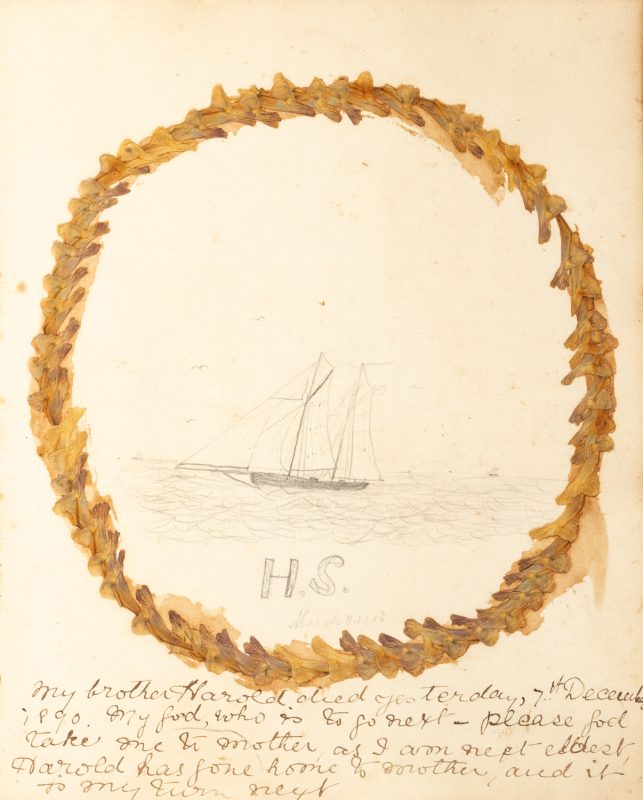
Leaf 2 recto. As if the content of the first page was not tragic enough, here is Violet’s entry on the following one:
‘My brother Harold died yesterday, 7th December 1890. My God, who is to go next – please God take me to mother, as I am next eldest, Harold has gone home to mother, and it is my turn next.’ These words are written underneath a pencil sketch of a yacht initialed by her dearly departed brother ‘H. S.’, along with the date 8 March 1886 – so it was made when he was just twelve, and while the children’s mother Sabina was still alive.
Leaf 2 verso. [blank]
Leaf 3 recto. Mounted pressed fern specimen. Annotated by a 15 year-old Sabina Howitt Embling: ‘Gathered by Helen Mack and me, March 25th 1868, at Berrambool [just south of Wycliffe and Narrapumelap in Victoria’s Western District] the morning I started to come home.’ ‘The fronds are placed so as to show the spores or beads.’
Leaf 3 verso – Leaf 4 recto. Lengthy manuscript entry by Sabina Howitt Embling, a meditative prose description of Berrambool Station. ‘Down just below the house by the side of the river there is a grave, & a gravestone put there in 1851. There is a dead gum tree by the grave, a beautiful little flower like coral drops growing all over it. There is enough in that sight to suggest many thoughts; it is a young woman, only 24, with tears they may have laid her there, planted a young gum tree by it & in time, have left this lonely grave to its inmate; it matters not where it is laid, but we wonder whether that husband ever thinks of this grave, this lonely grave. We can go to the rocks a little further down and look for ferns. The last day of my visit I went with my friend Helen Mack to gather them, which I have pressed in this book. On the plains the silence is strange, thrilling if you stop while driving over them, you feel as if there was a weight on your ears, it must be dreary to live on them. But the noble gum trees, with their branches bowed near the earth so that they may be used for seats and swings, high up hangs maybe a branch of mistletoe … The busy sounds are hushed, every now & then some sleepy magpie gives a few notes, is answered by another, the laughing jackass is heard too, but soon these sounds are hushed, & then the cricket commences its cheerful song, dew comes down, the honey scent (smells) rises from the grass. And now is heard the opossums calling one to another, but a solemn quiet is upon most of [the] birds & insects, the trees whisper more quietly, the stars disappear behind the horizon, the night wears on & then commences another lovely day. But there are rainy days, hot wind days, squatters’ lives are not the pleasantest. But still to pay a visit at such a station is delightful, & is what might be desired by many a girl less fortunate than I am.’
Leaf 4 verso. [blank]
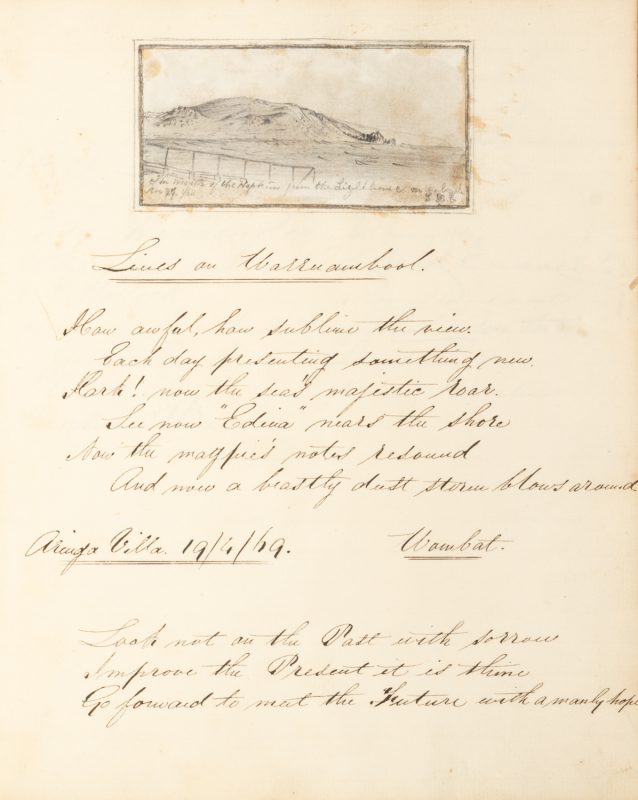
Leaf 5 recto. At the head of the page is a small mounted pencil sketch by Sabina Howitt Embling, captioned, dated and initialed ‘The mouth of the Hopkins from the Light house on the beach, Nov. 27th 1868, S.H.E.’. Below this Sabina has written out two short original poems. The first is titled ‘Lines on Warrnambool’, and is dated at Aringa Villa (a Warrnambool guesthouse), 19 April 1869: ‘How awful, how sublime the view / Each day presenting something new / Hark! now the seas majestic roar / See now “Edina” nears the shore / Now the magpies’ notes resound / And now a beastly dust storm blows around’. The second is somewhat enigmatically titled ‘Wombat’: ‘Look not in the Past with sorrow / Improve the Present it is thine / o forward to meet the Future with a manly hope.’
Leaf 5 verso. [blank]
Leaf 6 recto. A page of autographs belonging to around 20 relatives and friends of Sabina Howitt Embling. These include Thomas Embling, Jane Webb Embling, Herbert A. Embling (‘written when 8 years old’), F. Madeline, J. Crawford, Annie B. Bell, E. M. Harrington, E. S. Margetts, Frederick G. Margetts, E. R. Boston, Jennie M. Maidment, Thomas Maidment, Jane B. Mack, Frank Mack, Minnie Butcher, and Norton Butcher.
Leaf 6 verso. [blank]
Leaf 7 recto. A page of autographs, including Jane B. Mack, Sabina H. Embling, Minnie Butcher, Norton Butcher, Herbert Embling, ‘La chat Blanche’, Catherine Austin, and Sidney Austin.
Leaf 7 verso. [blank]
Leaf 8 recto. Two mounted pressed fern specimens. Annotated by Sabina Howitt Embling: ‘Gathered by myself from the Melbourne Cemetery the day I went with the [?Corchmans], Melbourne’, and ‘Gathered at Warrnambool by Helen Mack and me.’
Leaf 8 verso. [blank]
Leaf 9 recto. A page of autographs, including David Ogilvy (Airlie Bank, South Yarra), David Kaye (The Manse, Wycliffe), Austin Mack, Frank Mack, and Thomas Maidment.
Leaf 9 verso. [blank]
Leaf 10 recto. Mounted pressed fern specimen. Not annotated.
Leaf 10 verso. [blank]
Leaf 11 recto. A page of autographs, including Laura A. Margetts and John A. Ardlie.
Leaf 11 verso. [blank]
Leaf 12 recto. ‘On the Threshold’, a Christian poem about dying, written out in the hand of Sabina Howitt Embling; below it, written in another hand, is a famous quote from St. Philip Howard, ‘Quanto plus afflictionis pro Christo in saeculo, tanto plus gloriae cum Christo in futuro.’ ‘The more affliction we endure for Christ in this world, the more glory we shall obtain with Christ in the next.’
Leaf 12 verso. [blank]
Leaf 13 recto/verso. [blank].
Leaf 14 recto/verso. Poems written in Sabina Howitt Embling’s hand: ‘The Dream’, ‘Copied by S.H.E. at Melbourne May 20th 1867’; ‘Fragmentina’ (an extract from Longfellow’s Footsteps of Angels), copied ‘July 12 1868, re-copied at Warrnambool’; and ‘The Shell and the Heart’, also copied at Warrnambool.
Leaf 15 recto/verso, 16 recto/verso. [blank]
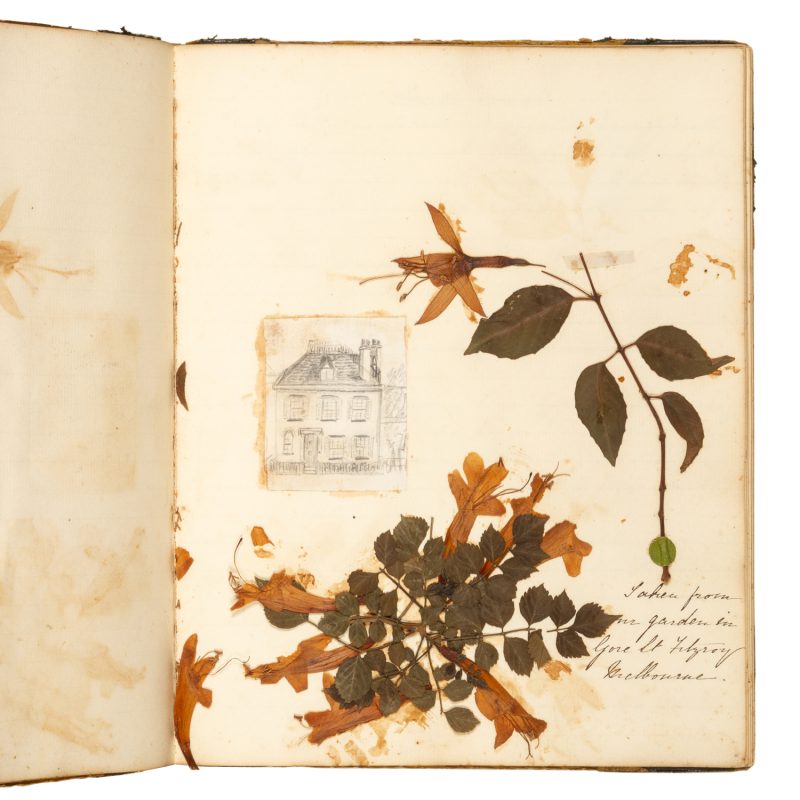
Leaf 17 recto. Small mounted pencil sketch by Sabina Howitt Embling of her family’s residence at 27 (now 43) Gore Street, Fitzroy, made around 1868. The appearance of the front facade has changed remarkably little in the last century and a half. The sketch is ccompanied by two mounted pressed fern specimens, annotated by Sabina: ‘Taken from our garden in Gore St. Fitzroy, Melbourne’.
Leaf 17 verso. [blank]
Leaf 18 recto. A poem, ‘Mother’s Love (A German legend)’, written out in Sabina Howitt Embling’s hand.
Leaf 18 verso. [blank]
Leaf 19 recto. Mounted pressed flower specimen, sentimentally annotated by Sabina Howitt Embling, probably soon after the family’s move to Kew: ‘From our white fuchsia in the window at the old house at Gore St. Fitzroy, Melbourne’.
Leaf 19 verso. [blank]
Leaf 20 recto. Mounted fern specimen. Not annotated.
Leaf 20 verso. [blank]
Leaf 21 recto. A poem, ‘Signs of Rain’ (by E. Jenner) written out in Sabina Howitt Embling’s hand.
Leaf 21 verso. [blank]
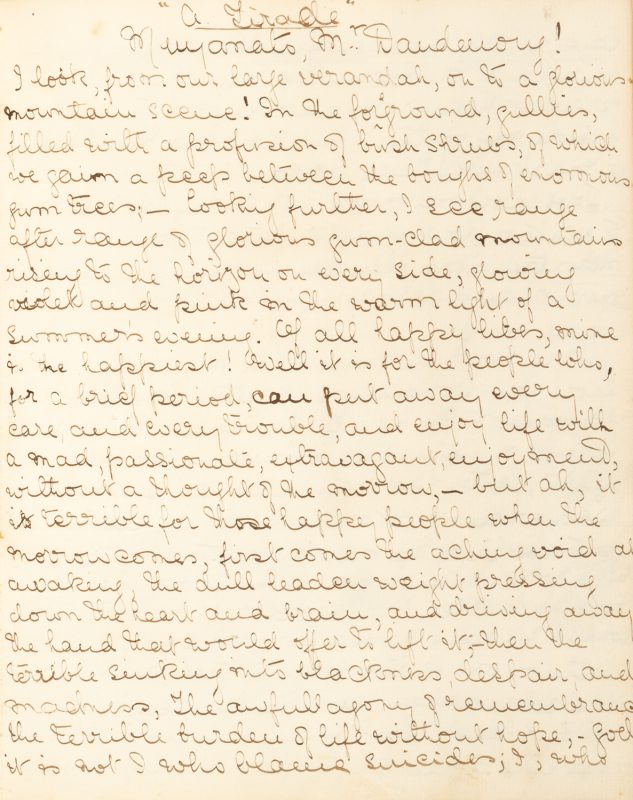
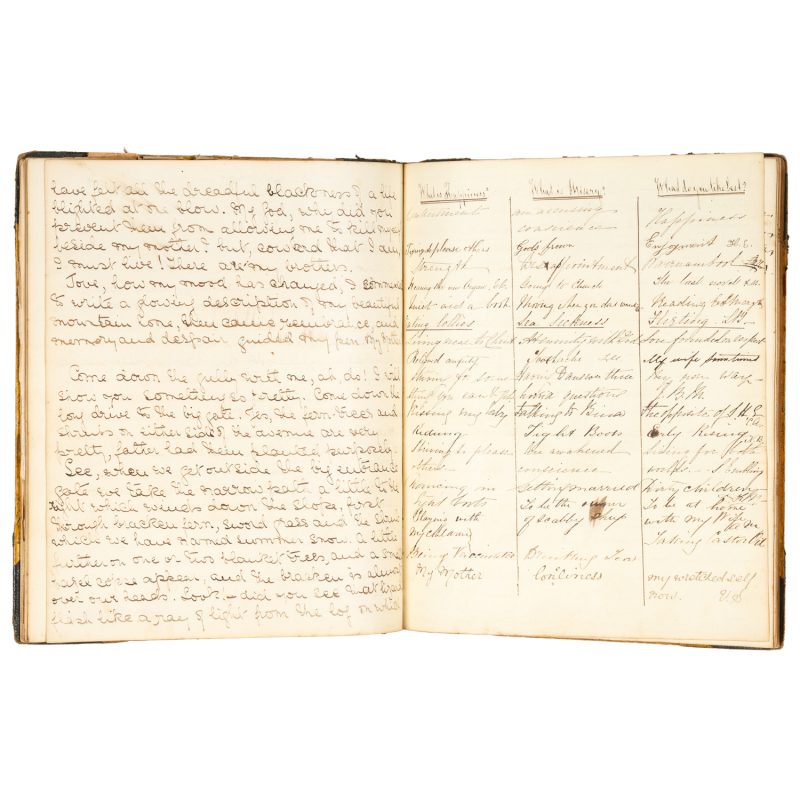
Leaf 22 recto/verso (continued on 23 verso, 24 verso, 25 verso). A lengthy prose piece by Violet Etta Singleton, written around 1890, when she was still only 13 or 14, titled ‘A Tirade, Muyanato, Mt. Dandenong’. Written at her father’s residence in the hills, it contrasts the serene beauty of this idyllic environment with her own existential despair. The writing is frighteningly mature – a lucid, intense expression of a young adolescent woman’s deep depression, stemming from the trauma of her mother’s death in 1887: ‘… first comes the aching void at awaking, the dull leaden weight pressing down the heart and brain, and driving away the hand that would offer to lift it; then the terrible sinking into blackness, despair, and madness, the awful agony of remembrance, the terrible burden of life without hope – God, it is not I who blame suicides; I, who have felt all the blackness of a life blighted at one blow. My God, why did you prevent them from allowing me to kill myself beside my mother? But, coward that I am, I must live! There are my brothers. Jove, how my mood has changed, I commenced to write a glowing description of my beautiful mountain home, then came remembrance, and memory, and despair guided my pen. My Mother! … Ah, we have disturbed a lyre-bird, here is its dancing ground just on the edge of this open space; just listen how it squawks as it runs away, and oh, it has dropped such a pretty feather, see who can get it first – No, I’m not hurt, but that root was horrid to trip me up and send me head over heels as it did; what a good thing that there were no men about, as I’m sure that I showed plenty of leg and petticoat; I am glad that you got the feather, put it in your hat, and then you won’t be bothered to carry it’.
Leaf 23 recto (continued on 28 recto). A self-designed questionnaire by Sabina Howitt Embling, arranged in three columns under the headings ‘What is Happiness?’, ‘What is Misery?’, and ‘What do you like best?’. The columns contain her friends’ and family members’ responses to these questions, entered in their own hands. Among the answers to the first question are: ‘Trying to please others’, ‘Kissing my baby’, ‘Being vaccinated’, ‘Hearing the new Organ’, ‘Quiet and a book’, and ‘Striving for something you can’t get’; answers to the second include: ‘God’s frown’, ‘Sea sickness’, ‘An awakened conscience’, ‘Loneliness’, ‘Moving when you don’t want to’, and ‘Going to Church’; and to the third: ‘Warrnambool’, ‘The latest novels’, ‘Flirting’, ‘Living for both worlds’, and ‘Love founded on respect’.
Leaf 24 recto. An original poem by Sabina’s friend E. M. Margetts, titled ‘Home’, dated 8 December 1868.
Leaf 25 recto. A page of autographs taken while Sabina was on holiday at Berrambool, including Caroline H. C. Kay, Nancy Millar, ‘Sabina Embling, Berrambool’, and ‘Jennie Maidment, Berrambool’ (the Maidments had properties at Berrambool and in Hawthorn, Melbourne).
Leaf 26 recto. Mounted pressed flower specimen. Not annotated.
Leaf 26 verso. [blank]
Leaf 27 recto. Mounted pressed flower specimen. Not annotated. Several loosely inserted newspaper cuttings including one with a recipe for fish curry, and another with instructions on how to make a potpourri.
Leaf 27 verso. [blank]
Leaf 28 verso , 29 recto/verso, 30 recto/verso. [blank]
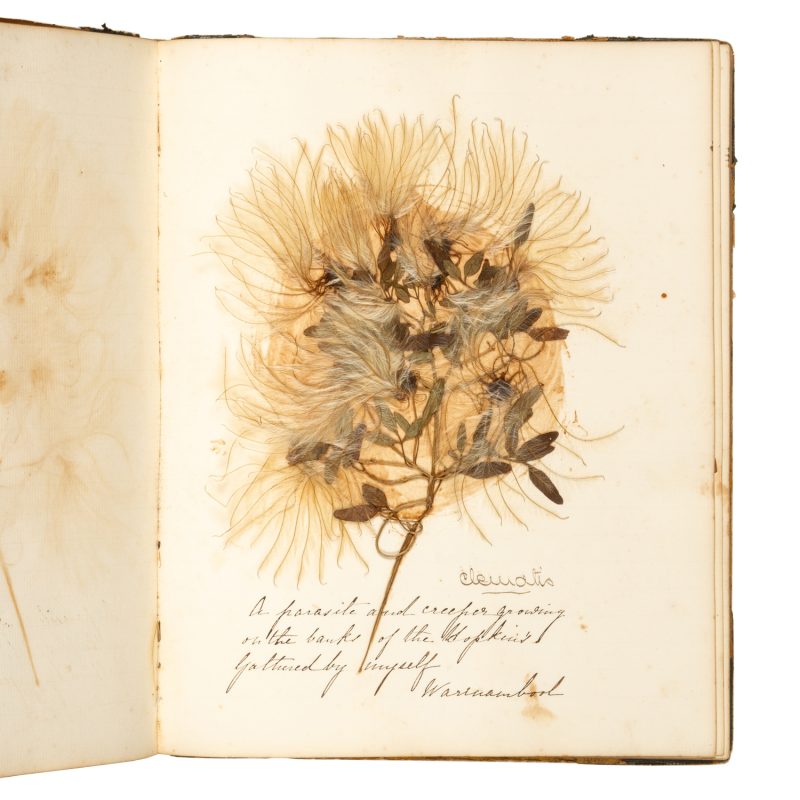
Leaf 31 recto. Mounted pressed flower specimen, annotated by Sabina Howitt Embling: ‘A parasite and creeper growing on the banks of the Hopkins. Gathered by myself. Warrnambool’, and with a later identification in Violet Etta’s hand ‘Clematis’.
Leaf 31 verso. 32 recto/verso, 33 recto/verso. [blank]
Leaf 34 recto. Mounted pressed fern specimen, annotated by Sabina Howitt Embling: ‘Fairy fern from the Reserve. Warrnambool’.
Leaf 34 verso, 35 recto/verso. [blank]
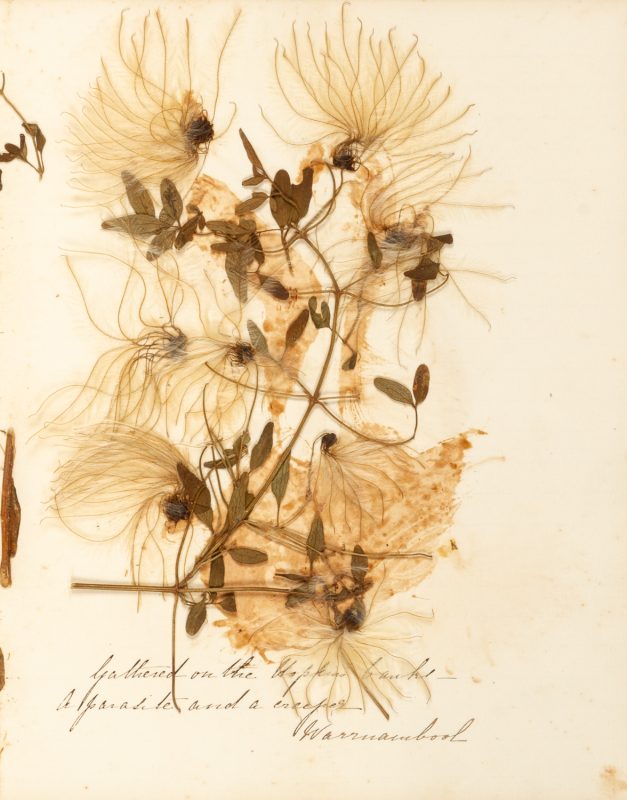
Leaf 36 recto. Mounted pressed flower specimen, annotated by Sabina Howitt Embling: ‘Gathered on the Upper banks – A parasite and a creeper. Warrnambool’.
Leaf 36 verso, 37 recto/verso. [blank]
Leaf 38 recto. Mounted pressed flower specimen, annotated by Sabina Howitt Embling: ‘Petals from our Scarlet bush’ [Scarlet mint bush?], and with a poem ‘How doth the little Busy Bee Delight to bark & bite, Gathers honey all the day And eats it up at night’, initialed ‘J. M.’ [Jennie Maidment].
Leaf 38 verso. [blank]
Leaf 39 recto. Mounted pressed fern specimen (perished).
Leaf 39 verso, 40 recto-verso, 41 recto/verso. [blank]
Leaf 42 recto. Mounted pressed fern specimen (perished).
Leaf 42 verso, 43 recto/verso, 44 recto/verso, 45 recto/verso. [blank]
Leaf 46 recto. Mounted pressed fern specimen (remnant only), annotated by Sabina Howitt Embling: ‘Fairy fern gathered at Warrnambool in the Reserve’.
Leaf 46 verso, 47 recto/verso, 48 recto-verso, 49 recto/verso, 50 recto/verso, 51 recto/verso. [blank]
Leaf 52 recto. Mounted pressed flower specimen, annotated by Sabina Howitt Embling: ‘Wold geranium gathered near our garden, Warrnambool’.
Leaf 52 verso, 53 recto/verso, 54 recto/verso. [blank]
Leaf 55 recto. Mounted pressed flower specimen (Clematis), annotated by Sabina Howitt Embling: ‘Gathered the day I went up the Hopkins River with Mr. Coombs & Mr. Fletcher, 1868. It is a parasite, a creeper & looks exceedingly beautiful, like a mass of silver. Warrnambool’.
Leaf 55 verso, 56 recto/verso, 57 recto/verso, 58 recto/verso, 59 recto/verso. [blank]
Leaf 60 recto/verso. Original poem by Sabina Howitt Embling, initialed ‘S. H. E.’ and dated at Berrambool, 22 March 1869. It is in two parts, the first titled ‘Question: A thought for the closing year’, and the second ‘Answer: The Chamber of Sickness’ – the content of which seems eerily premonitory of her own death some 18 years later, and intimates that Sabina may have had tuberculosis (known in the nineteenth century as consumption, and sometimes called the White Plague): ‘… God’s will be done! I softly said; His will is ever best. This earth is very fair and bright, But it is not our rest’. ‘… Within, a moaning of incessant pain, The hollow cough, the quick, the labouring breath, Life struggling sore and wearily with Death. Struggle, alas! How horrible – how vain!. Above invisible to mortal eyes, Angels all holy have encamped about her, And unite, and beckon upward to the skies….’. On the same page is a mounted cutting with John Guthrie’s Christian poem about death, ‘Kneeling at the Threshold’. At the foot of the page is Sabina’s comment on her own poem, made some nine years later: ‘I have no right to such feelings yet, but when the work is done that is appointed me here, God give me these thoughts again. S. H. Singleton, July 1878’.
Leaf 61 recto. Mounted In memoriam card for Sabina’s friend Eliza Rachel Bostock, who died at Ellerslie, Warrnambool, 14 March 1869, in her seventeenth year. Sabina has written beneath it: ‘Not lost, but gone before’, and somewhat later (after she was married) commented: ‘My first sorrow, but not the last. S. H. S.’
Leaf 61 verso, 62 recto/verso, 63 recto/verso, 64 recto/verso, 65 recto/verso, 66 recto/verso. [blank]
Leaf 67 recto. Mounted pressed fern specimen. Not annotated.
Leaf 67 verso, 68 recto/verso. [blank]
Leaf 69 recto. Mounted pressed fern specimen. Annotated by Sabina Howitt Singleton: ‘Gathered from the top of the hill behind Annandale house on the Upper Murray [near Mitta Mitta], a large party of us climbed to the top. Robert, Henry, Tom & Fanny, Harry, William & myself. Easter Monday, April 1878.’
Leaf 69 verso, 70 recto/verso. [blank]
Leaf 71 recto. Mounted pressed flower specimen. Not annotated.
Leaf 71 verso, 72 recto/verso, 73 recto/verso, 74 recto/verso, 75 recto/verso, 76 recto-verso, 77 recto/verso, 78 recto/verso, 79 recto/verso, 80 recto/verso. [blank]


