


# 50406
DE PINNA, Prof. Francis "Frank"
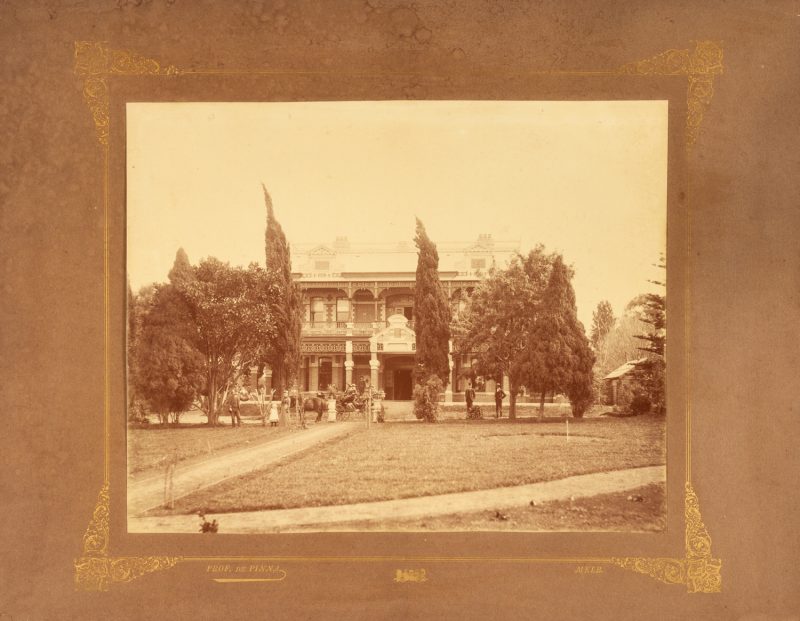
A Melbourne family posed outside their mansion (possibly on St. Kilda Road), c.1895.
$500.00 AUD
Large format silver albumen print, 230 x 285 mm, on photographer’s studio mount of brown card with gilt decorative border and imprint: ‘Prof. de Pinna / Melb.’; both the print and the mount are in excellent condition.
Relatively little is known about Prof. Francis “Frank” de Pinna, artist, musician and photographer (1864-1914), although he was the son of a famous father, the Irish-Jewish composer “Signor” Joseph de Pinna (1798-1885). His interesting professional career in Victoria is undoubtedly worthy of deeper research. He is not listed as a professional photographer in Davies & Stanbury’s The Mechanical Eye in Australia: photography 1841-1900, and does not have an entry in the DAAO. Examples of his beautifully designed photographic In Memoriam cards, an area in which he was specialising commercially around 1900, are held in the collections of the State Library of Victoria and Museum Victoria; however, we can trace no other examples of his photographic output in Australian institutional collections.
The first mention we find of him is in a wedding notice in The Age, 26 October 1899, which explains a little of his background:
‘DE PINNA – CROWLEY. — At St. Francis’s R.C. Church, by the Rev. Father Heffernan, Mons. F. de Pinna, son to Sig. Vi. Depinna, Doctor of Music, London and Dublin, to Nellie, youngest daughter of Cornelius Crowley, Esq….’
We then find him in St. Kilda, offering piano tuition at 1 Princess Terrace, at the very bottom of what is now Fitzroy Street (The Argus, 7 October 1890). Soon after this de Pinna relocated to Kyneton, where he advertised himself as a teacher of music, singing, pianoforte, painting – and photography! – offering classes at his studio in High Street:
‘Prof. de Pinna, Artist and Professor of Music, Singing or Pianoforte. Patronised by the Earl of Hopetoun and the leading gentry of Melbourne. Parents can have their children taught, without respect to age, to paint on China or any other medium. This is a rare opportunity which should be embraced by all. Paintings from faded or defaced Photography. Enlargements and Photography executed on the Shortest Notice, or TAUGHT’ (Kyneton Observer, 14 May 1891).
De Pinna had moved back to Melbourne by the end of 1894, where he was residing at “Brocka”, Wellington Street, Flemington when his wife gave birth to twin boys in December that year. By the end of the following year he had settled down back in St. Kilda. One of his oil portraits was written-up in the Mount Alexander Mail, 25 November 1895:
‘An oil painting of the late Sir James Patterson, K.C.M.G., is on view at Allan’s music warehouse, Collins-street. It is a copy of the portrait which was exhibited for some time in the Queen’s Hail at Parliament House, when the deceased statesman was Premier. As in the original painting, the likeness is faithful, and the attitude in which the subject is represented is characteristic. The artist is Mr F. de Pinna, of St Kilda.’
In the last half of the decade, however, de Pinna began to specialise exclusively in photography. At premises in Dandenong Road, Windsor, near the corner of Chapel Street, he began producing photographic In Memoriam cards. One of these, date November 1897 and with his Dandenong Road address, is held in the State Library of Victoria.
De Pinna next moved a short distance to new premises in Acland Street, St. Kilda:
‘ART PHOTOGRAPHY. We had the pleasure the other day of inspecting the photographic work of Professor F. De Pinna, of Acland street, St. Kilda. Specialists in nearly every branch seem to be the order of the day, and certainly the Professor is a specialist of the highest class in anything pertaining to photography. We saw beautiful specimens of bromide and platnotype enlargements, water color and crayon : drawings, and oil paintings direct from life and from nature. There was a very fine enlargement of His Grace Archbishop Carr seated on his throne, and amongst other ments were Lord Hopetoun, the late Captain Fullerton, the late Sir -James Patterson, Mr A. Tobin, of Alma road, and a magnificent picture of the late Father Quirk. Photography with the Professor has been a special study, and he has some original ideas, notably one in photo memorial cards that ought to he largely called for. To anyone requiring enlargements, or anything special in photography, a visit to Professor De Pinna’s will well repay the time occupied.’ (Prahran Chronicle, 14 October 1899)
In May 1914 Frank de Pinna died at his final residence in Alma Road, St. Kilda. He is buried in the Brighton General Cemetery, as are his wife Nellie and their twin sons, Augustus (“Gus”) and Frank junior.


