


# 50755
NEW SOUTH WALES COMMISSION
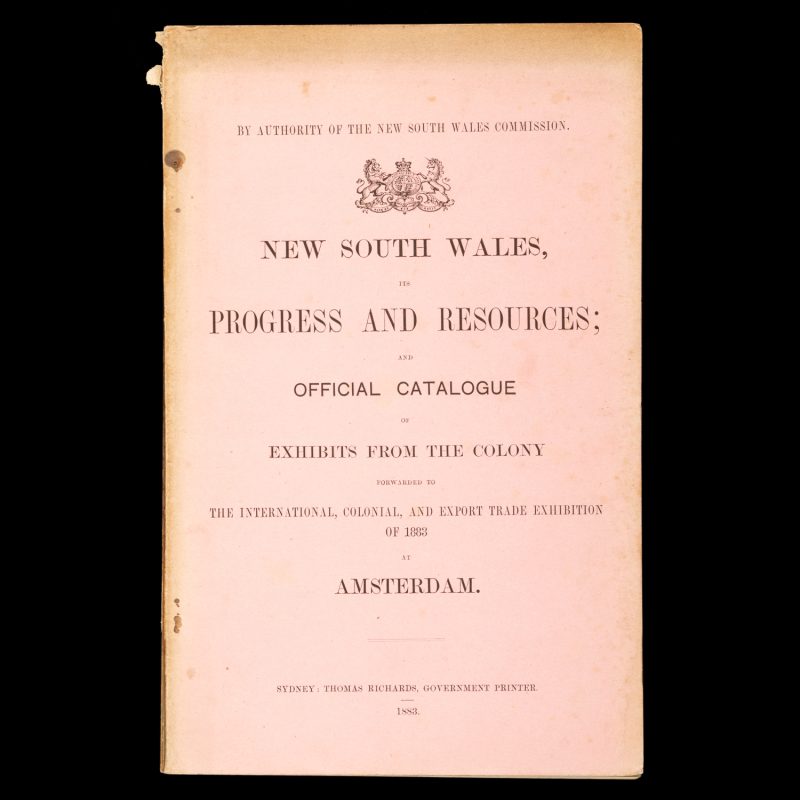
New South Wales : its progress and resources; and official catalogue of exhibits from the colony forwarded to the International, Colonial, and Export Trade Exhibition of 1883 at Amsterdam.
By Authority of the New South Wales Commission. Sydney : Thomas Richards, Government Printer, 1883. Octavo, lettered salmon wrappers (toned), pp. 43; [blank]; [4]; 76; viii (index); internally clean.
A scarce catalogue of New South Wales’s involvement at the 1883 International Exhibition in Amsterdam, which was organised by Edouard Agostini, a French entrepreneur who had previously been involved in organizing the 1878 Exposition Universelle in Paris. The list of exhibits includes fine specimens of natural resources such as wool, gold, silver, copper, tin, asbestos, gemstones and other precious metals and minerals, fossils, building stones, manufactured goods, grains etc.
The ‘Fine Arts and Education’ section includes various ornithological and other natural history specimens, as well as ‘Photographs, Cartes de Visite, and Cabinets’ by T. H. Boyd of Sydney; Photographs by Rudolph Caspers of Goulburn, Henry Geyer of Hay, B. O. Holtermann of Sydney and J. Paine of Waterloo; ‘Photographs of Australian Aborigines, prepared by J. W. Lindt of Grafton, New South Wales and Melbourne, Victoria’, which ‘were taken from life by Mr. Lindt, and comprise men, women, and children of various ages, belonging to the tribes of the Clarence River, Richmond River, Urara River, Yulgibar, Cunglebung, and the Northern Coast of New South Wales’; and ‘Ethnological Exhibits … Made by the Aboriginals of the Richmond River District’ collected by Mary Bundock, including ‘bags, water-vessels, fishing lines and bark from which cord is made’ (NB: this collection now held in the National Museum of Australia). Additionally, there is an extensive list of ethnological artefacts from the collection of Allaster Cox of Hunter Street, Sydney which includes fighting spears, woomera, boomerangs, and nulla-nullas from New South Wales, Queensland, and Botany Bay, as well as various other artefacts from the Solomon Islands, New Guinea, Fiji, New Caledonia, New Zealand, the New Hebrides, the Admiralty Islands and the South Sea Islands, and also a collection of Aboriginal Weapons from the collection of Edward G. W. Palmer of Burwood, with a lengthy description of the use of boomerangs, nulla-nullas, woomeras, spears, shields etc. ‘They are an adaptive and imitative race, easily acquiring a fluent use of the English language and the children make considerable progress in the rudiments of an English education. Many write a bold, firm hand, and have even made some progress in arithmetic. They are a light-hearted, improvident race. Occasionally they make useful servants’ (p. 38).
The final 25 pages concerns Wines exhibited, including examples from the Bouffier Brothers, Hunter River; Carl Brecht, Denman; George Fleming, Albury; H. J. Lindeman of Paterson River; Alexander Munro of Singleton; and John Wyndham of Dalwood.
An important record of the exhibition itself, and of the representation of Indigenous Australian material culture in continental Europe during the late nineteenth century.


