


# 16544
Quirós, Pedro Fernández de [Queirós, Pedro Fernandes de], 1563-1615
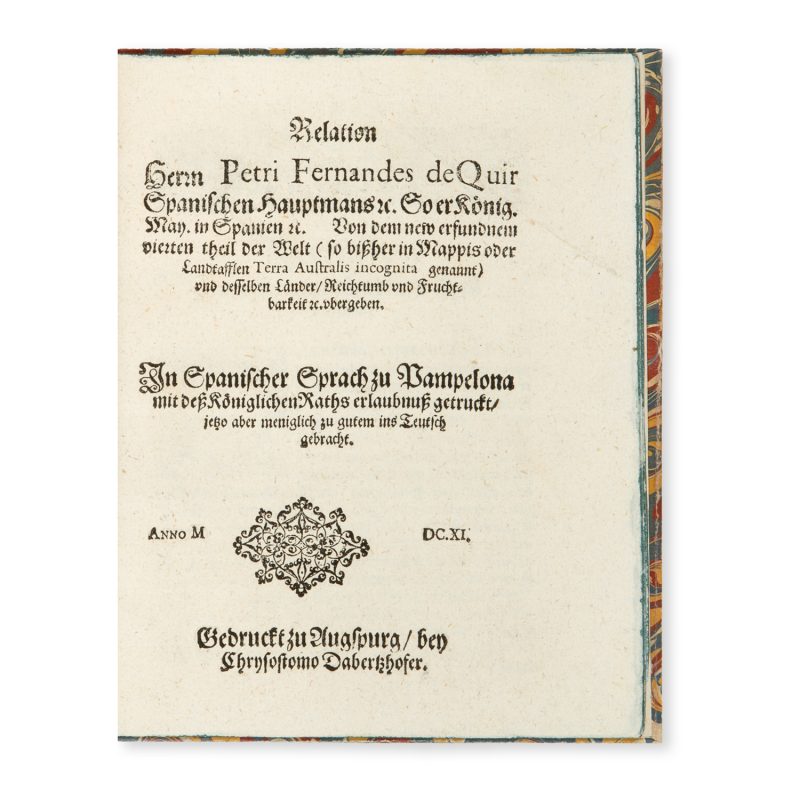
Relation Herrn Petri Fernandes de Quir, Spanischen Hauptmans [et]c. So er König. May. in Spanien [et]c. : Von dem new erfundnem vierten theil der Welt (so bissher in Mappis oder Landtafflen Terra Australis incognita genannt) vnd desselben Länder, Reichtumb vnd Fruchtbarkeit u. vbergeben : In Spanischer Sprach zu Pampelona mit dess Koniglichen Raths erlaubnuss getruckt jetzo aber meniglich zu gutem ins Teutsch gebracht.
$95,000.00 AUD
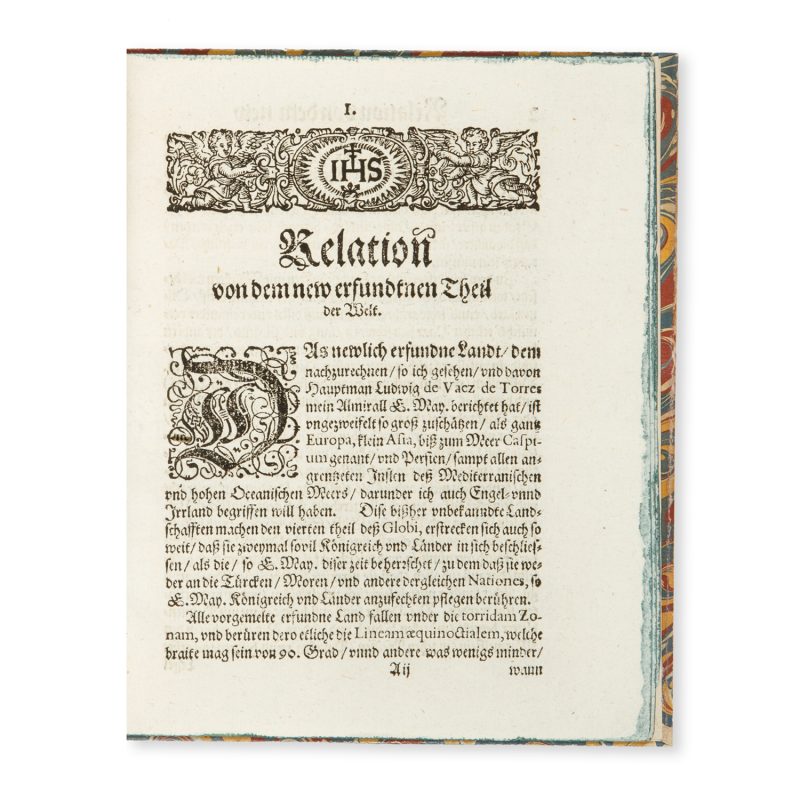
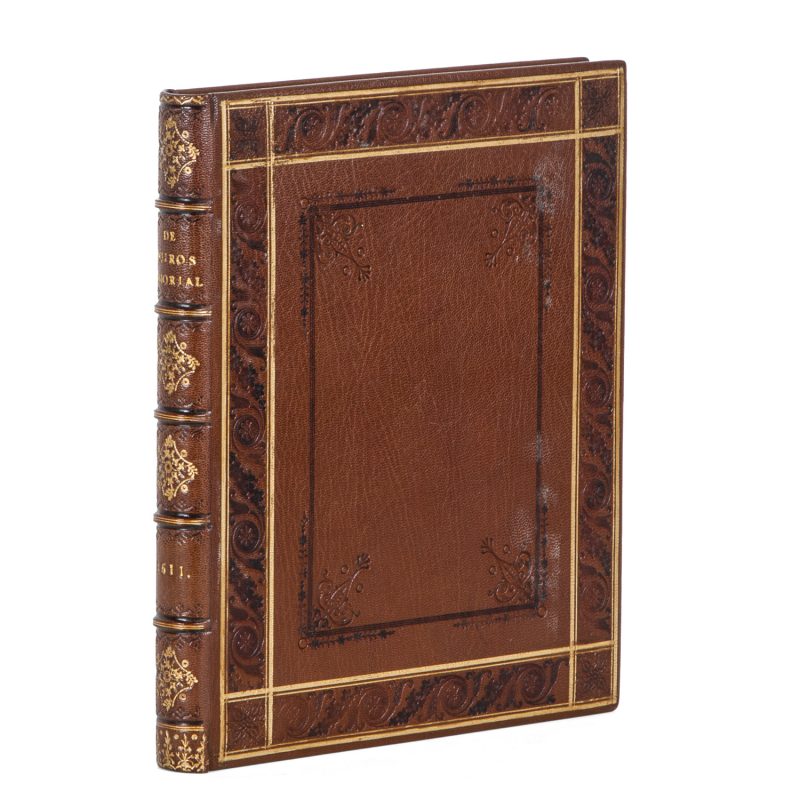
Augspurg [i.e. Augsburg] : bey Chrysostomo Dabertzhofer, 1611. Small quarto, recent marbled papered wrappers, all edges blue; pp. [2], 9, [1], title-leaf with woodcut printer’s device, engraved headpiece with Jesuit trigram, historiated initial; a fine copy, housed in a custom blind-tooled morocco clamshell box.
Rare first German edition of the Eighth Memorial of the explorer Fernández de Quirós, in which he describes his discovery of what he presumed to be the southern continent, or Terra Australis Incognita.
Of over 50 memorials thought to have been written by Quirós and addressed to King Philip III of Spain, petitioning for royal support to mount a new expedition to establish a Spanish colony in the lands that he, along with Mendaña and Torres, had discovered in the South Seas, this is one of fourteen known to have been printed. Quirós describes his discovery of Terra Australis Incognita, the fifth part of the known world, which he had named Australia del Espiritu Santo. In fact, Quirós had not discovered a southern continent, but part of the New Hebrides archipelago.
The memorials penned by Quirós were circulated exclusively among the King and his Council ministers. The majority were manuscripts, but between 1607 and 1614 Quirós published fourteen memorials at his own expense, which were presented at the Council of the Indies. In 1610, on learning that some of these memorials had been distributed beyond their intended circle, the King ordered the recall of all copies of these documents. However, copies of the eighth memorial found their way outside the Spanish realm. This German translation was printed a year after the Spanish original, and was one of the first publications disseminated outside Spain which reported on the supposed discovery of Terra Australis by the Spanish. An Italian edition is believed to have been printed earlier in 1611. The German and Italian editions were followed by translations into Dutch (1612), as well as English and French (1617).
The Portuguese navigator Pedro Fernandes de Queirós (Spanish: Pedro Fernández de Quirós) was associated with two important Spanish voyages of discovery in the Pacific. The first of these was the ill-fated expedition of Mendaña (1595-96) to the Solomon Islands, on which he served as pilot. Quirós assumed command of the only surviving ship following Mendaña’s death at Santa Cruz, bringing it to safety in the Philippines. In 1605-06 Quirós led an expedition in search of Terra Australis, with the intention of taking possession of the southern continent for the Spanish crown. Departing from Callao in late 1605, the expedition’s three ships reached the New Hebrides in May, 1606. In the mistaken belief that one of the larger islands formed part of a southern continent, Quirós named it Australia del Espiritu Santo (later referred to in his Memorial octavo as Austrialia del Espiritu Santo, in recognition of King Philip III’s association with the House of Austria). After losing contact with his other ships, Quirós turned back across the Pacific, arriving at Acapulco in November, 1606. However, his second-in-command, Luis Váez de Torres, continued westward, discovering the strait which divides New Guinea from the northern part of Australia and charting part of the southern coastline of New Guinea, before reaching Manila in May, 1607.
Two variant printings of the German edition are known, which display several typographic differences. For example, in the second line of the title-page in the present copy Quirós’s name is in roman type, while in other copies it appears in Gothic lettering.
Church, 352; Palau, 89606; Sabin, 67354; Kelly, Calendar of documents, 595.
Two copies recorded in Australian collections, both in the State Library of New South Wales.

