


# 49674
[FREYCINET, Rose de] MALLAC, Jacques
À Madame L. de Freycinet.
$35,000.00 AUD
Île-de-France [Mauritius, Port-Louis] : Imprimerie de Mallac frères, 25 May 1818. Quarto (250 x 194 mm), 2 pp., letterpress, recto and verso of a single loose leaf; light horizontal fold, a fine example.
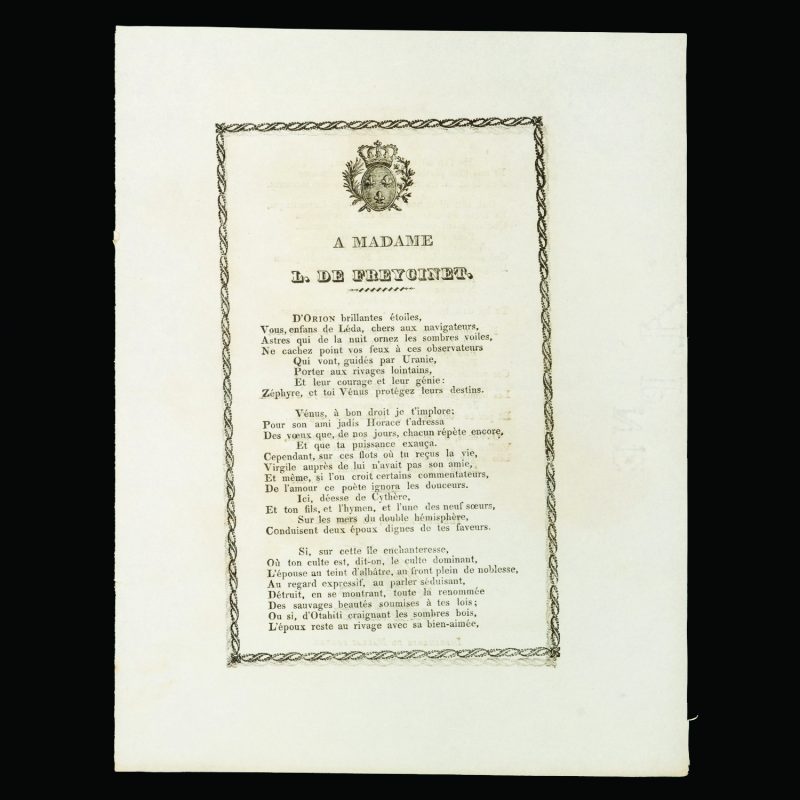
This extremely rare and precious document – one of only three copies known – is a poetic tribute to the adventurer Rose de Freycinet (1794-1832), wife of navigator Louis de Freycinet. It was written and published by Jacques Mallac, a Mauritian Creole printer who took his inspiration from an encounter with Rose during the voyage of the Uranie (1817-1820).
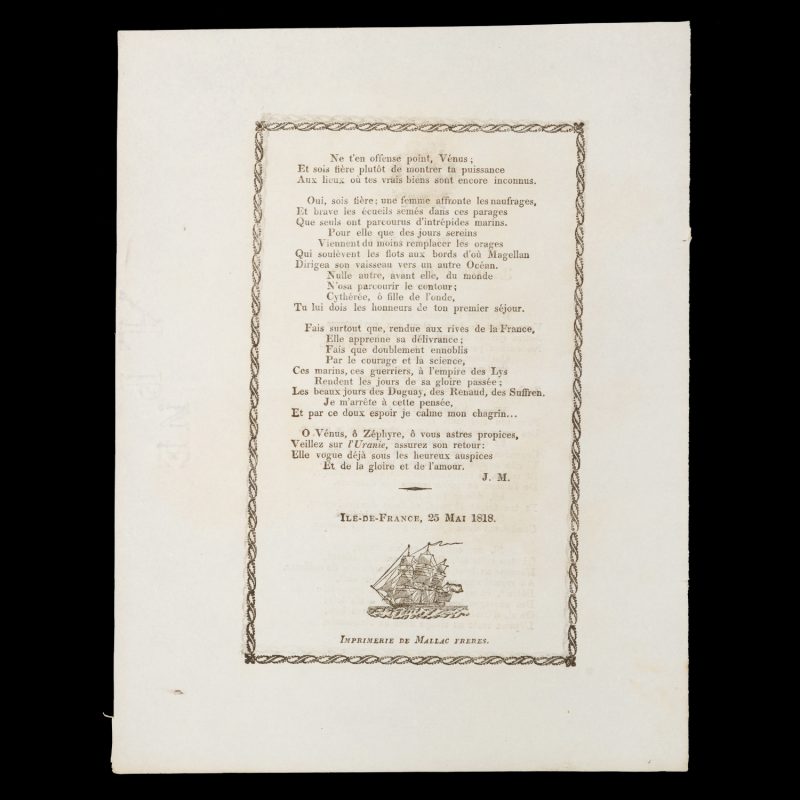
The 55-line panegyric by Jacques Mallac (1772-1827) was printed on his press in Port-Louis, Mauritius. It is signed at the end ‘J.M.’ and dated 25 May 1818. The sheet features a typographical border, the royal crest of France at the head, and a colophon vignette depicting a three-masted ship – likely the French corvette Uranie.
There was a clandestine aspect to the Uranie voyage, for when Louis de Freycinet’s expedition departed Toulon on 17 September 1817, the 22-year-old Madame Rose de Saulces de Freycinet (née Pinon) was on the Uranie, having been smuggled aboard in men’s clothing. She had disguised herself to join her husband, the geographer Louis de Freycinet. His expedition, whose objectives were largely scientific in nature, would visit Brazil, Mauritius, Western Australia, New South Wales, Hawaii, Timor, New Guinea, and other Pacific Islands on its three-year circumnavigation. In recognition of his wife’s courage, Louis would name a virgin island in the Samoa archipelago “Rose”.
The expedition left Rio de Janeiro in January 1818 for Île Bourbon (Réunion); on 5 May, it anchored at Port-Louis, Île-de-France (Mauritius), which had been under British administration for eight years. During their stay, the Freycinets mingled with Mauritius’ Creole high society, befriending Jacques Mallac, a judge and printer. Mallac, it is perhaps worth noting, had met the explorer Matthew Flinders in 1806 during his captivity on Île-de-France, when he was introduced by his friend Edward Pitot as a member of the Société d’émulation (Matthew Flinders’ private journal from 17 December 1803 at Isle de France to 10 July 1814 at London. Friends of the State Library of South Australia, 2005). He had lost his fortune in the fire of 1816, but with the support of friends, he had recently established a printing house in Port-Louis, intended for his children. Rose herself describes in her diary the circumstances surrounding her pleasant discovery of Mallac’s poem during a visit to his press:
‘I wanted to visit the printing presses, which had been built in England, and I expressed this wish to Mr. Mallac, who took me into the workshop. I was offered the chance to compose and print something before my eyes. The intelligent director operated the press himself, explaining each step in great detail. As soon as he had finished, he presented me with the sheet, asking me to admire the beauty of the type. What a surprise it was to see at the top “À Madame Rose de Freycinet” and to read the following lines [i.e. the first eight lines of the present poem]: “D’Orion brillantes étoiles, / Vous, enfans de Léda, chers aux navigateurs, / Astres qui de la nuit ornez les sombres voiles, / Ne cachez point vos feux à ces observateurs / Qui vont, guidés par Uranie, / Porter aux rivages lointains, / Et leur courage et leur génie: / Zéphyre, et toi Vénus protégez leurs destins.” I was deeply moved by the gesture and will judge the intention rather than the work itself.’ (Journal de madame Rose de Saulces de Freycinet: campagne de l’Uranie (1817–1820) d’après le manuscrit original. Paris, Société d’éditions géographiques, maritimes et coloniales, 1927, pp. 34-35).
Under the imprint of his English press, Mallac published legal compendia, archives, and gazettes: Les Archives de l’Île-de-France (1819), L’Almanach de Maurice (1821), and New Mauritius Gazette (1821-1825) are all examples of these. Unofficial or more specialised works, such as his panegyric for Madame Freycinet, are extremely rare: only two copies of the poem printed for Rose de Freycinet are known, one at the Bibliothèque nationale de France (mandatorily acquired from the Jean Viardot collection: cf. catalogue of his sale, 1 June 2016), the other at the State Library of New South Wales (ex Freycinet family, acquired from Hordern House in 2018, priced at $35,000).
The third recorded copy, and the only one in private ownership.
Not in Toussaint, Bibliography of Mauritius (1502-1954).


