


# 45462
[CLEARY, Thomas]
A pair of tableau photographs forming part of a narrative sequence, showing white women being aided by Aborigines. Northern Victoria or Southern New South Wales, 1896-98.
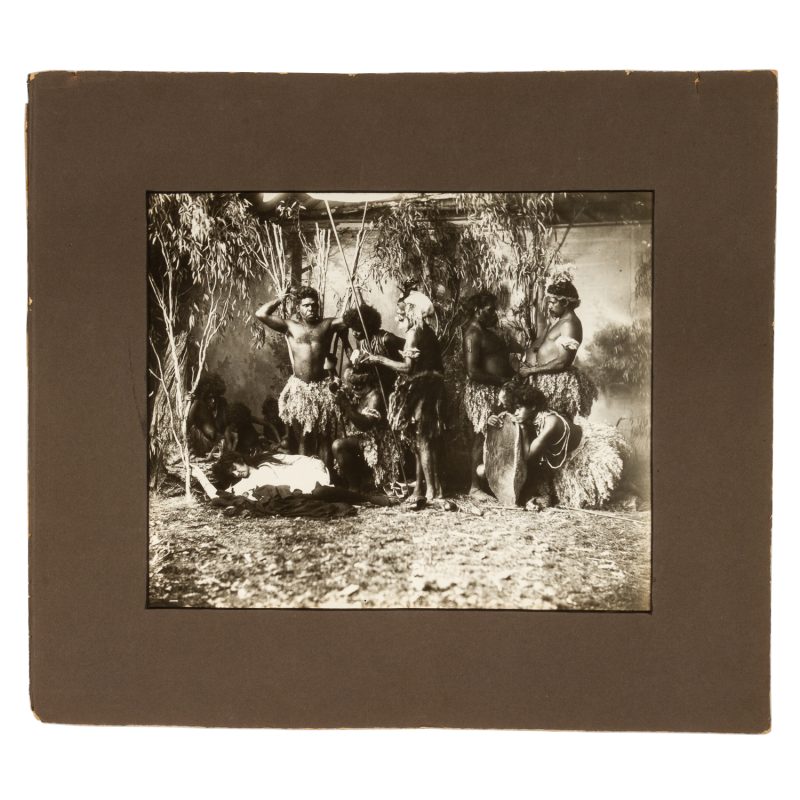
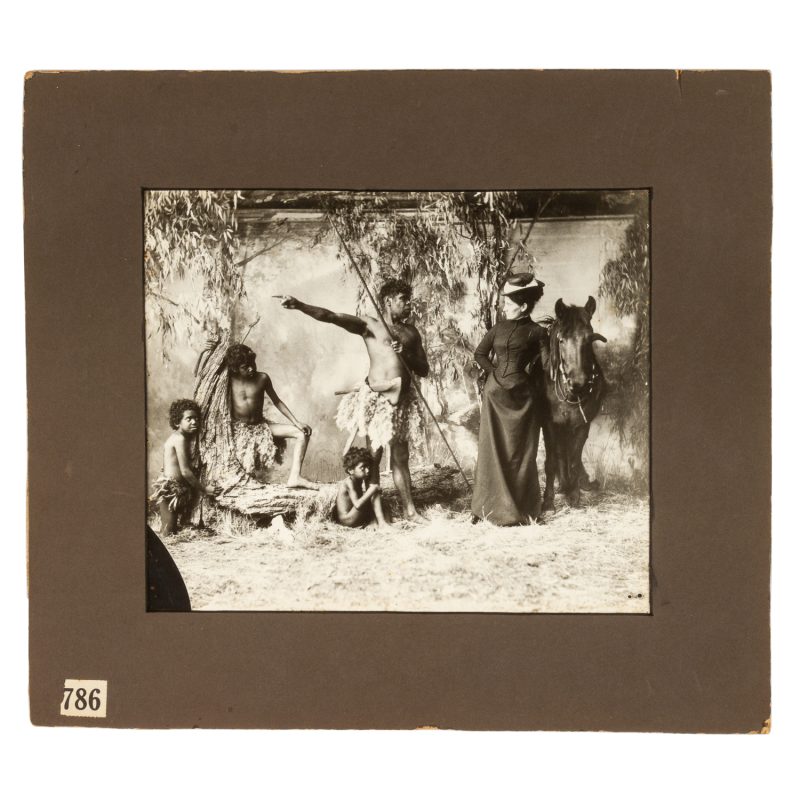
Two gelatin silver print photographs, in uniform 230 x 270 mm format; no photographer’s imprint; in original grey board mounts (one with a very old auction sticker), 360 x 400 mm; the prints are in superb condition, and the mounts clean and stable.
The only two known surviving original prints from an extraordinary sub-group of photographs from the oeuvre of little-known colonial commercial photographer Thomas Cleary.
The story of the serendipitous discovery of a group of Thomas Cleary’s dry plate glass negatives is related by academic Karen Donnelly, Lecturer in Photography, Charles Sturt University, in her article The Discovery of a 19th century photographer – Thomas Cleary, published in The Olive Pink Society Bulletin 7 (1/2), National Library of Australia, 1995, pp. 9-21. The article illustrates all twelve of the known glass plates from at least two narrative sequences that record staged interactions between Aboriginal and European subjects; some of these were taken in Benalla in 1896, others in Wahgunyah (near Lake Moodemere and Rutherglen) in 1897, while a few are undated and without location; several are accompanied by captions. One of the prints we offer here is the same image as Plate 10 (ibid., p.19: no precise date, location or caption); the other appears to be unrecorded.
Between around 1891 and his death in 1899, New Zealand-born Thomas Cleary (c.1854-1899) worked as a travelling photographer in northern Victoria, including in the townships of Charlton, Donald, Echuca, Benalla, Shepparton, and Wahgunyah, and southern New South Wales, in both Corowa and Tumut (ibid., p.14), before moving back across to the western Riverina town of Hay, where he died of a heart attack in November 1899 (ibid., p.18). In June 1897, Cleary was taken to court in Corowa, on the New South Wales side of the Murray opposite the Victorian town of Wahgunyah, by two local Lake Moodemere Aboriginal men, the artist Tommy McRae and John Friday, for non-payment of fees owing to them for participation in some of his narrative photographs. Although the case was dismissed, Donnelly suggests the legal scare may have prompted Cleary to move on from that area and head for Tumut (ibid., p.17).
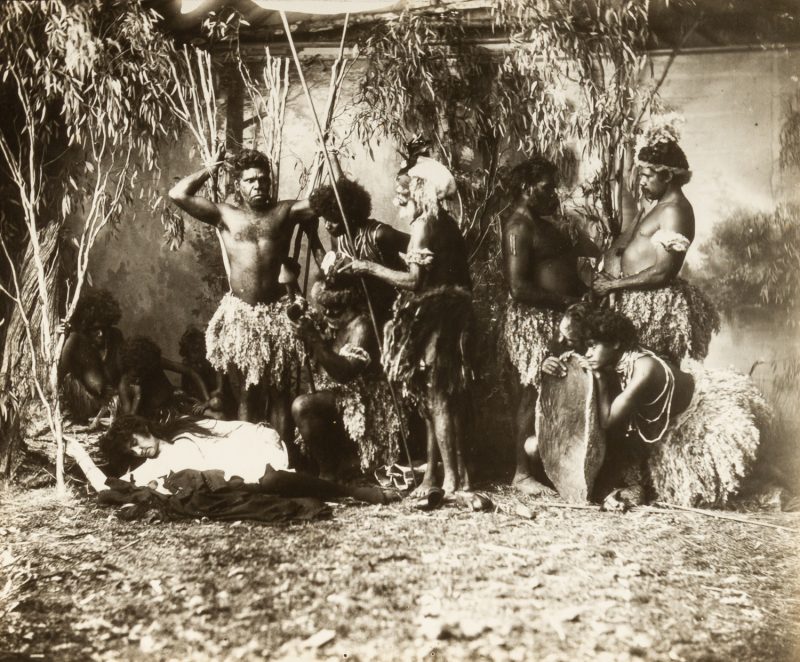
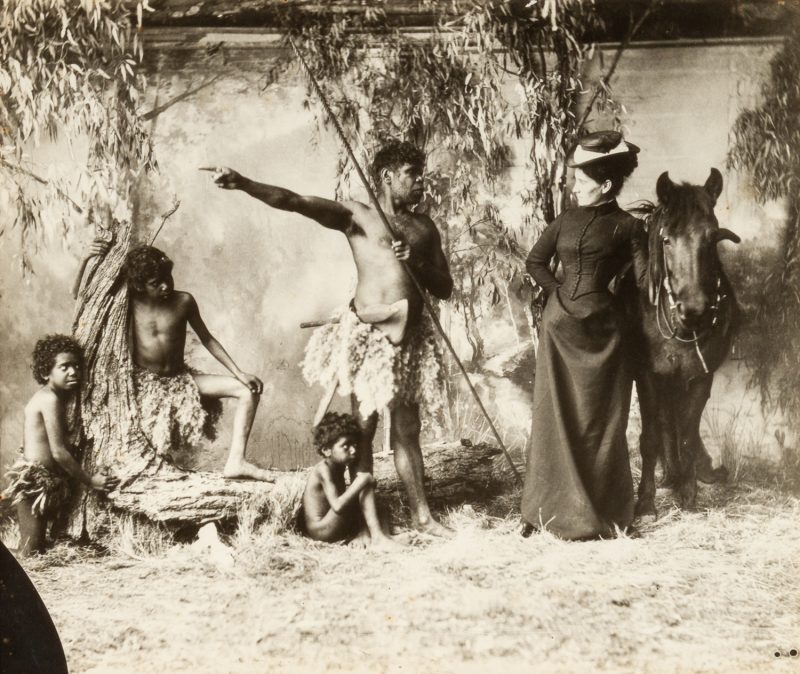
In the first of the two photographs offered here (which is the same image as Plate 10, ibid., p.19), a white woman lies injured (and perhaps unconscious) on the ground, with a group of concerned Aborigines, including an older male who possibly represents a medicine man, gathered around her. In the second, another white woman, who appears to be leading her horse through the bush in search of her lost friend, is being given directions by an Aboriginal man while his children look on.
The photographs were taken in an elaborately arranged improvised studio with a large canvas backdrop of the Australian bush done by an accomplished professional scene painter. A curious feature of both is that, with the exception of a large coolamon, the Aboriginal “actors” are holding several props which are in fact from Pacific Islands cultures: the man who is pointing the way for the horsewoman is holding a New Hebrides spear and has a Solomon Islands paddle club tucked into his waistband, and the “medicine man” who is kneeling over the unconscious woman holds what are unmistakably a New Caledonian phallic-headed war club and ceremonial stone axe. These facts suggest that the images were not intended to withstand close scrutiny or to be regarded as visual documentation of Australian Aboriginal material culture (so they have little in common with a J. W. Lindt tableau, for example). Clearly, their purpose was to tell a story – and they do, in fact, form part of a longer narrative sequence, the other parts of which are lost to history.


