# 50733
MÜLLER, Andreas
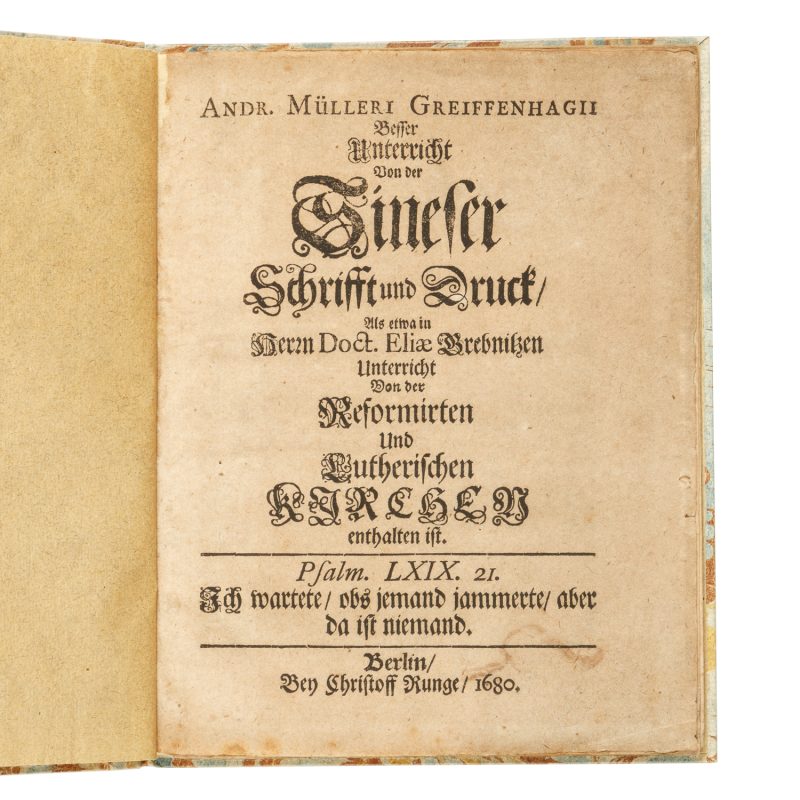
Andr. Mülleri Greiffenhagii Besser Unterricht Von der Sineser Schrifft und Druck/ Als etwa in Herrn Doct. Eliae Grebnitzen Unterricht Von der Reformirten Und Lutherischen Kirchen enthalten ist.
$9,500.00 AUD
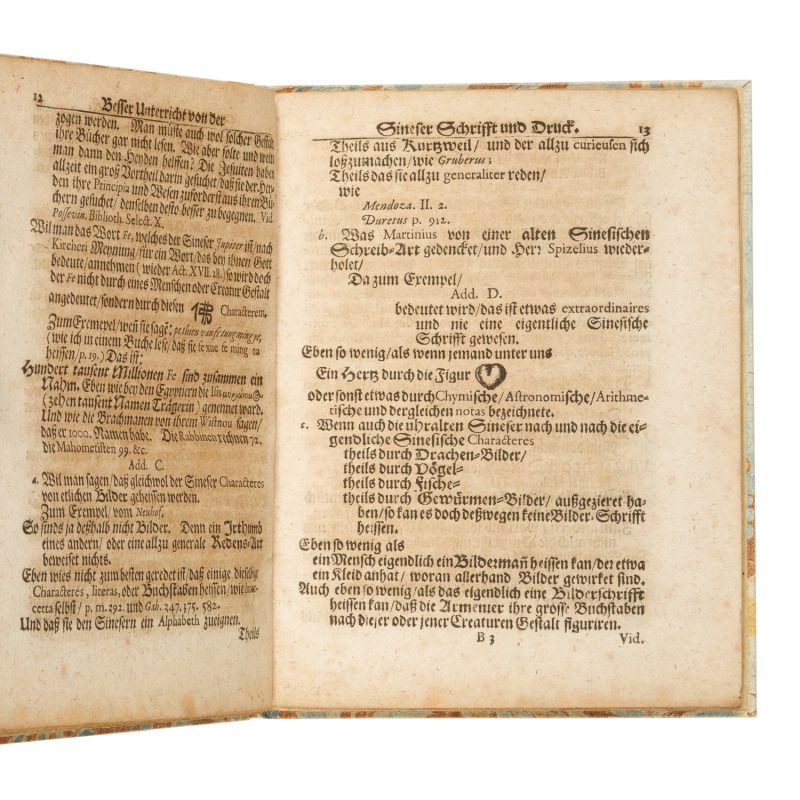
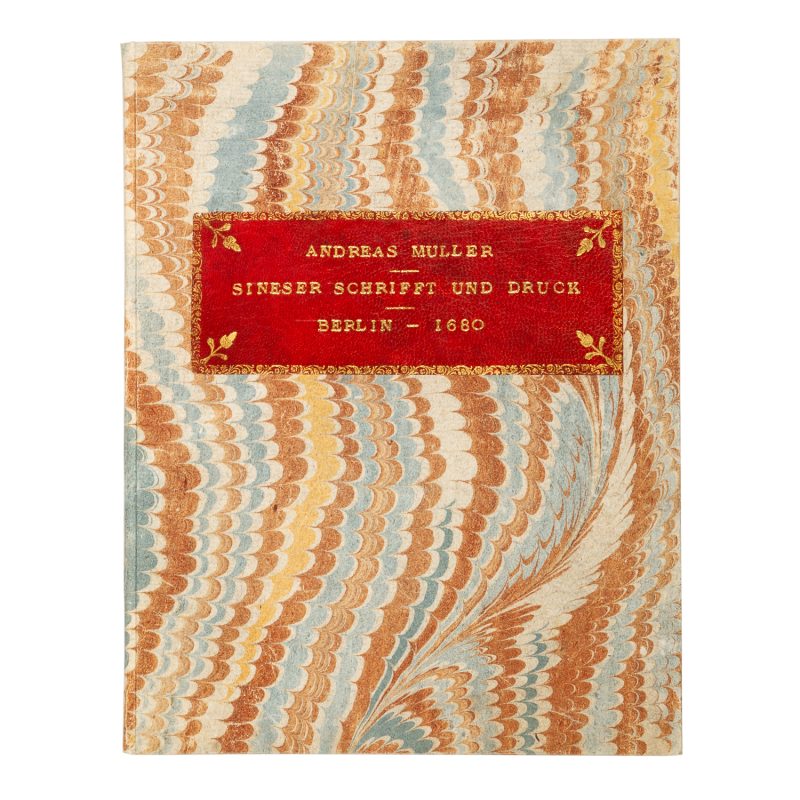
Berlin : bey Christoff Runge, 1680. Quarto, modern papered boards with gilt-lettered red leather title label to front; pp. 28 (including title), lacking the four unnumbered Addenda leaves at rear; woodcut headpiece, Chinese character (p. 12) and various other symbols in text; first two leaves with minor restoration at gutter, paper browned; ex libris label of H. P. Kraus to front pastedown.
Born in Greifenhagen an der Oder, theologian and Orientalist Andreas Müller Greiffenhagius (1630-1694) was one of the most renowned Sinologists of his time. He matriculated at the University of Rostock in 1649, and then studied in Greifswald and Wittenberg. In 1653 he was appointed rector of the municipal school in Königsberg in der Neumark, and was awarded the degree of Master of Arts by Rostock in 1654. In 1655 his work Horologium linguarum orientalium was published in Stettin, while he was serving as Provost of Treptow. In 1660 he was admitted to the Faculty of Philosophy in Rostock, although he in fact spent a year in England at this time, where he was able to establish connections with international scholars. In 1665, he became Provost of Bernau and discovered various Oriental manuscripts in the library recently established in Berlin; these manuscripts formed the basis of his work Excerpta manuscripti turcici de cognitione dei et sui ipsius (Cologne, 1665). At the end of 1666 he was appointed Provost of St. Nicolai in Berlin, making him the city’s most prominent clergyman. However, Müller devoted most of his time to the study of the Chinese language, and from around 1670 he began to publish a succession of significant contributions to scholarship in this field, including an edition of the Latin Marco Polo (1671), Monumentum Sinicum (1672), and a catalogue of Chinese books in the Berlin library (1683). Furthermore, he formulated a new method of teaching the Chinese language (although this was challenged by several leading scholars). His ideas on this subject are outlined in the present work, which also doubles as Müller’s defiant response to the misguided statements of Frankfurt Reformed theologian Elias Grebnitz (1627-1689), who in the late 1670s denounced the Chinese pictographic script as a work of the Devil that violated the Second Commandment. Reformist antagonism surrounding this issue, however, meant that Müller – an orthodox Lutheran – began to find his position in Berlin increasingly less tenable; as a consequence, he requested and was granted a discharge in 1685. Returning to Stettin, his scholarly research continuing unabated until his death. Although he burned many of his manuscripts before he died, the bulk of his library and the surviving manuscripts entered the St. Marienstift collection in Stettin, where they remain to this day.
VD17 39:124138U; digitised by the Staatsbibliothek zu Berlin; not in Wiener Chinabibliographie
Very rare. No copies traced in North American libraries; no sale record in the Rare Book Hub database.