


# 50604
[Max Harris; Sidney Nolan; James McGuire; Harry Roskolenko]
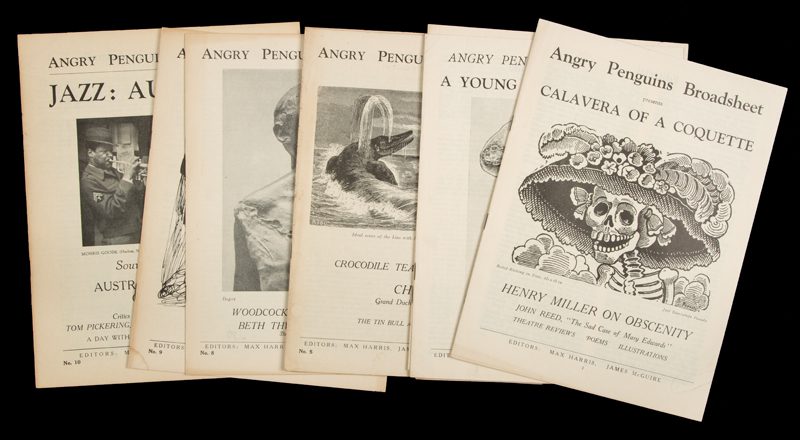
Angry Penguins Broadsheet : a complete set of ten issues
Editors: Max Harris, nos. 1-10; James McGuire, nos. 1-9; Sidney Nolan, nos. 2-9; Harry Roskolenko, no. 10. [Melbourne : Reed & Harris, 1946]. Ten issues, no. 1 (Jan. 1946) – no. 10 (Dec. 1946), large octavo, staple-bound, pictorial wrappers, illustrated; a couple of minor stains, a very good complete set.
The Angry Penguins Broadsheet was an offshoot of Max Harris’ modernist magazine, Angry Penguins, which had been founded in Adelaide in 1940 by Harris and the gifted young poet D.B. Kerr. The Broadsheet, along with the later issues of the magazine itself, was published in Melbourne by the small-press firm of Reed & Harris, run by art patrons John and Sunday Reed together with Max Harris. This publishing house was ideologically committed to printing books in the fields of literature, art, politics and social commentary whose ideas might not otherwise have found a voice. With its little magazine, the Broadsheet, it attempted to directly challenge and shock the bastions of conservative culture in Australia.
The first issue of the Broadsheet included an essay of international significance by the controversial American writer Henry Miller, Obscenity and the Law of Reflection. At the time it appeared, in January 1946, Miller’s novels were banned not only in the United States but also in Britain and Australia (Reed & Harris subsequently published Miller’s Murder the Murderer : an Excursus on War from the ‘Air-Conditioned Nightmare’). Issue no.3 contains the provocatively titled essays Governor Latrobe’s Underpants : a colonial melodrama and Sex life of booksellers; no.4 contains a satirical poem about James McAuley (who along with Harold Stewart created Ern Malley); issue no. 9 is titled simply Jews, and is devoted to articles by Charles Peguy and Jean-Paul Sartre concerned with Anti-Semitism; throughout the issues there are also art, music and film reviews.
An interesting figure in the Broadsheet ‘constellation’ was the American poet Harry Roskolenko, who became the New York agent for Angry Penguins and was responsible for organising the magazine’s American contributions. Roskolenko wrote several pieces for the Broadsheet (poetry and essays) and was joint editor of no. 10, Jazz: Australia. The curious fact about this last issue is that it does not have any positive words (in fact, NO words) to say about bebop, the new jazz idiom which emerged in 1944-45 with recordings by Charlie Parker, Dizzy Gillespie and Coleman Hawkins. Although it includes an interview with Duke Ellington, the remainder of the issue is exclusively (and zealously) devoted to Dixieland jazz, with the introduction provided by the purist, ultra-conservative musician Graeme Bell. Why Roskolenko, a native of New York, did not contribute or include any material in this issue that related to what was arguably the most exciting development in modern music up to that point is a mystery, even more so considering that bebop recordings must have been available for Harris and Reed to listen to in Melbourne by late 1946. This final issue is perplexingly reactionary in tone, as if the Penguins have run out of steam and things have come full circle. They are now the Establishment. Then one turns the page and reads, on page 13, the following grim announcement: ‘The publishing firm of Reed & Harris, publishers of “Angry Penguins” and “Angry Penguins Broadsheet”, has been forced to close down. This firm was founded for the express purpose of providing a channel of expression for the creative artist in Australia and of helping to give him that security and position in the community to which he is entitled; but after nearly 4 years of work and the publication of 14 books in addition to “Angry Penguins Broadsheet”, it has now reached the end of its financial resources.’


