


# 17253
[Author unidentified]
[POLYNESIA] Original letter containing vivid descriptions of Tahiti and Rarotonga. August, 1934.
$250.00 AUD
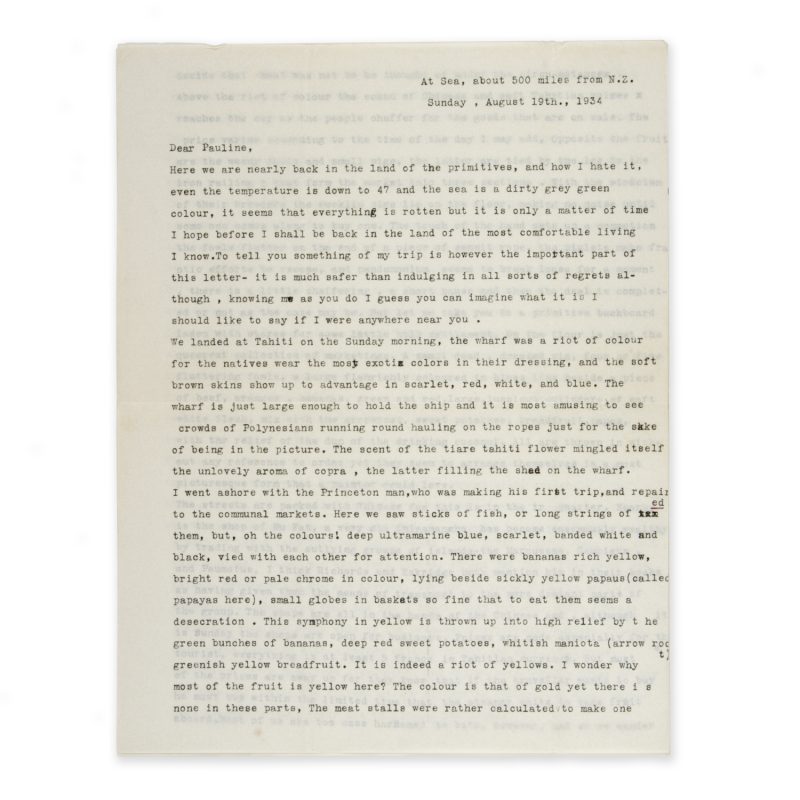
Typed letter, [7] pages, on onion-skin paper, 280 x 215 mm, headed ‘At Sea, about 500 miles from N.Z. Sunday, August 19th, 1934’; with pencil map of the ship’s journey through the islands of Tahiti and three lines of handwritten text; addressed to ‘Dear Pauline’ (internal references indicate she was a close personal friend of the writer), and signed at the foot ‘Yours, J. D. ..ale’; the letter is in fine condition, but without its original envelope.
This colourful, unpublished private letter was evidently written by a professional writer during a cruise across the Pacific from Tahiti to New Zealand in the Southern Hemisphere winter of 1934:
‘… I feel at present that there is not much use in doing any further work until I realise that if I am to get anywhere I must turn something in and have been reading novels most of the time, at least between meals and erratic sleeps’ … ‘Did I tell you that I had written to Stacy May re the Language so that I expect to hear from him in about two months …’.
The letter contains vivid, detailed descriptions of Tahiti as if it were being seen ‘with the eye of a visitor for the first time’.
The following passages are typical of the writer’s highly romantic style:
‘Against the sky suffused with a soft tropical pink the peaks of the island stood out like the turrets of some medieval castle. The sea seemed to be alight except where the shadows flung themselves across the strait, here it was a deep cobalt. Slowly night hovered over the reef, the fluid colour of the water changed from blue to pink to indigo, the peaks of Moorea took on fantastic shapes, imagination made them the towers of Camelot, the sky become a delicate pink, to gold …’
‘… the wharf was a riot of color for the natives wear the most exotic colors in their dressing, and the soft brown skins show up to advantage in scarlet, red, white, and blue …’
‘Above the riot of colour the sound of Chinese and soft Tahitian voices reaches the ear as the people chaffer for the goods that are on sale. The price varies according to the time of day I may add. Opposite the fruit are the weedy fowls and small pigs … Nearby is the shop of Mu Fat, a very old Chinaman who has become enormously wealthy by trading with the outlying groups of islands – the Marquesas, Gambiers, and Paumotus, I think Richards and Eskridge both mention him in their books as having given the means of transport to the more distant parts of the group. The shops are all in the hands of the Chinese ….’
The letter also contains the writer’s lengthy impressions of Avarua in Rarotonga in the Cook Islands:
‘… The leis are made from the scarlet skin of a sort of native cherry while the fragrant frangipani ad tire are everywhere in evidence. The men and women have copied the Tahitian trick of wearing a flower over the ear, over the left if in search of a “lover”, in the right ear if one os already on hand. The wharf is a baby doll like jetty, laden with green bananas … With my usual luck I found a family about to begin a meal, and as they speak almost the same language as the Maori people I invited myself and the fellow with whom I went ashore to partake of te pork, taro, and arrowroot cooked native fashion, in the earth, as a bit of experience of Polynesian life….’
Although it is tempting to suggest that this letter was written by none other than James Norman Hall, co-author of Mutiny on the Bounty, the scrawled signature at the foot of the last side does not appear to match that of the renowned novelist.


