


# 50375
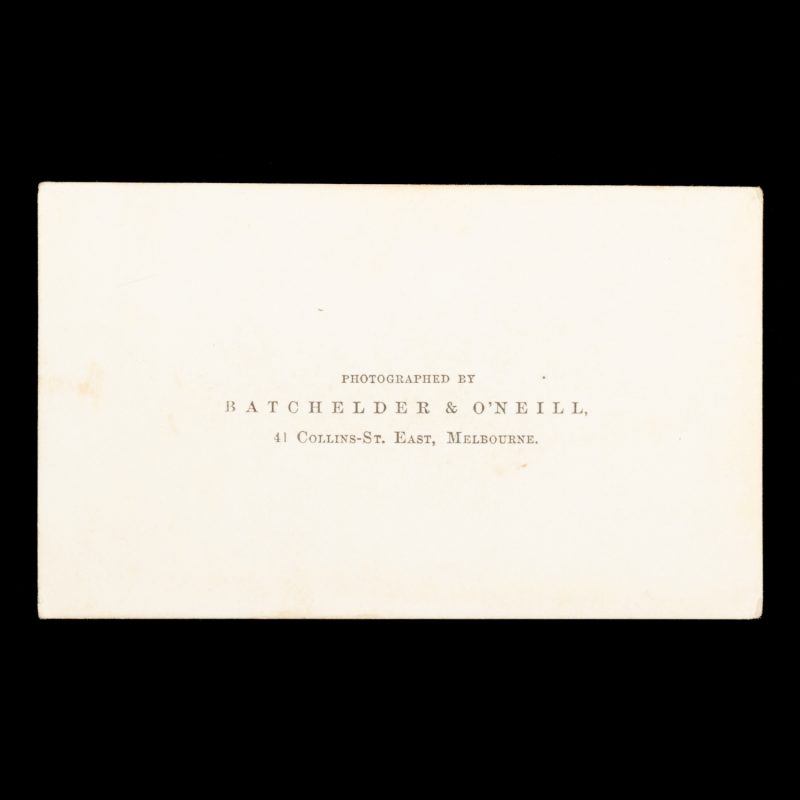
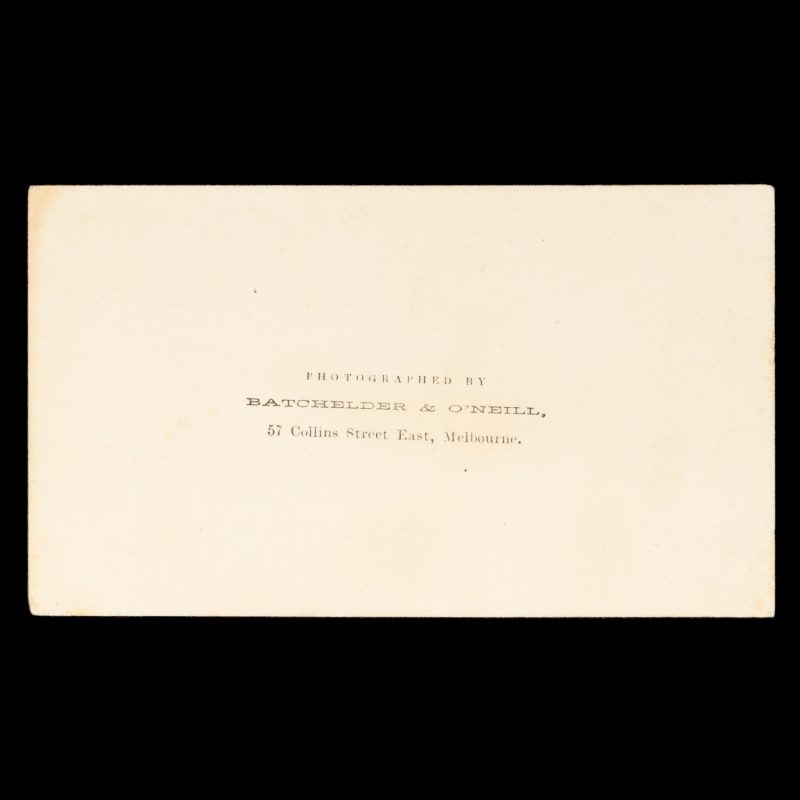
BATCHELDER & O'NEILL
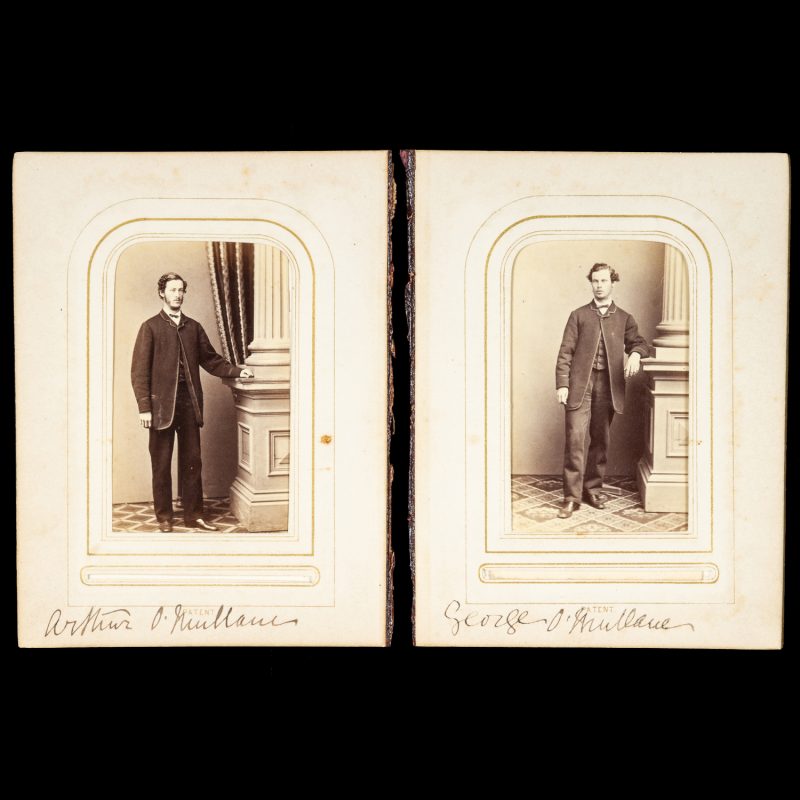
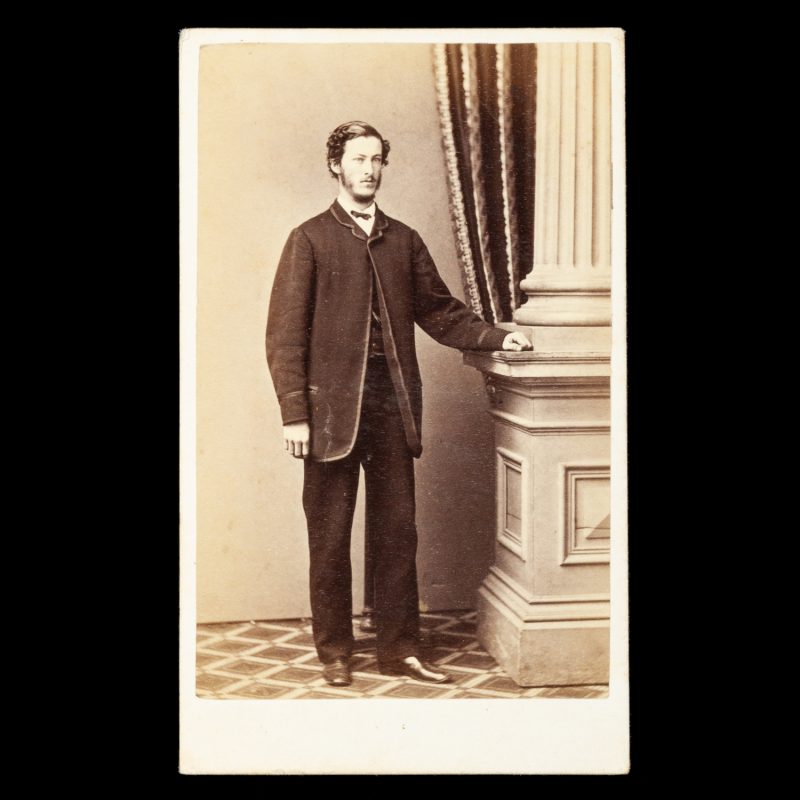
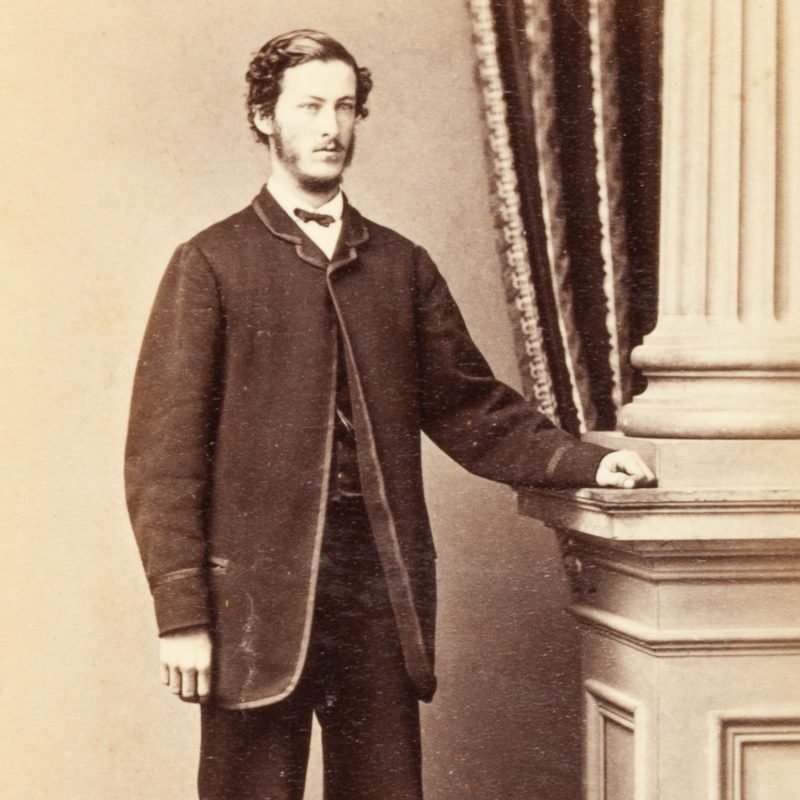
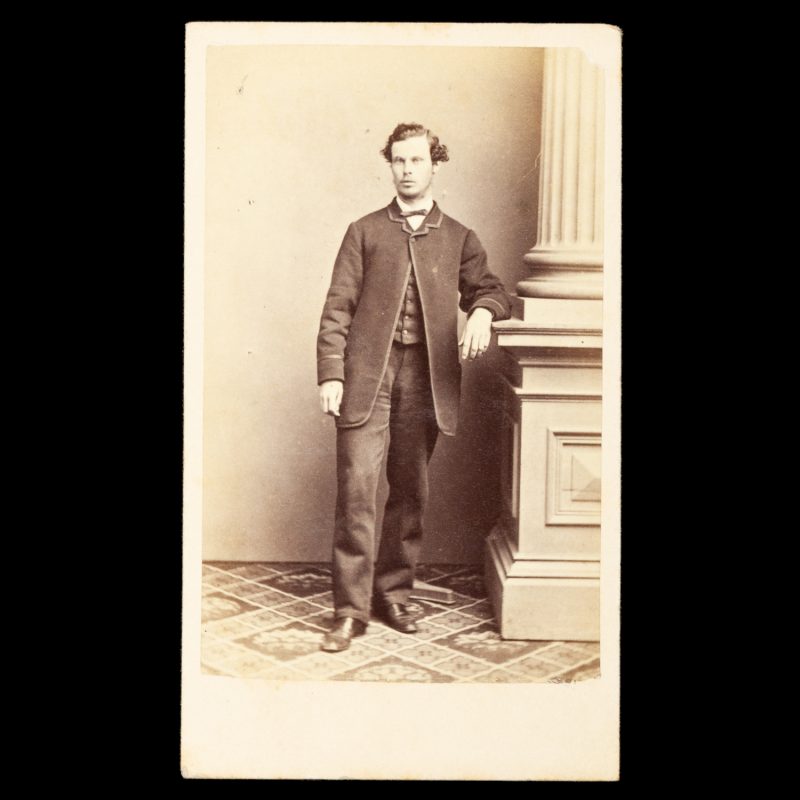
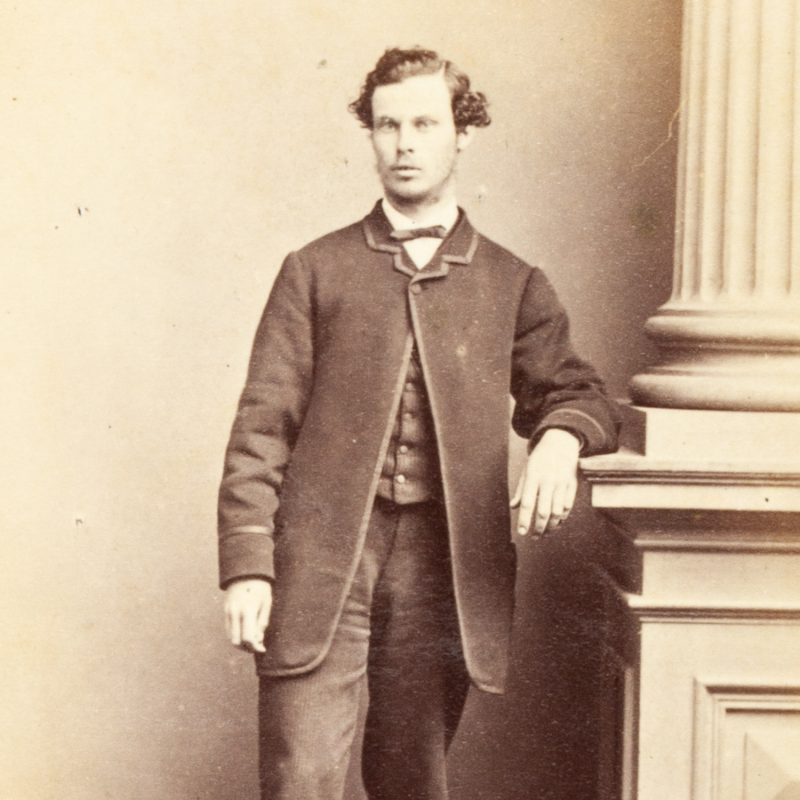
[CRICKET] Studio portraits of Arthur and George O’Mullane, sons of Dr. Arthur O’Mullane. Melbourne, c.1863-64.
$750.00 AUD
I. Portrait of Arthur Augustus O’Mullane (1841-1865), by Batchelder & O’Neill (41 Collins Street, East, Melbourne). Albumen print, carte de visite format (103 x 63 mm. mount). Fine condition; accompanied by its original album window mount inscribed with the sitter’s name ‘Arthur O’Mullane’.
II. Portrait of George Jeremiah Patrick O’Mullane (1842-1866), by Batchelder & O’Neill (57 Collins Street, East, Melbourne). Albumen print, carte de visite format (103 x 63 mm, mount). Fine condition; accompanied by its original album window mount inscribed with the sitter’s name ‘George O’Mullane’.
Provenance: A distressed photograph album compiled by Jane Emma Murphy (Balcombe) (1854–1924), “The Briars,” Mornington, Victoria (Australia); à Beckett family, Melbourne (by descent).
A pair of possibly unique photographic portraits of two members of one of Melbourne’s most prominent early settler families, that of Dr. Arthur O’Mullane (1812-1863) and his wife Maria (Barber) O’Mullane.
Arthur Augustus O’Mullane, Arthur and Maria’s oldest son, died in May 1865, at the age of just 23; his younger brother George O’Mullane, a notable sportsperson in the colony, died in December, 1866, aged 24:
‘George Jeremiah Patrick O’Mullane (3 December 1842 – 20 December 1866) was an Australian cricketer and Australian rules footballer. Born and raised in Melbourne, Victoria, O’Mullane was a standout cricketer from an early age, and came to be regarded as his colony’s premier wicket-keeper. During the winter months, he excelled as a footballer in the nascent Australian game, receiving praise for his courage and strength. O’Mullane’s promising career was cut short when he died of tuberculosis, aged 24….’ (Wikipedia)
The two young men feature (as young boys) in a painting of the O’Mullane family made around 1852 by an unknown artist, which is now in the collection of the NGV. The following is from curator Jennifer Phipps’ essay on the painting, published in the NGV’s Art Journal 18, July 2014, and available online at https://www.ngv.vic.gov.au/essay/portrait-of-maria-elizabeth-omullane-and-her-children-c-1852/
‘The portrait of Maria Elizabeth O’Mullane and her children was acquired by the National Gallery of Victoria in 1976 from a distant cousin of Maria O’Mullane’s descendants.
The painting is by an unknown artist of professional training – its oval shape, dark smooth background, genre elements of toys and pet, costume detail and stage-like pose are reminiscent of the work of the fashionable German artist Franz Xaver Winterhalter who painted portraits in the Royal Courts of Europe, especially France and England, in the early and mid-19th century. Maria O’Mullane’s head is painted in the detail of miniature technique, while the clothes, and particularly the carpet, are handled in a much broader fashion. Through the window can be seen a century plant, characteristic of the succulents grown in early Melbourne colonial gardens to suit the dry climate. The sparse interior is furnished with chaise longue, footstool and chair; this kind of furniture and the English floral carpet was sold in Melbourne in the 1840s and 1850s. The tipped-up perspective of the carpet, the carefully spaced figures and the plain background give a charming and naive quality to the painting which is a record of prosperous colonial life of the 1850s.
The Port Phillip Herald reported in 1840 the marriage of Miss Maria Elizabeth Barber, formerly of Kergingham near Hull, Yorkshire, to Dr Arthur O’Mullane, at St James’ Church on 5 December. A Miss Barber had come to the Port Phillip District as a cabin passenger on the ship William Metcalfe which arrived on 15 November, 1839. Dr Arthur O’Mullane was Surgeon Superintendent on the same ship.
Dr Arthur O’Mullane, on settling in Melbourne, formed a brief partnership with Dr Barry Cotter, one of the original settlers from Launceston; an advertisement in the Port Phillip Herald 24 March, 1840, gives Dr O’Mullane’s qualifications as ‘Member of the Royal College of Surgeons, London and Accoucheur’. Garryowen’s Chronicles of Early Melbourne has a brief account of Dr Arthur O’Mullane’s success as a physician in the colony. As well as acting in some official government and welfare medical positions, in 1847 he was elected one of the first honorary physicians to the Melbourne Hospital shortly before it opened, and was a founding member in 1846 of The Port Phillip Medical Association. His business interests in the 1840s included a part-ownership in the Port Phillip Gazette, and he bought land in Prahran which he later subdivided, naming Greville and Grattan Streets. One of the houses in which the O’Mullanes lived in the 1840s was at 24 Queen Street, one of the first three storeyed houses built in Melbourne, and in 1852 Dr O’Mullane bought Redmond Barry’s house at 97 Bourke Street West, where Redmond Barry, later Sir Redmond Barry, Supreme Court Judge, Chancellor of University of Melbourne and Chairman of the Public Library Trustees, had established Melbourne’s first lending library.
Dr O’Mullane, who originally came from Cork, Ireland, died at his house in Bourke Street on 21 October 1863, aged 51 years.
During the 1840s, the O’Mullanes had five children, and this portrait was probably painted shortly after the death of their son, Frederick, in April, 1851. The children from left are Ann Eliza, Jeremiah, Arthur Augustus and George. The little boy in a dress, Jeremiah, was born in 1845, and died in 1856, and as it was customary to keep boys in dresses until they were 7 or 8, this dates the portrait from 1851 to 1853. The two sons, Arthur, holding a book, and George, with bow and arrow, both went to Melbourne Church of England Grammar School, and each successively captained the Cricket XI. Arthur died in 1865 and George in 1866, leaving Maria and her daughter, Ann, as the only living members of the family.
Of the four children in the portrait, only the little girl Ann Eliza, had children of her own. She married William Garrard, a surgeon, in East Melbourne in 1868, and when she and her husband died in 1883, her mother Maria Elizabeth O’Mullane, brought up Ann’s five surviving children. This portrait, passed from Maria O’Mullane to her grandson William Garrard, and from him to his son, Basil. When Basil Garrard died recently, the painting then passed to his cousins, together with three miniatures, amongst which was a second portrait of Maria Elizabeth O’Mullane….’ Jennifer Phipps, Curator, Department of Australian Art, National Gallery of Victoria (in 1977).


