


# 42946
GOW, James
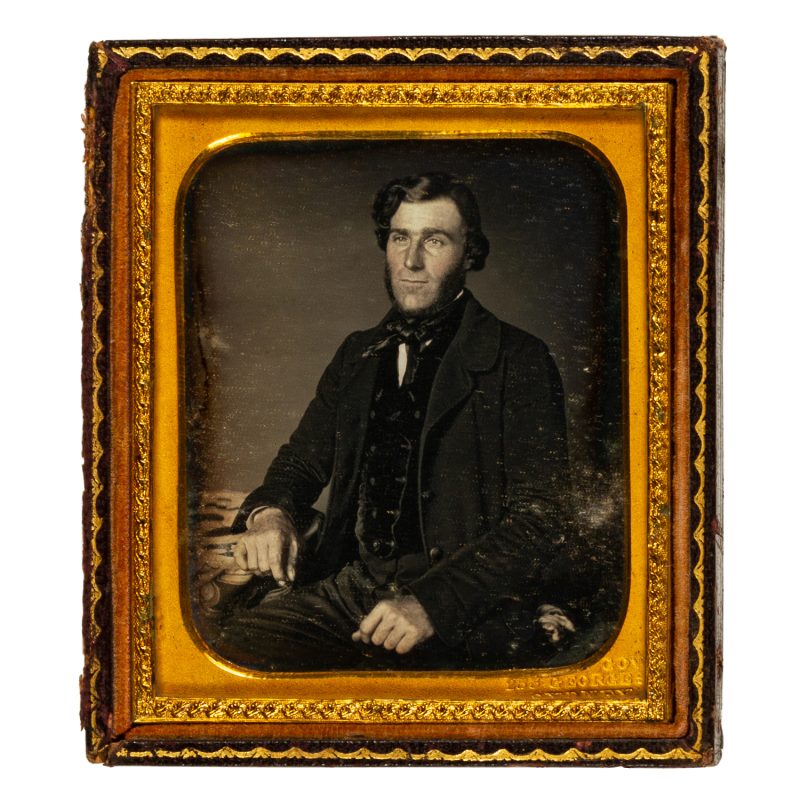
Daguerreotype of a seated gentleman wearing a silk cravat, velvet waistcoat and woollen overcoat. Sydney, 1854-55.
$14,000.00 AUD
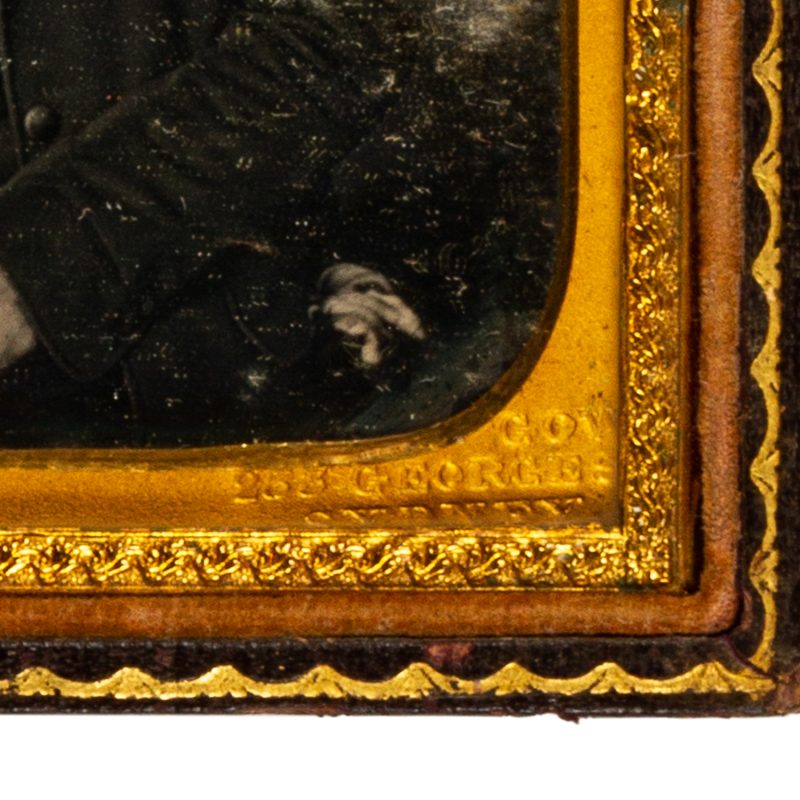
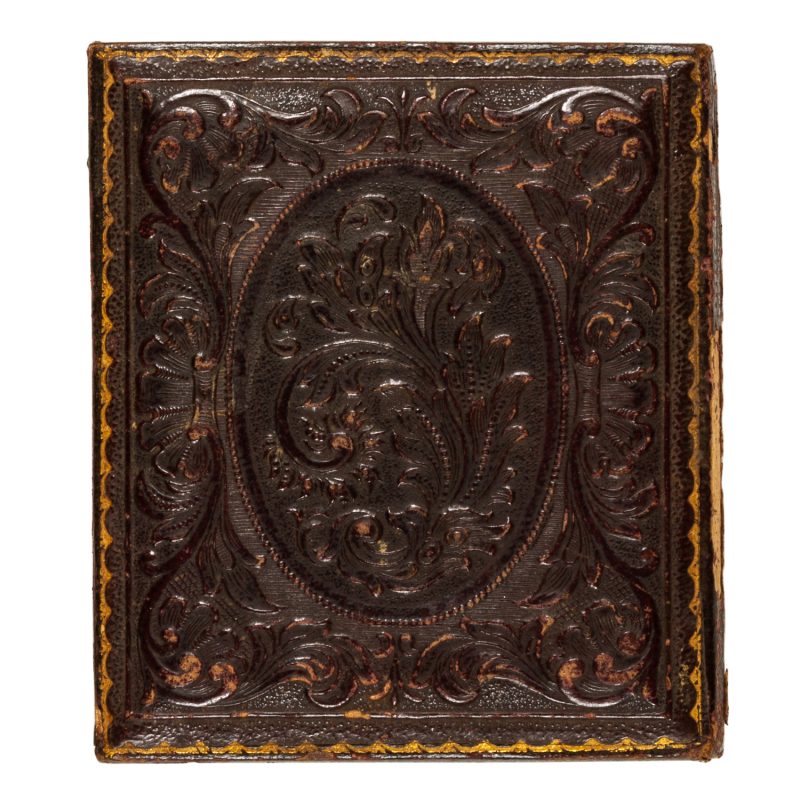
Sixth-plate daguerreotype with applied colour, 70 x 60 mm (sight); in a round-cornered square brass mat and ormolu preserver, the mat stamped at lower right ‘GOW / 253 GEORGE ST.’; housed in a half leather case with embossed floral design; the daguerreotype has some minor oxidisation at the right- and left-hand edges but is otherwise in fine condition.
An extremely rare example of a portrait by Sydney daguerreotypist James Gow.
The only James Gow daguerreotype we have been able to trace in Australian public collections is the portrait of James Allpress, tipstaff at the Supreme Court, held in the Powerhouse Collection (Object No. H5572-3).
According to the DAAO, ‘Gow was in partnership in San Francisco in 1851-52 with engraver Robert W. Fishbourne as photographers and lithographers. The pair produced illustrated gold fields letter paper, a panorama of San Francisco and a view of the burnt out city in 1851. In Sydney in 1853 Gow advertised with Richard H. Acley, who had possibly travelled with Gow from San Francisco.’
Gow and Acley opened a studio at rented premises in Pitt Street, offering daguerreotypes of all kinds. The following advertisement appeared in the SMH, 19 February 1853:
‘MESSRS. GOW AND ACLEY (from America) have opened rooms in Pitt-street, over Mr. Mort’s Auction Room, for taking Daguerreotype Portraits with the most improved American apparatus, and at such prices that all persons may be enabled to have their likenesses taken. Portraits, miniatures, landscapes, and subjects of every description accurately copied by the Daguerrian process. Daguerreotype miniatures for lockets, bracelets, rings, &c.‘
We know that the partnership was still together until at least the end of that year. A woodcut published in the Illustrated Sydney News, 24 December 1853, was captioned ‘KING GEORGE TUBOU, OF THE FRIENDLY ISLANDS. From a Daguerrotype by Gow and Acley‘.
Two weeks later, on 7 January 1854, a review of Moore’s Catholic Almanac and Directory for 1854 that appeared in Freeman’s Journal lavished praise on Gow and Acley’s daguerreotypes:
‘So much for the labor of the compilers of the Almanac ; we must now say something of the artistic and mechanical portion of the work. The portraits are the very best that we have seen executed in the colony ; they are eminently truthful, clear, light, and exceedingly chaste, and reflect the highest credit not only on the artists engaged on them but in fact on the whole colony. They are from daguerreotype portraits by Gow and Acley, drawn on wood by Nicholas, and engraved by Mason.‘
Perhaps the partnership had already dissolved by the time a notice appeared in the SMH on 16 May 1854, announcing that ‘MR. GOW, Daguerreotype Artist, is requested to call at 70, Hunter-street, corner Elizabeth-street.‘
Certainly, however, it seems that Gow had gone solo and was operating a studio in George Street South, at least from the second half of 1854: in June, 1854 the Pitt Street premises were taken over by Conrad Martens and Pierre Nuyts. The following review appeared in Bell’s Life in Sydney and Sporting Reviewer, 4 January 1855, which confirms that Gow was no longer in partnership with Acley, who had probably already left Sydney for Victoria, where he would continue as a daguerreotypist, first in Gippsland, then at Beechworth:
‘DAGUERREOTYPE PORTRAITS & LANDSCAPES.—Amongst the many valuable works of art exhibited in the Sydney Branch of the Paris Exhibition, few were more interesting, and attracted greater observation than the six large views of the interior of the Museum, taken by Mr Gow, the Daguerreotypist, of George-street. As regards depth of tone, distinctness, and general effect, they are superior to any spe cimens we have seen ; and at the suggestion of his Honor the Chief Justice, two of the plates were purchased for transmission to Paris, as also the splendid panoramic view of George-street, taken by the same artist. The committee have likewise proposed to Mr Gow the publication of an engraving from the plates of the interior of the Exhibition ; to bring within the reach of all lovers of the arts so valuable a memorial of the Colony’s first attempt at a national collection. For this purpose Mr S. C. Marsh has been authorised to receive subscriptions for the Print, which will be published about the middle of February.‘
The latest advertisement for James Gow’s business at 253 George Street (South) is one that was published in the SMH, 13 October 1855:
‘LIFE-LIKE LIKENESSES.—GOW’S American Daguerrean Gallery. Mr. G. has the pleasure of informing friends and the public generally, that he has just received a choice assortment of daguerreotype materials for likenesses or every size, from one pound upwards. Likenesses taken daily from eleven till five. Daguerreotypes, engravings, oil paintings, &c., carefully copied. All pictures warranted to give satisfaction, or no charge. Artists and amateurs are requested to call and examine his stock, being carefully selected and of the best quality. Full instructions given in the art on reasonable terms, by J. GOW, importer and wholesale dealer, 253, George-street, Sydney.‘
Since James Gow clearly identified his enterprise with America, he should not be confused with the ‘R. Gow’ whom we find advertising as a professional photographer in Sydney in late 1857. From Freeman’s Journal, 21 November 1857:
‘THE LATE DEAN COFFEY. CORRECT and FAITHFUL LIKENESSES of the above-lamented gentleman may be obtained from R. GOW’S, at his AUSTRALIAN PHOTOGRAPHIC GALLERY, George-street, near King-street, Sydney, opposite the new buildings of the English, Scottish, and Australian Chartered Bank.’
The fact that R. Gow’s premises would seem to be at the same address as James Gow’s earlier American Daguerrean Gallery strongly suggests the possibility that ‘R. Gow’ may have been James Gow’s brother (or cousin?). This is corroborated by Davies & Stanbury’s entry for an ‘M. Gow’ (“M” for “Mister”?) as Manager of the Australian Photographic Gallery at 253 George Street in 1858 (Davies & Stanbury, The Mechanical Eye in Australia, p. 170). The picture is further muddied by advertisements appearing between 1858 and 1867 for James Gow’s ‘Photographic Portrait Rooms’ at 410 George Street, where a ‘John Gow’ was also advertised as a ‘Writing Master’. Presumably John was another close relative of James.
Genealogical records are conflicting, but it does appear that James was born in 1828. He married Helena (aka Elenor, Elleanor, Ellen) Sophia Wiggins (b. 1831) in Sydney in 1853. The couple had four children, including eldest daughter Florence, born in 1861, and John junior, born in 1863.
