


# 50134
BARROS, João de
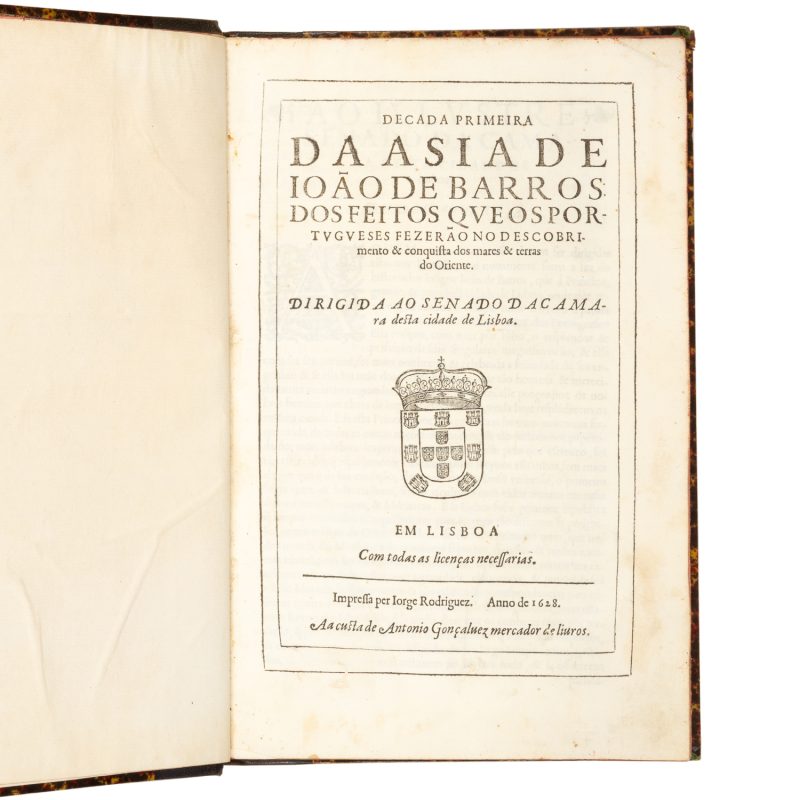
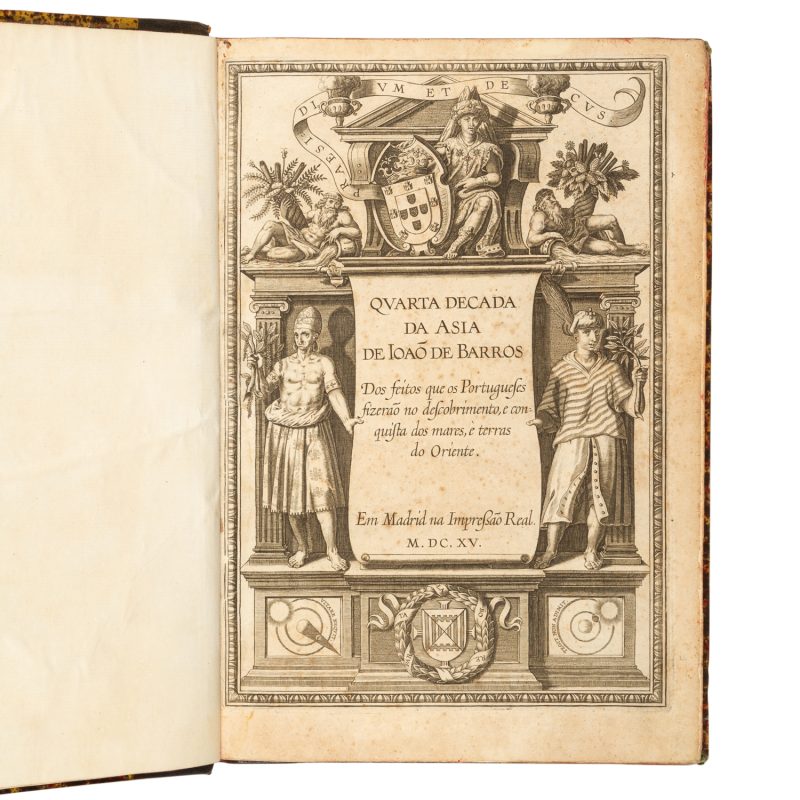
Década primeira [-terceira] da Asia de João de Barros dos feitos que os Portugueses fizerão no descobrimento & conquista dos mares & terras do Oriente. [WITH] Quarta década da Asia de João de Barros …
$8,000.00 AUD
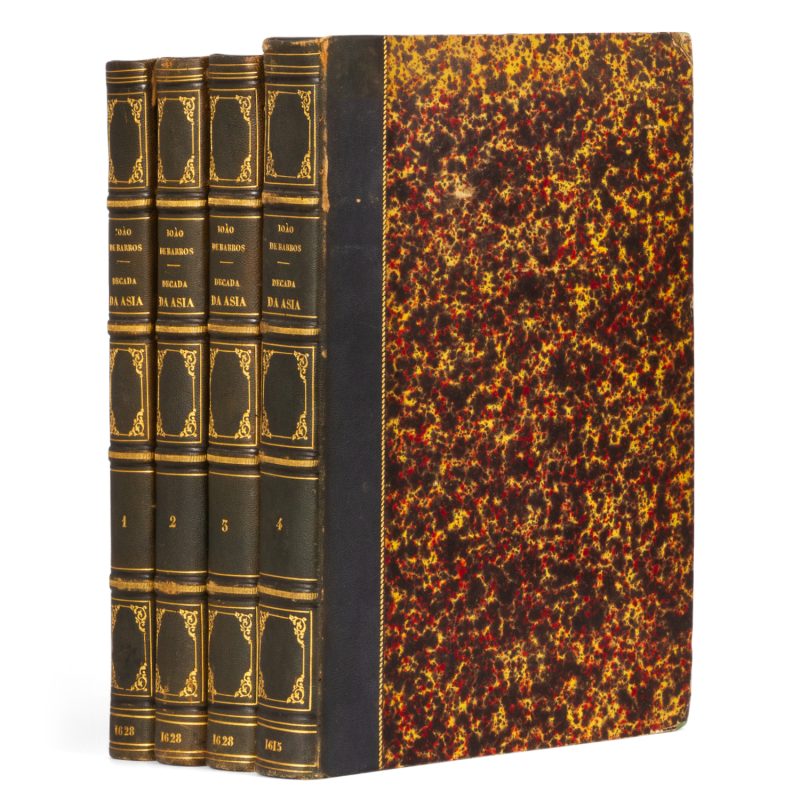
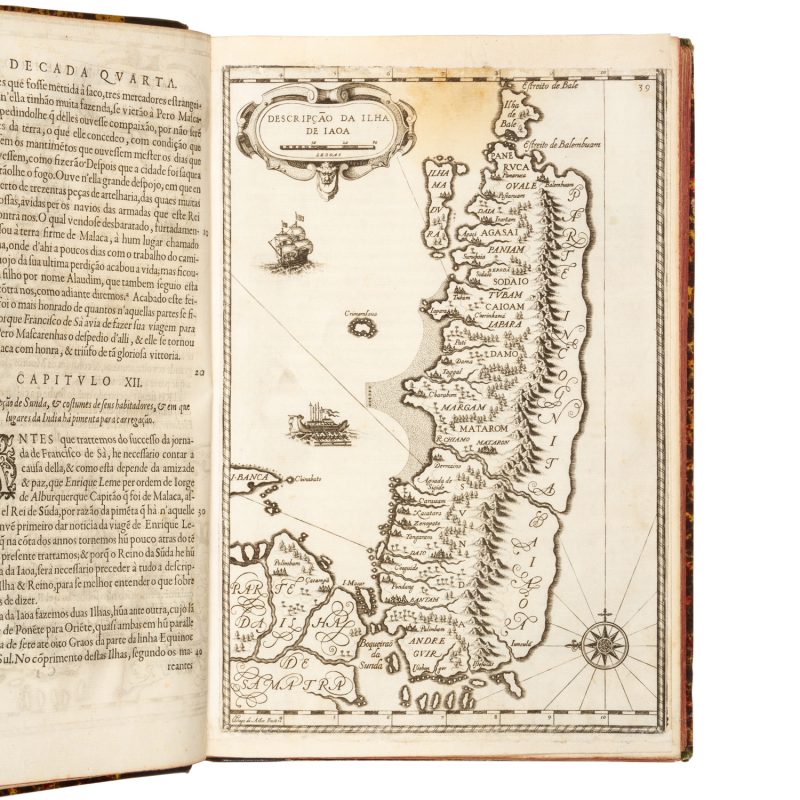
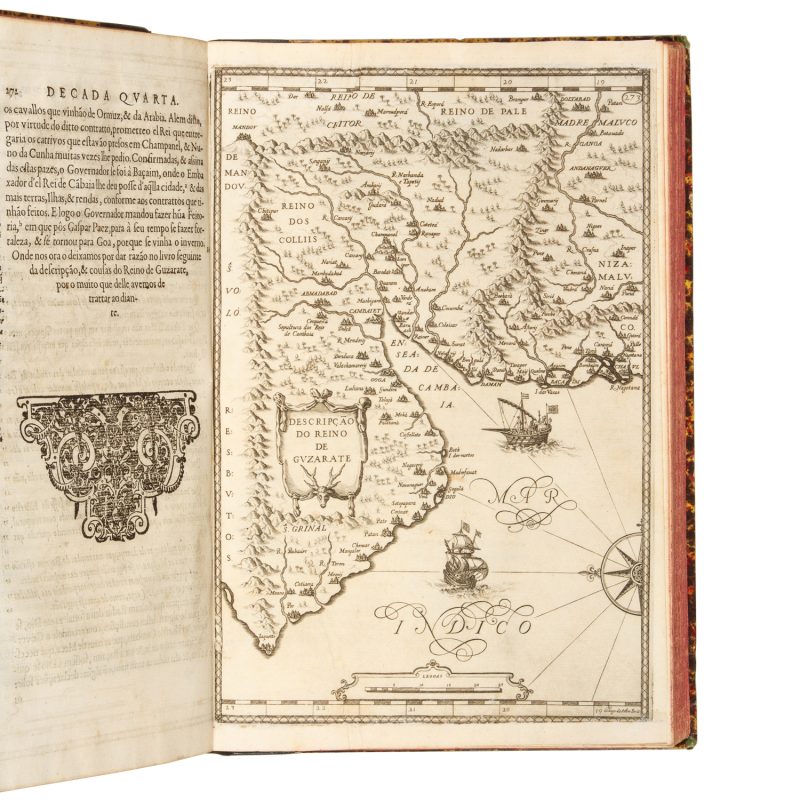
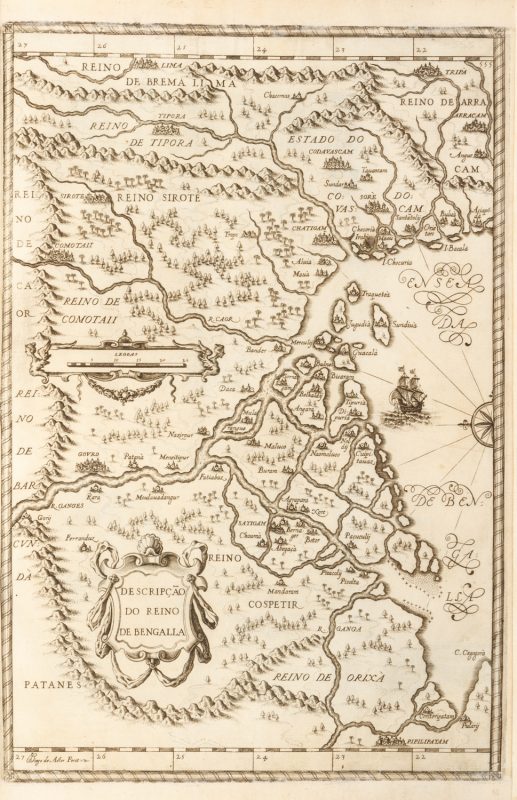
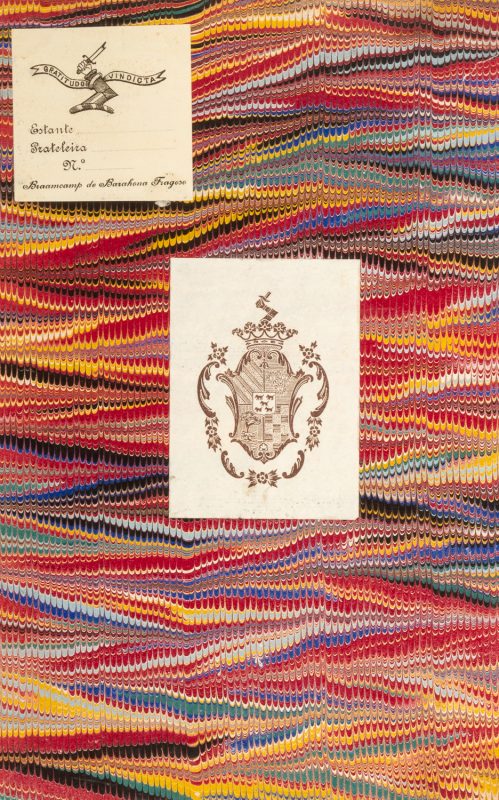
Lisbon : Jorge Rodriguez, 1628 (complete second edition of the first three Décadas) ; Madrid : na Impressão Real, 1615 (first edition of the fourth Década). Four volumes, folio (300 x 205 mm, the fourth volume slightly taller), uniform early twentieth-century bindings of gilt-ruled quarter black morocco over marbled papered boards, spines in compartments lettered and decorated in gilt; edges stained red; all front pastedowns with the armorial bookplate and library shelf label of José Manuel Braamcamp De Barahona Fragoso, 3rd Count of Esperança (1887-1963), marbled endpapers; I. ff. [7], 208; II. ff. [6] (last blank), 238; III. ff. [10], 262; IV. engraved title-leaf, pp. [20], 711, [12], complete with the three full-page maps of Java, Gujarat, and Bengal (which are lacking in many copies); across the four volumes there are numerous errors in foliation; occasional light foxing and dampstaining (most pronounced on the first two leaves of Década terceira); a good mixed set in attractive uniform old bindings with a distinguished provenance.
The most substantial and significant account of the Portuguese exploration and colonisation of Asia and America during the maritime nation’s Golden Age.
The Décadas da Ásia is the magnum opus of the Portuguese historian João de Barros (1496-1570), who, as Comptroller of Customs, was able to draw on eyewitness accounts and other first-hand information accessed from official documents in compiling his chronicle of Portuguese expansion into East Asia and Brazil that focuses on the period 1497-1526. The first two Decades were first first published in 1552-53. The third Decade was published in 1563, and the fourth appeared posthumously – almost half a century after Barros’s death, in fact – in Madrid in 1615, edited by João Baptista Lavanha from Barros’s own manuscript notes.
A second edition of the first three Decades was published by the Portuguese senate in 1628. Since that edition did not include the fourth Decade, collectors and booksellers have often joined the three volumes of the 1628 second edition with the single volume 1615 first edition of the fourth Decade to make a mixed set of all four Decades, as is the case here.
Lach (Asia in the Making of Europe) comments: ‘Because of his official position, Barros had at his disposal the full facilities, documents, and. . . reports of the Casa da India. All the Portuguese manuscript sources now extant – such as the account of Tome Pires, Domingo Paes and Fern Nuniz – were used in the preparation of the Décadas. For geographical locations he depended implicitly on the written and oral accounts of the pilots and navigators who had sailed in Eastern waters and, on their testimony, did not hesitate to point out the mistakes of the Ptolemaic geographers. Nor was he satisfied to use the evidence of European observers exclusively. He was constantly trying to procure native accounts of the Eastern regions. For his remarks on India, he assembled Persian, Arabic, and Indian manuscripts and bought educated slaves to translate them for him. He also had Chinese books and a Chinese slave as a translator. He likewise sought to assemble information from the oral tradition of places which had no written histories. But, whether his sources were of European or Asian provenance, he tried, according to his own statement, to use them judiciously in order to produce a balanced narrative without “too much of any one thing”. The result of his labours was a history that stands as one of the classics of Portuguese literature and of European historiography’.
Sabin, 3646; Cordier, BS, 2306-7 (not noting the maps in the 1615 Quarta Década)


