


# 51624
MACDONALD, George Ranald (1788-1873)
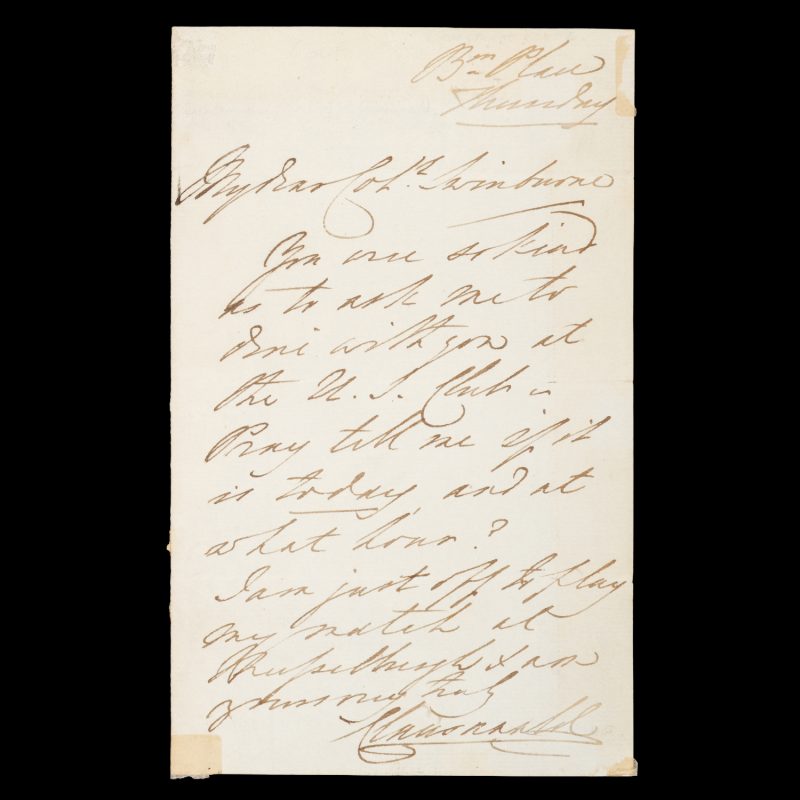
[GOLF] 20th Chief of Clanranald: autograph letter signed, mentioning his “match” at the Musselburgh links. Edinburgh, c.1840.
$1,500.00 AUD
[Undated, but probably c.1840]. Manuscript in ink, 1 page, octavo (195 x 120 mm); headed ‘Brn. Place [i.e. Broughton Place, Edinburgh], Thursday’, the note is addressed to ‘My dear Col. Swinburne’ [i.e.Thomas Robert Swinburne of Marcus, 1794-1864], and is signed at the foot ‘Clansranald’ [i.e. Ranald George Macdonald, 1788-1873, Chief of Clanranald, who was the only person entitled to use this one-word signature]; one light horizontal fold, remnants of hinges at each corner from where the letter was once mounted in an album, otherwise very well preserved.
Along with the Old Course at St. Andrews, Musselburgh is one of the two oldest golf courses in the world, the first documented game played there having taken place in 1672. The course originally had only seven holes; an eighth was added in 1838, but the ninth was not added until 1870. In this handwritten note dating to around 1840, the Chief of Clanranald mentions that he is to play a ‘match’ at the course that day, and is about to leave his residence in Broughton Place in the New Town of Edinburgh to travel the 6 miles out to the Musselburgh links in East Lothian.
‘My Dear Col. Swinburne,
You are so kind as to ask me to dine with you at the U. S. Club [i.e. the Caledonian United Service Club in Queen Street, Edinburgh]. Pray tell me if it is today, and at what hour? I am just off to play my match at Musselburgh. I am yours very truly, Clansranald‘.
Ranald George Macdonald (1788-1873) was the 20th Chief of Clanranald (also known as the Clan Macdonald of Clanranald), and a Member of the British Parliament for Plympton Erle, 1812-1824. ‘Between 1813 and 1838 Macdonald was forced to sell virtually all his inherited property, sparing only the uninhabited island of Risca and the rui of Castle Tirrim. Neither the £214,211 realized by these sales nor his second marriage to a widow ‘said to be possessed of a fortune of £200,000’ saved him from the ‘very great penury and privation’ which he pleaded when writing a begging letter to Sir Robert Peel in 1844’ (historyofparliamentonline.org).
The famous double portrait of young James and Alexander Macdonald (National Galleries of Scotland collection), painted around 1749-50 and now attributed to William Mosman, is one of the earliest known paintings depicting golf; it proves that members of Ranald George Macdonald’s ancestral line were great enthusiasts of the game, at least two generations before him.
Macdonald’s correspondent, Colonel Thomas Robert Swinburne (1794-1864) was a British Army officer, originally from Durham, who had served at Waterloo. In 1838 he was promoted from the rank of captain to lieutenant colonel – which helps considerably in dating the note by giving it a firm terminus post quem. Swinburne was based in Edinburgh in an administrative role from this time on, and in 1839 he was elected a Fellow of the Royal Society of Edinburgh. He owned estates at Marcus in Forfar, and was made Deputy Lieutenant of that town. In retirement he moved to west Edinburgh, where he died in 1864.
Provenance: Autograph album compiled by Jane Emma Murphy (Balcombe) (1854-1924), “The Briars”, Mornington, Victoria, philanthropist, socialite and suffragist; à Beckett family, Melbourne (by descent).


