


# 48674
GONSALVES, J[oachimo] A[ffonso]
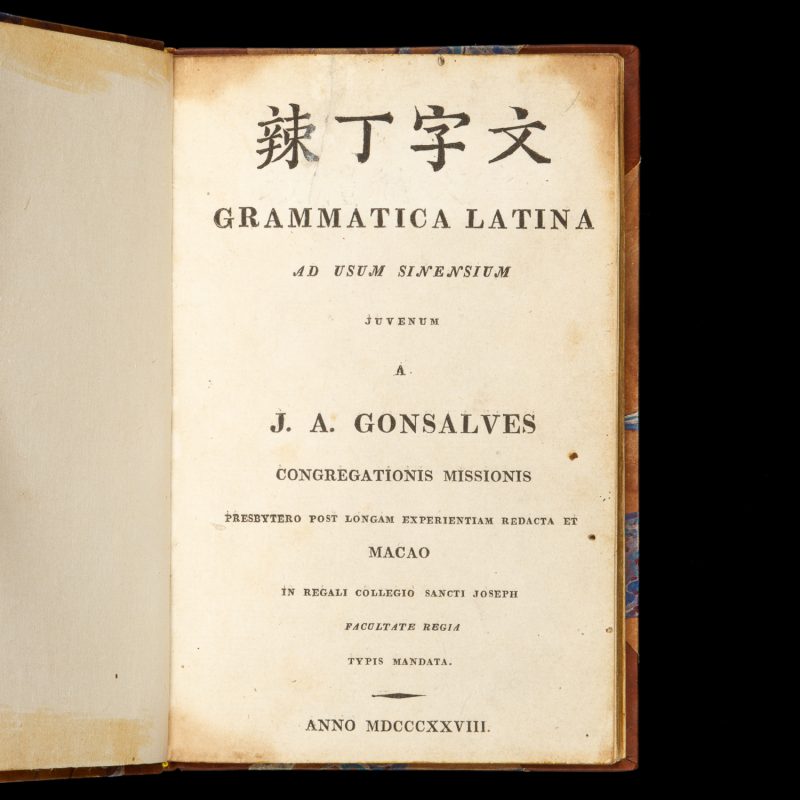
Grammatica Latina ad usum Sinensium Juvenum
$5,000.00 AUD
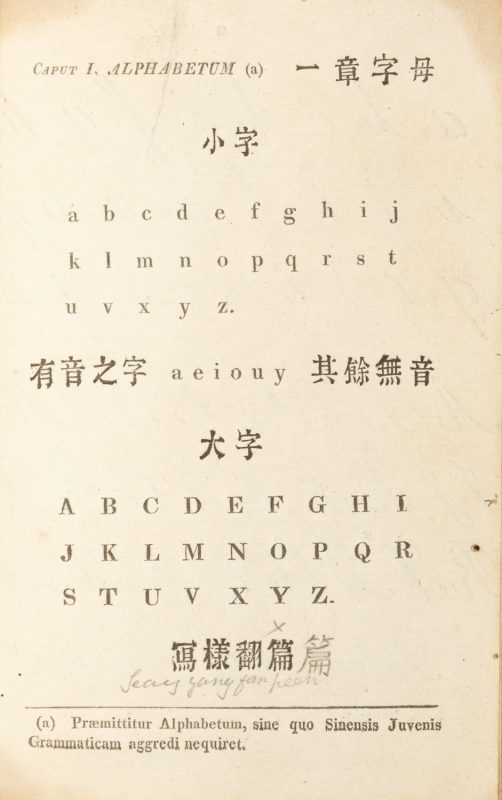
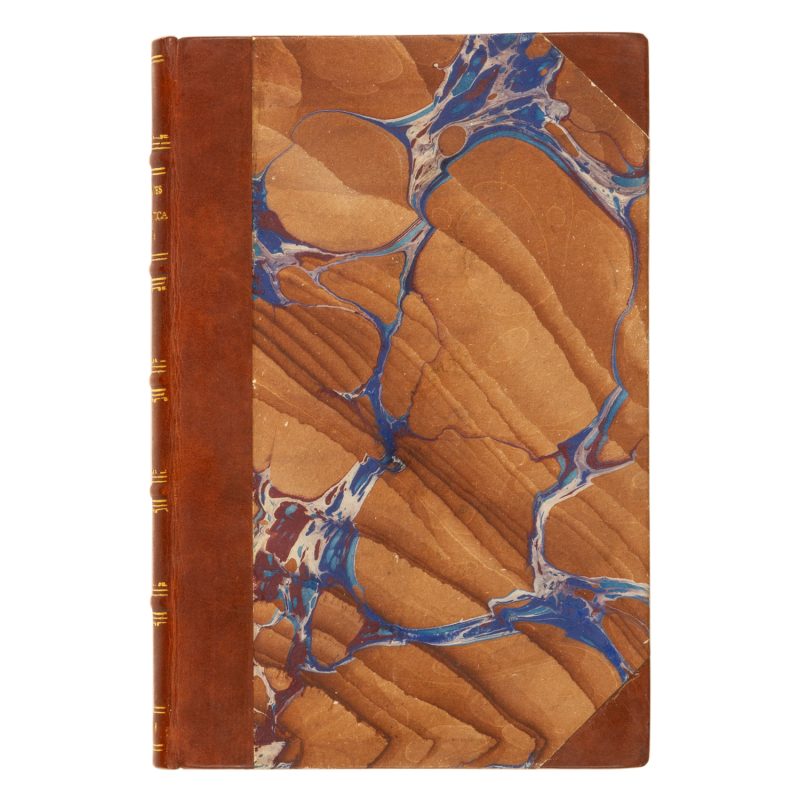
a J. A. Gonsalves Congregationis Missionis Presbytero post longam experientiam redacta et Macao in Regali Collegio Sancti Joseph Facultate Regia typist mandate. Macao : St. Joseph’s College, 1828. Small octavo, quarter calf over marbled papered boards, spine lettered in gilt, title leaf (short tear expertly sealed), pp. 232, errata leaf, terminal blank, printed on rice paper, neat pencil annotations in Chinese, a fine copy. Printed in Chinese and Latin.
A very rare linguistic work by noted Portuguese Sinologist Joachim Afonso Gonsalves, whose prodigious output is of the utmost scarcity in the market.
‘Father Joaquim Afonso Gonçalves was a central and pioneering figure in the teaching of Chinese to and from Westerners of different mother tongues from different families. Born in Tojais-Cerva, in the district of Vila-Real, in 1781, he studied at the Rilhafoles Seminary in Lisbon, and went to Macao in 1812, with Beijing and the Astronomical Observatory as his final destination, where he expected to be useful as an astronomer and mathematician, already recognized in Portugal. By the time of his arrival in Macao in 1813, however, Imperial China had closed its doors to foreigners, so he lived and worked in Macau as a Vincentian or Lazarist priest of the order of St. Vincent de Paul until his death in 1841. For almost three decades, he dedicated himself intensely to research and teach Chinese, among other subjects in which he was also an expert, at the Royal College of St. Joseph. There, Portuguese, Chinese, and European priests were trained, and Joaquim Gonçalves was the teacher of several future sinologists from Europe, such as J.M. Callery.
He left us numerous and voluminous bilingual works — either in Portuguese and Chinese or in Latin and Chinese, printed and manuscript, of didactic and metalinguistic scope, in a total of more than five thousand pages. Among them is the trio of grammar-manuals and dictionaries conceived and printed for the use of his Chinese-Portuguese students: the Art China, or art of Chinese grammar (of 1829), the Dicionário China-Português (of 1831) and the Dicionário Português-China (of 1833), true encyclopedic works that made his method of teaching and learning admittedly effective, fast and innovative, and that soon caught the attention of his contemporaries European sinologists and teachers of Chinese, such as Jean-Pierre Abel-Rémusat, Antoine-Pierre-Louis Bazin or the Hong-Kong neighbor Thomas Francis Wade.’
– University of Minho https://cehum.elach.uminho.pt/events/493/en


