


# 51261
HAIGH, Edward (attributed)
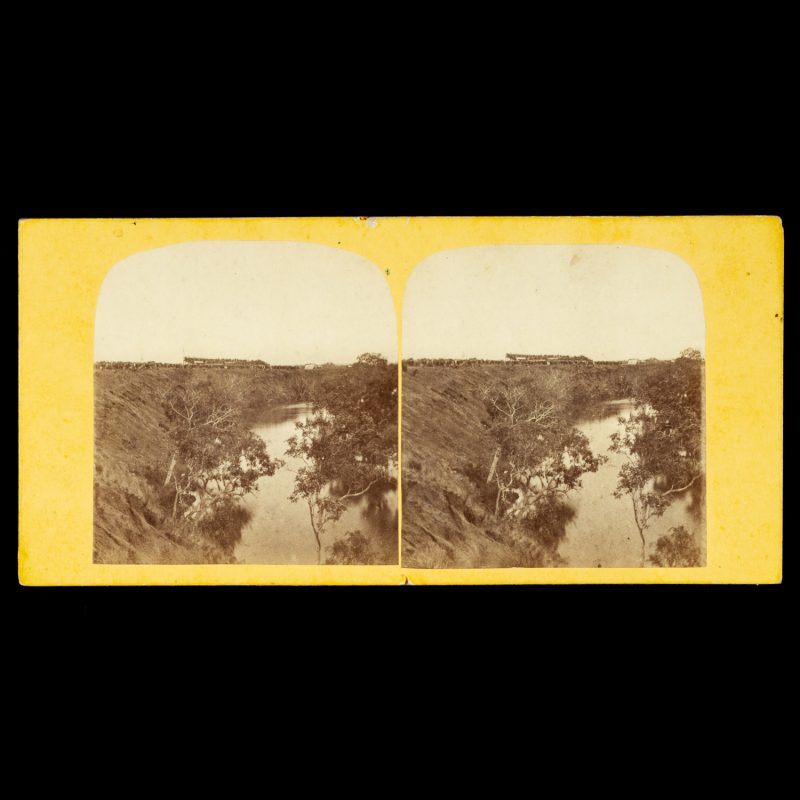
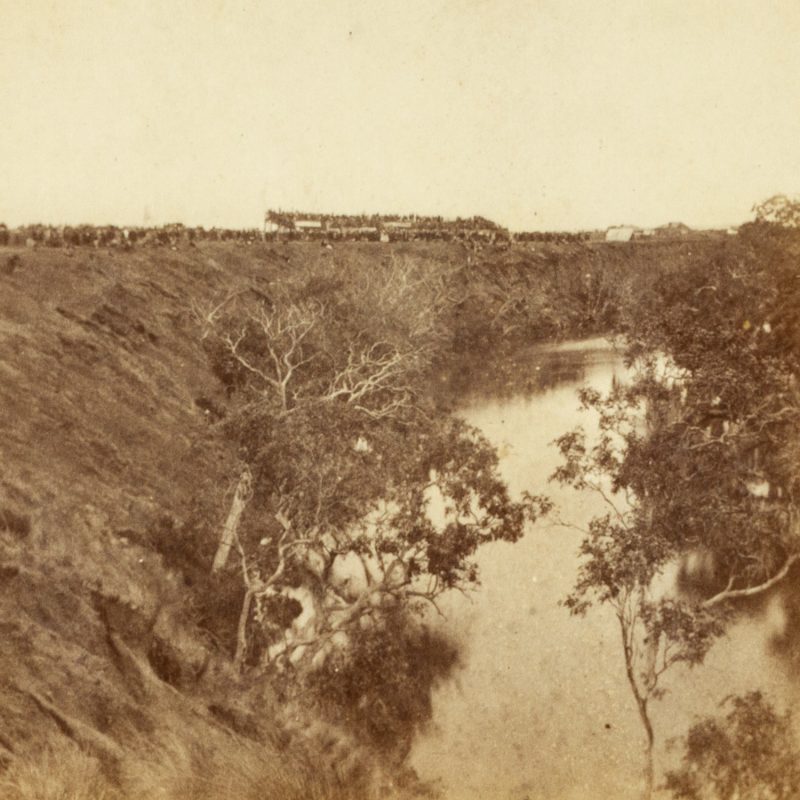
Grand Stand on the Werribee, Victoria.
$500.00 AUD
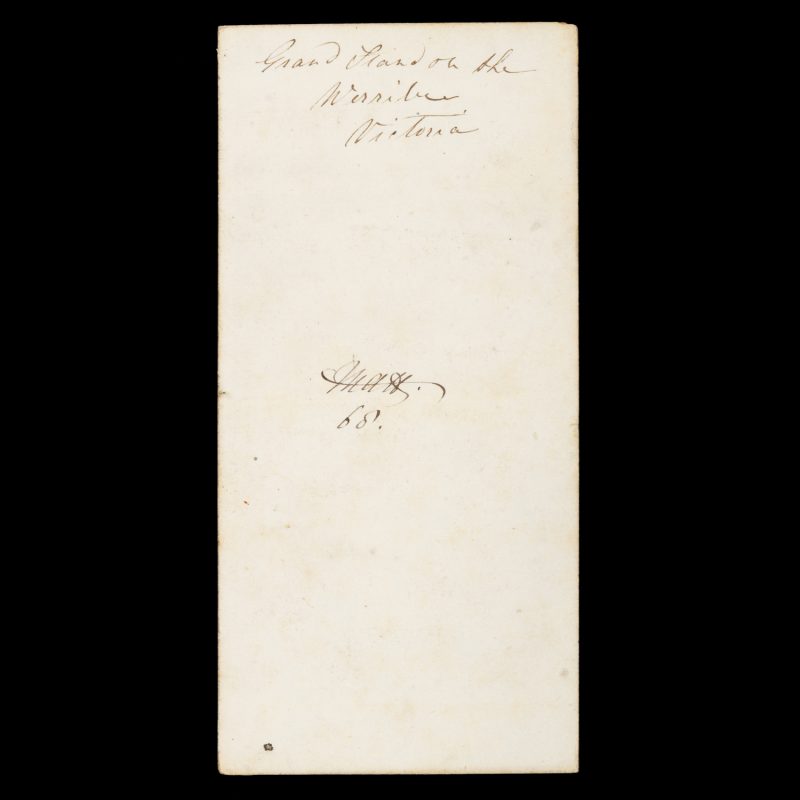
[April, 1862]. Stereoscopic albumen print photograph, each image approximately 73 x 73 mm, flat yellow mount 83 x 165 mm, verso with contemporary manuscript caption ‘Grand Stand on the Werribee, Victoria’, and below this in manuscript the monogram and sequence number of the original owner ‘MAH. 68’; both prints, as well as the mount, are in fine condition.
This rare stereoview looks along the Werribee River towards the Easter Encampment of the Victorian colonial volunteer forces which was held in April 1862. A large crowd of spectators in a temporary two-tiered grandstand can be seen on the horizon, with some tents and buildings on the right. The format is identical to other stereoviews with Haigh’s printed label from the same source (in the U.K.), which had the same original owner’s monogram and were clearly acquired at the same time by an English visitor to Victoria.
No other example traced.
The following is an extract from a lengthy article on the forthcoming Easter Encampment that appeared in the Mount Alexander Mail, 7 April 1862:
‘The troops will be encamped as nearly as possible on the same site as last year, on the east bank of the Werribee. A few hundred yards lower down the river is a large stone wool-shed belonging to Mr Chirnside. This it is intended to fortify with gabions and fascines, and to place field pieces in position around it. Lower down again, nearer the sea, the grand stand will he erected, and the public who are to witness the military operations will be confined within a large space marked out by flags. On the opposite or Geelong side of the river, the country is on a lower level, and is therefore commanded by the Melbourne bank. Nearly opposite the fortified wool-shed, which for the nonce is to be christened Fort Chirnside, are three huts, which are being entrenched under the superintendence of Captain Scratchley, and undermined. From them a sap will lead to a star-redoubt formed of earth. These works are to be called Fort Pitt. Operations will commence by the troops taking Fort Chirnside, after a desperate resistance, and the attacking party will occupy it by a strong detachment. The main body will then cross the river by a ford near the home station, and beyond the place reserved for the public, and commence a cannonade upon Fort Pitt, in which they will receive substantial aid from Fort Chirnside which will then be in their possession….’
The English photographer Edward Haigh, who had studied with the Crimean War photographer Roger Fenton, arrived in Melbourne in January 1861. He opened a studio in South Yarra and spent over a year in the colony. Haigh specialised in stereoscopic photography and his views of Victoria, England and France won a first-class award at the 1861 Melbourne Exhibition. He returned to London in 1862, where his stereoviews of Melbourne and Victoria won a medal at the London International Exhibition that year.

