


# 47846
SMITH, John (1767-1842)
[GREEK WAR OF INDEPENDENCE] John Smith, of the London Philhellenic Committee, writes to the Swiss benefactor Jean-Gabriel Eynard in Geneva, apologising for the lack of British financial support for the Greek nationalist cause. London, 29 December 1826.
$2,200.00 AUD
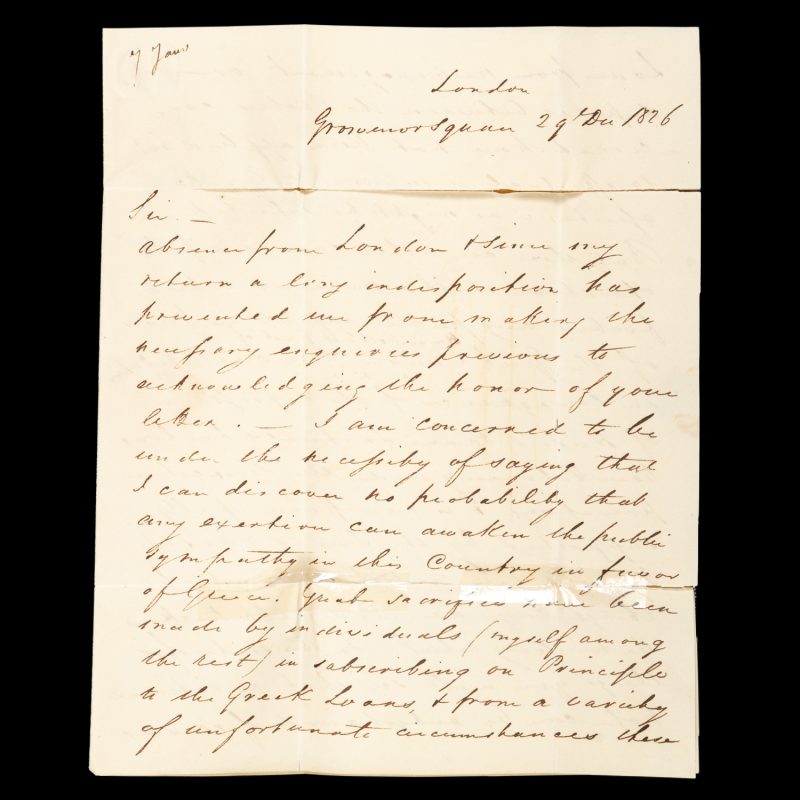
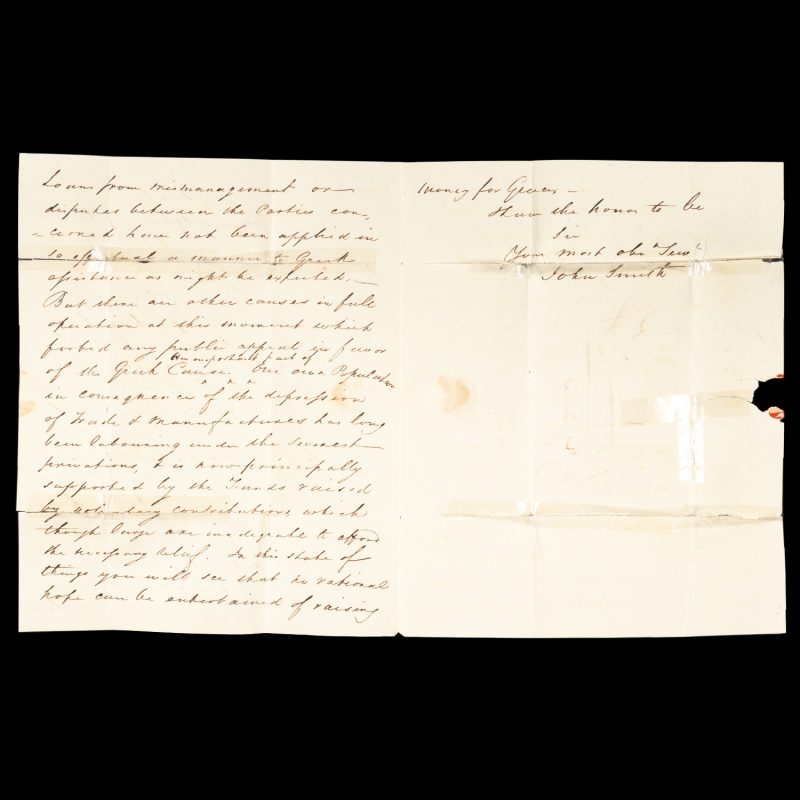
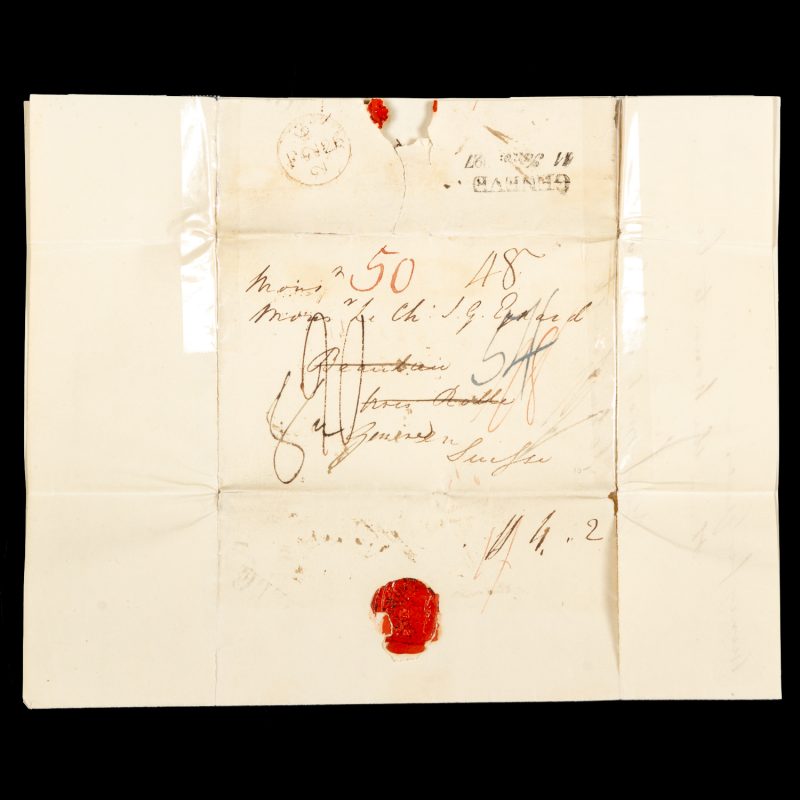
Entire letter, 2 1/4 pp. quarto (225 x 180 mm), manuscript in ink on laid paper; headed ‘London, Grosvenor Square, 29th Dec. 1826’, the letter is written in John Smith’s hand and is signed by him at the foot ‘Your most obd. servt, John Smith’; the outer panel is addressed ‘Mons. Le Ch[evalier] J. G. Eynard, Beaulieu, près Rolle [crossed out], Genève, Suisse’, and has an arrival stamp in black ‘GENEVE 11 Janv. ’27’; in the top corner of the first side of the letter is Eynard’s blind stamp used for marking correspondence received, along with a manuscript date of ‘7 Janv.’ (certainly in error!); remnants of original red wax seal; original folds – which have several non-archival repairs using clear tape, with (fortunately) no loss of text; otherwise, the letter is complete and free from foxing, and its content entirely legible.
A newly discovered foundation document for the establishment of Greece as a modern nation state.
John Smith (1767-1835), a cousin and ally of abolitionist William Wilberforce, was a British banker and politician who sat as an MP in the House of Commons from 1806 to 1835, representing Midhurst from 1818-1830. Smith also served as chairman of the London Philhellenic Committee (aka the London Greek Committee). Founded in March 1823, this was a circle of prominent citizens dedicated to the Greek cause during its War of Independence against the Ottoman Empire (1821-1832), which counted among its number such illustrious figures as the poet and freedom fighter Lord Byron (1788-1824), the philosopher Jeremy Bentham (1748-1832), high-ranking naval officer Edward Blaquiere (1779-1832), and political economist and diplomat John Bowring (1792-1872), as well as a number of Whig politicians such as Joseph Hume, Francis Burdett and John Cam Hobhouse. Broadly speaking, the Philhellenic Committee’s support for the Greek cause reflected the liberal outlook of its members, whose views on major issues including the abolition of slavery, relief for the poor, and prison reform tended to align.
The present letter – never before published – is addressed by Smith to the most prominent Philhellene in Europe at the time, the Swiss financial benefactor Jean-Gabriel Eynard (1775-1863), unquestionably the single most influential supporter of the Greek cause during this turbulent period of its history, and a figure whose name remains synonymous with Greece’s struggle for independence.
Full transcript of the letter:
‘Sir,
Absence from London & since my return a long indisposition has prevented me from making the necessary enquiries previous to acknowledging the honor of your letter. I am concerned to be under the necessity of saying that I can discover no probability that any exertion can awaken the public sympathy in this Country in favour of Greece. Great sacrifices have been made by individuals (myself among the rest) in subscribing on Principle to the Greek Loans, & from a variety of unfortunate circumstances these Loans, from mismanagement or disputes between the Parties concerned, have not been applied in so efficient a manner to Greek assistance as might be expected. But there are other causes in full operation at this moment which forbid any public appeal in favour of the Greek Cause. An important part of our own Population in consequence of the depression of Trade & Manufactures has long been labouring under the severest privations, & [the Greek cause] is now principally supported by the Funds raised by voluntary contributions, which though large are inadequate to afford the necessary relief. In this state of things you will see that no rational hope can be entertained of raising money for Greece.
I have the honour to be, Sir, Your most ob[edien]t Serv[an]t, John Smith’.
Reference: Korinna Schönhärl, European investment in Greece in the nineteenth century : a behavioural approach to financial history. New York : Routledge, 2021, pp. 31 ff.


