


# 48834
AMATI, Scipio
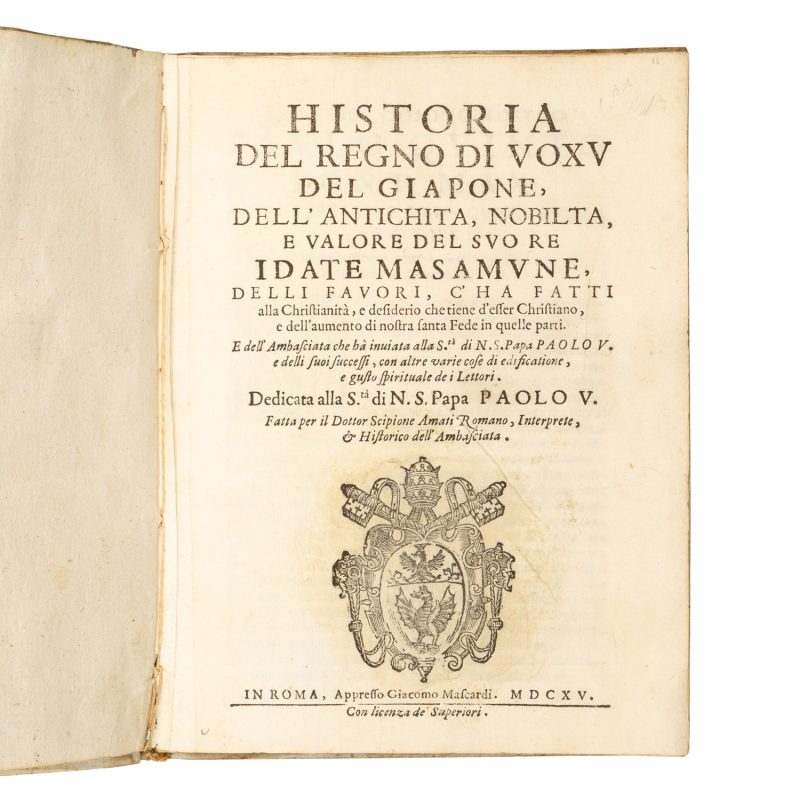
Historia del Regno di Voxu del Giapone,
$25,000.00 AUD
dell antichita, nobilita, e valore del suo re Idate Masamune, delli favori, c’ha fatti alla Christianita … Rome : Giacomo Mascardi, 1615. Small quarto, contemporary limp vellum (worn); original endpapers, title with woodcut coat of arms of Pope Paul V, pp. [16], 76, decorated initials and headpiece; text in Latin; occasional browning and light foxing, an excellent example, housed in a handsome clamshell box of quarter calf over cloth.
Very rare first edition of the interpreter Scipione Amati’s account of the second Japanese mission to Europe, the so-called Keichō Embassy, in 1614-15.
The last sale record in the Rare Book Hub database is for the Harmsworth copy (1948) – which we believe is the very copy offered here, bearing an old note in pencil to the front endpaper: ‘Of Mexican and other American interest’. The work may certainly be considered scarce and important enough to have warranted the production of a limited facsimile edition by the Otsuka Kogeisha Company in 1954.
The embassy representing Date Masamune (1567-1636), daimyō of Oshu in the Tōhoku region of Japan, was brought to Europe by the Spanish Franciscan missionary Luis Sotelo (1574-1624). Its titular head was Hasekura Rokuemon Tsunenaga (1571-1622), Date’s retainer, and it comprised a large retinue of Japanese merchants and attendants. Departing from Japan in October 1613, the mission sailed for Spain by way of Manila, Acapulco, and Mexico City, finally arriving in Seville in October 1614. The embassy was received by Philip III in Madrid, where it proposed a treaty of perpetual friendship with Spain and indicated a renewed desire to introduce Christianity to Japan, following a period which had seen the persecution of Kirishitan (Japanese Christians) and missionaries. A request was also made for the Spanish to send shipbuilders and navigators with a view to inaugurating an annual voyage between Seville and Sendai, the chief port of Oshu. The daimyō’s proposals were unenthusiastically received. The mission toured Italy in late 1614 and 1615, and was granted an audience with Pope Paul V. By this time, however, news had begun to reach Europe of the recent flare-up of hostilities towards the Kirishitan, as well as of Tokugawa Hidetada’s proclamation announcing his intention to expel all Catholic missionaries from Japan. Hasekura eventually arrived back in Japan in 1620, to a cold reception. Having delayed his return until 1622, Sotelo was imprisoned immediately upon his arrival by the Tokugawa Hidetada, and was martyred by being burned alive at the stake, along with four other missionaries, at Ōmura in 1624.
Cordier, BJ, 283


