


# 47768
NISBET, (James) Hume (1849-1923)
How we were saved. A New Guinea experience
$350.00 AUD
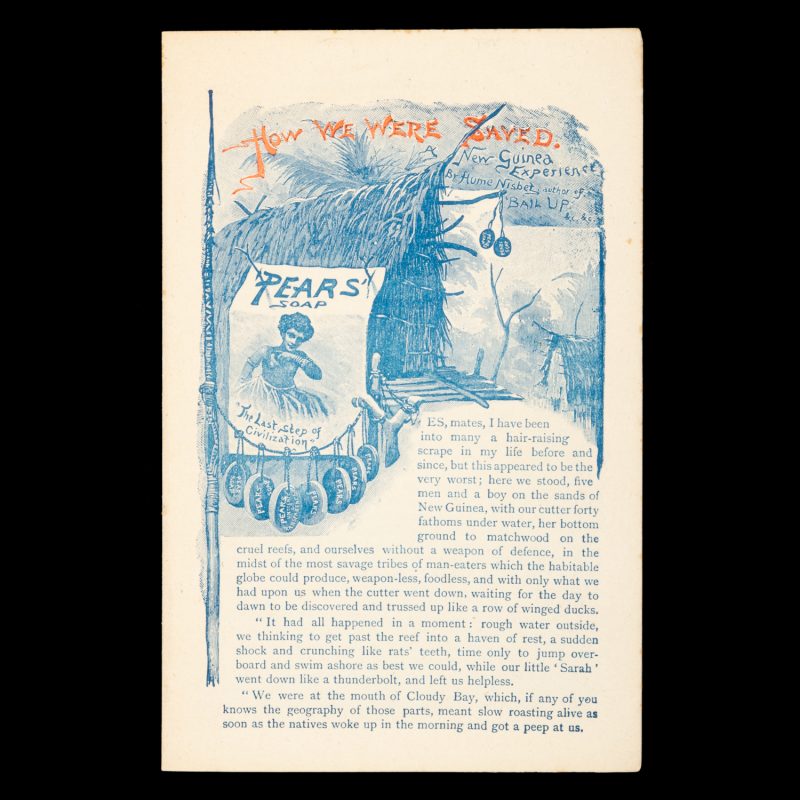
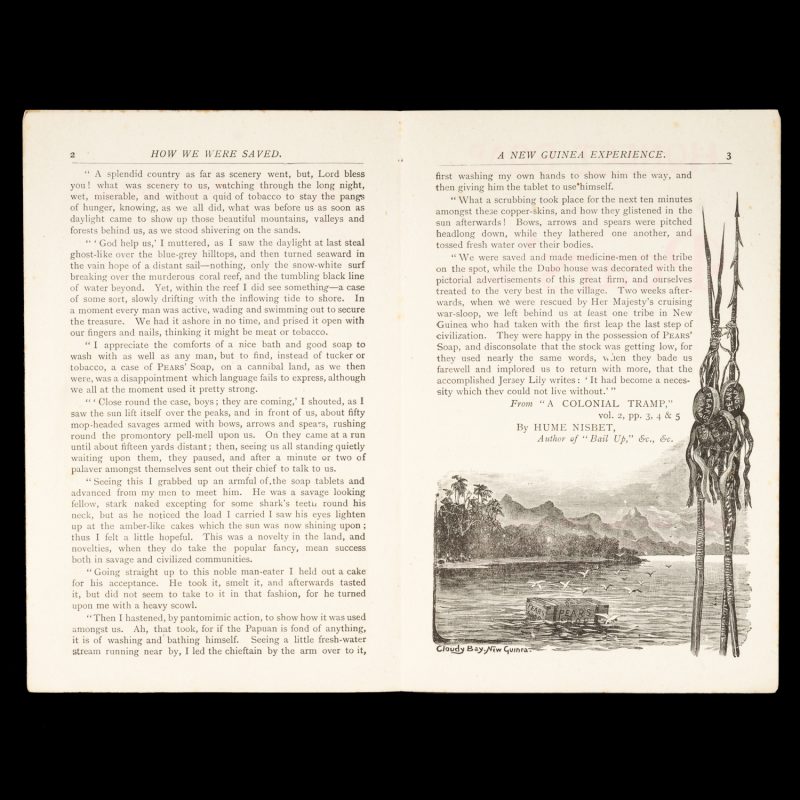
[London] : [A. & F. Pears Limited], [1892?]. Octavo, folded sheet, pp. [4], printed in black, blue and red, illustrations by the author, advertisement for Pears Soap on lower panel. A fine copy.
‘A four-page, single-sheet leaflet printed in red, blue and black. The unpaged back cover is a advertisement for Pears’ Soap, and the three pages of text are an extract from Hume Nisbet’s A Colonial Tramp: Travels and Adventures in Australia and New Guinea (London: Ward and Downey, 1891). It describes an encounter with one of “the most savage tribes of man-eaters the habitable globe could produce” after a coastal cutter is wrecked on a reef at the mouth of Cloudy Bay (in the Abau District, Central Province of Papua New Guinea, approximately 250 km south-east of Port Moresby). Tensions are eased and the men are saved when the locals are introduced to the benefits of Pears’ Soap.’ – Trove
Very scarce with a single example recorded in Australian collections (NLA).
Nisbet was a prolific author who published no fewer than 40 novels between 1888 and 1905. He was a great traveller, and closely associated with Australia: in the mid 1860s, as a young man, he made his first visit to the Antipodes, where he spent seven years in Melbourne, Tasmania, New Zealand, and the South Sea Islands, painting, sketching, writing poetry and stories, and making notes for future work. Much of his later fiction writing is based on his experiences during this period. Nisbet managed to pursue an artistic career as well as a literary one: in the mid 1870s in Edinburgh he worked as a scene-painter; in 1878-85 he taught freehand drawing at the Watt Institution and School of Arts; and he also exhibited oil and watercolour paintings at the Royal Scottish Academy. His large-scale oil painting The Flying Dutchman is one of his best known artworks. Nisbet would again visit Australia (and New Guinea) in 1886, and Australia for a third time in 1895.

