


# 48957
Gonçalves, Joaquim Affonso
Lexicon manuale Latino Sinicum
$12,500.00 AUD
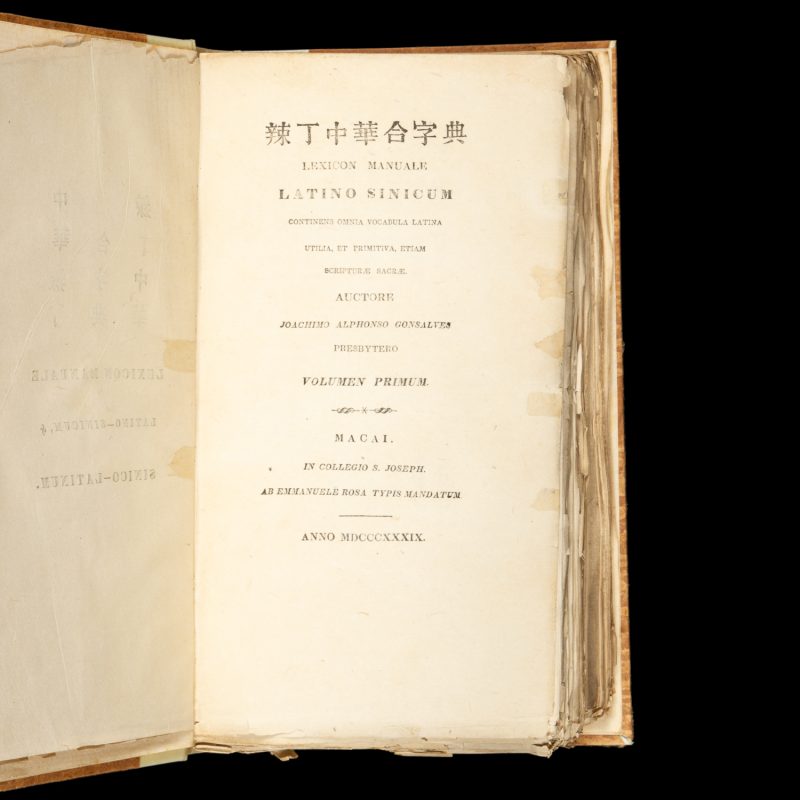
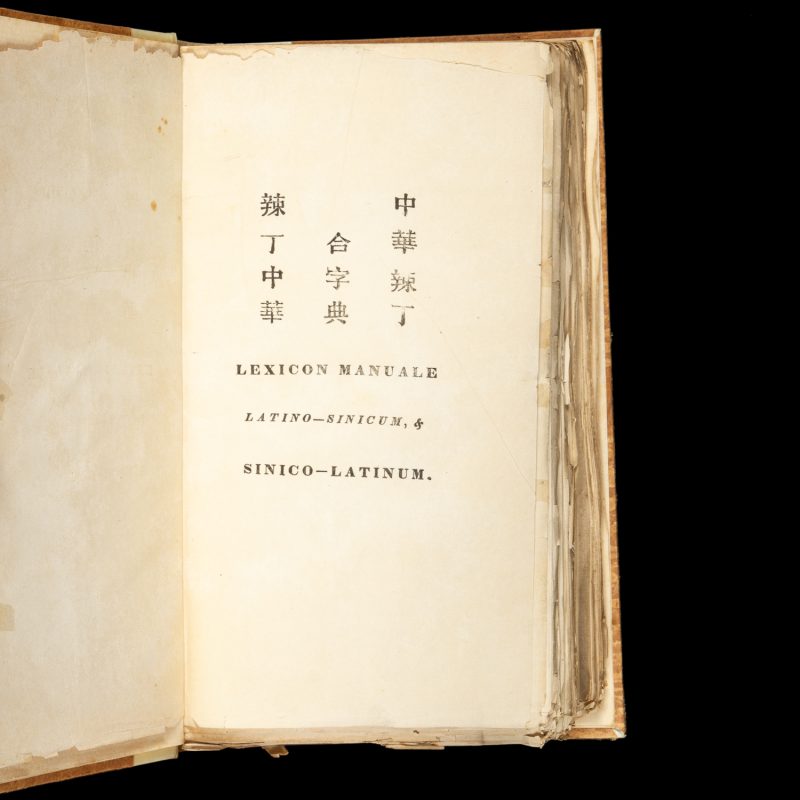
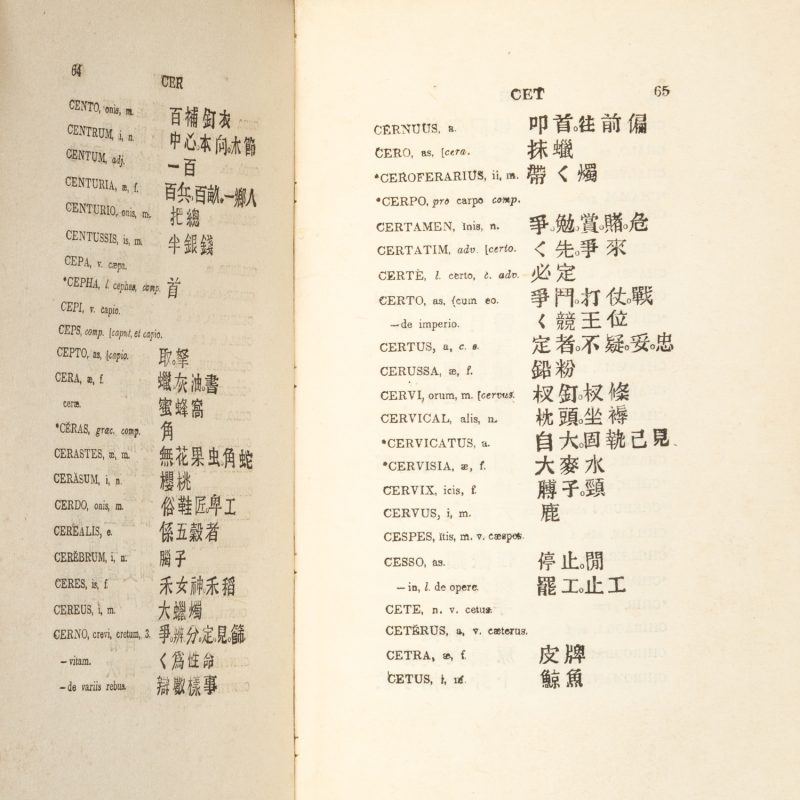
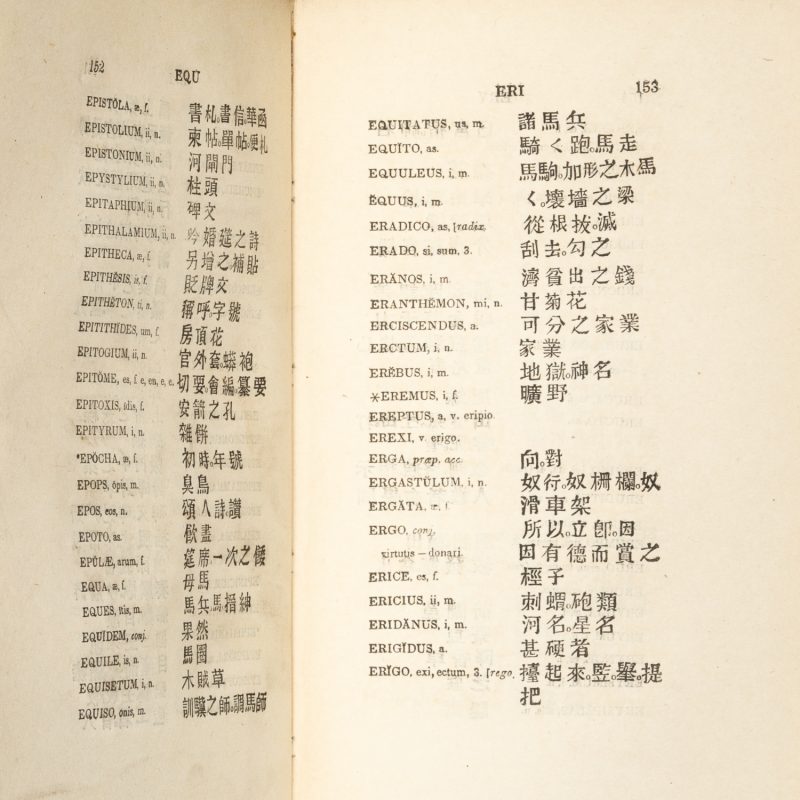
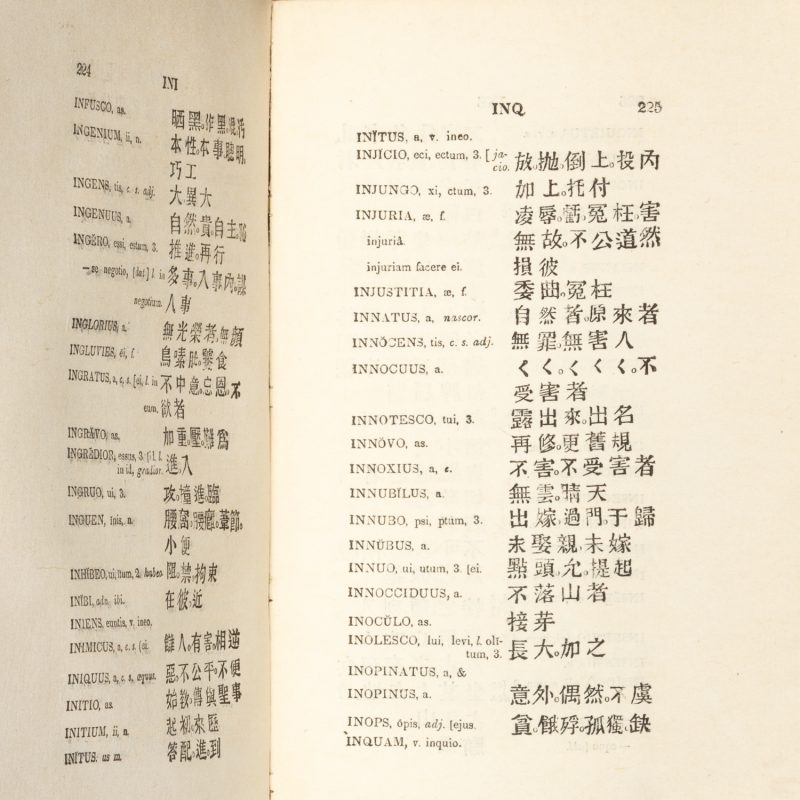
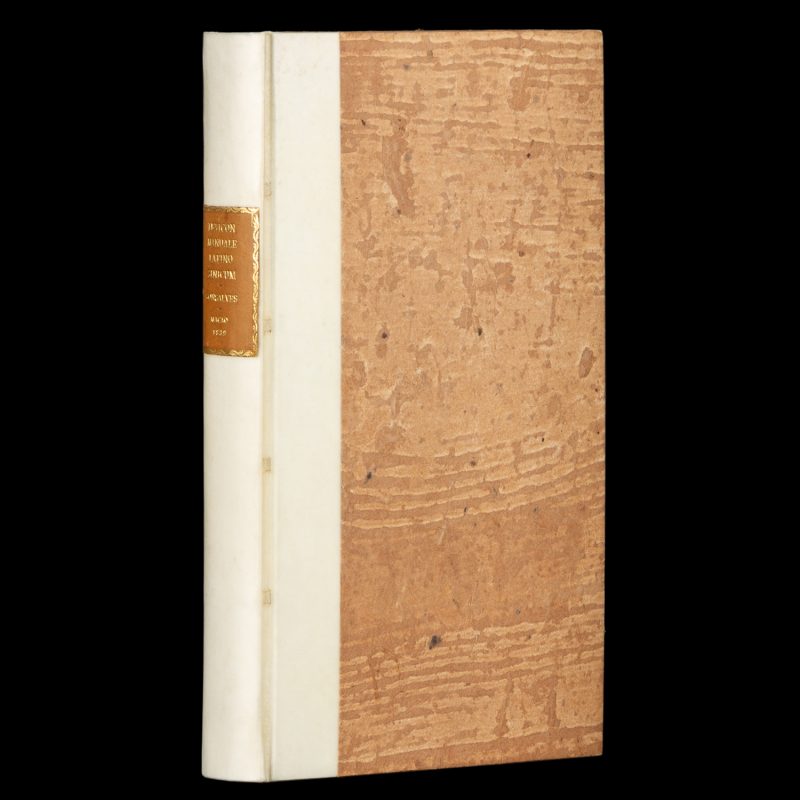
continens omnia vocabula Latina utilia, et primitiva, etiam Scripturae Sacrae. Auctore Joachim Alphonso Gonsalves, Presbytero. Volumen primum. Macai : In Collegio S. Joseph. Ab Emmanuele Rosa typis mandatum. Anno MDCCCXXXIX. [Macao : College of St. Joseph, 1839]. [All published]. Tall narrow octavo (275 x 160 mm), recent quarter vellum over papered boards, spine with contrasting leather title label lettered in gilt; [blank leaf], [half-title leaf in Chinese and Latin], pp. [i]-vii (including title in Latin and Chinese), 498, [blank leaf]; substantially uncut; fore-edges of preliminary leaves with some minor closed tears, otherwise in exceptionally fine condition throughout.
The exceedingly rare first edition of the Lexicon manuale Latino Sinicum, the shorter of the two Latin-Chinese dictionaries compiled by Father Joaquim Affonso Gonçalves, which was printed at Macao in 1839.
Although the title-page states ‘Volume one’, this was the only part of the work to be published. It was reprinted in Macao in 1863, and a second and third edition were published in Peking in 1878 and 1892.
Gonçalves also compiled a Chinese grammar, Arte China (1829); Portuguese-Chinese and a Chinese-Portuguese dictionary, Diccionario Portugez-China (Macao, 1831) and Diccionario China-Portugez (Macao, 1833); a Latin-Chinese vocabulary, Vocabularium Latino-Sinicum (Macao, 1836); and a more comprehensive Latin-Chinese dictionary, Lexicon Magnum Latino-Sinicum (Macao, 1841), his final work and also extremely rare.
Cordier, BS, 1595
The only copy located in the Rare Book Hub database was offered at Sotheby’s, London in 1958.
‘Father Joaquim Afonso Gonçalves was a central and pioneering figure in the teaching of Chinese to and from Westerners of different mother tongues from different families. Born in Tojais-Cerva, in the district of Vila-Real, in 1781, he studied at the Rilhafoles Seminary in Lisbon, and went to Macao in 1812, with Beijing and the Astronomical Observatory as his final destination, where he expected to be useful as an astronomer and mathematician, already recognized in Portugal. By the time of his arrival in Macao in 1813, however, Imperial China had closed its doors to foreigners, so he lived and worked in Macau as a Vincentian or Lazarist priest of the order of St. Vincent de Paul until his death in 1841. For almost three decades, he dedicated himself intensely to research and teach Chinese, among other subjects in which he was also an expert, at the Royal College of St. Joseph. There, Portuguese, Chinese, and European priests were trained, and Joaquim Gonçalves was the teacher of several future sinologists from Europe, such as J.M. Callery. He left us numerous and voluminous bilingual works — either in Portuguese and Chinese or in Latin and Chinese, printed and manuscript, of didactic and metalinguistic scope, in a total of more than five thousand pages. Among them is the trio of grammar-manuals and dictionaries conceived and printed for the use of his Chinese-Portuguese students: the Art China, or art of Chinese grammar (of 1829), the Dicionário China-Português (of 1831) and the Dicionário Português-China (of 1833), true encyclopedic works that made his method of teaching and learning admittedly effective, fast and innovative, and that soon caught the attention of his contemporaries European sinologists and teachers of Chinese, such as Jean-Pierre Abel-Rémusat, Antoine-Pierre-Louis Bazin or the Hong-Kong neighbor Thomas Francis Wade.
The numerous bilingual dialogues he created for the teaching of Chinese (and Portuguese), texts of great vivacity, dynamism, and cinematographic realism, of enormous didactic but also historical value, were immediately translated into French and republished in France by several authors, such as Hamelin or Kleczkowsi, for the teaching and learning of Chinese, and were also published in 19th century China itself.
Unlike the European sinologists of his time, the major Portuguese sinologist is practically unstudied, although his contribution to the description of Chinese, in contrast to Portuguese and Latin, is very extensive. In his didactic and metalinguistic works, he intentionally created and introduced examples to better introduce China and the Chinese to his students of Chinese, and Portugal and the Portuguese/Europeans to his students of Portuguese.
The College of St. Joseph, where he developed his intense activity as a priest, teacher, and researcher, was one of the first and most important centers for the teaching and learning of Chinese by Westerners and for Westerners and Chinese, having been Macau the first intercultural and interlinguistic bridge between Europe and China. Its colleges, where great European priests, missionaries and sinologists learned and taught, also deserve thorough research to put them in their rightful place in the History of European Sinology, as well as all the Portuguese sinologists whose names and works remain in the shadows, for lack of review and editing of their manuscripts, research, and study. At the College of St. Joseph, numerous sacred, didactic, and metalinguistic works were printed, not only in Chinese and Portuguese, but also in other Asian languages, such as Tetum.’ (Forum Joaquim Afonso Gonçalves, O Sinólogo. Center for Humanities of the University of Minho, Braga)


