


# 48892
Lieutenant Commander Charles Richard Cole Hamilton (1842-1911)
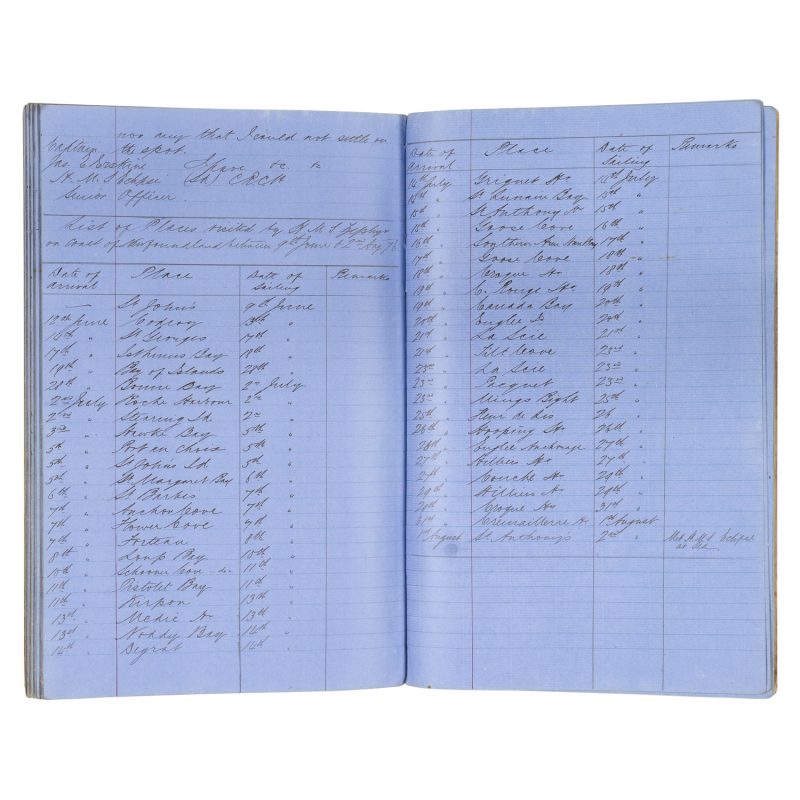
Logbook of HMS Zephyr, July 1873 – August 1876, recording visits to ports on the eastern Canadian seaboard (Halifax, Charlottetown, Picton and St John’s) as well as Bermuda and various ports in the West Indies.
$1,750.00 AUD
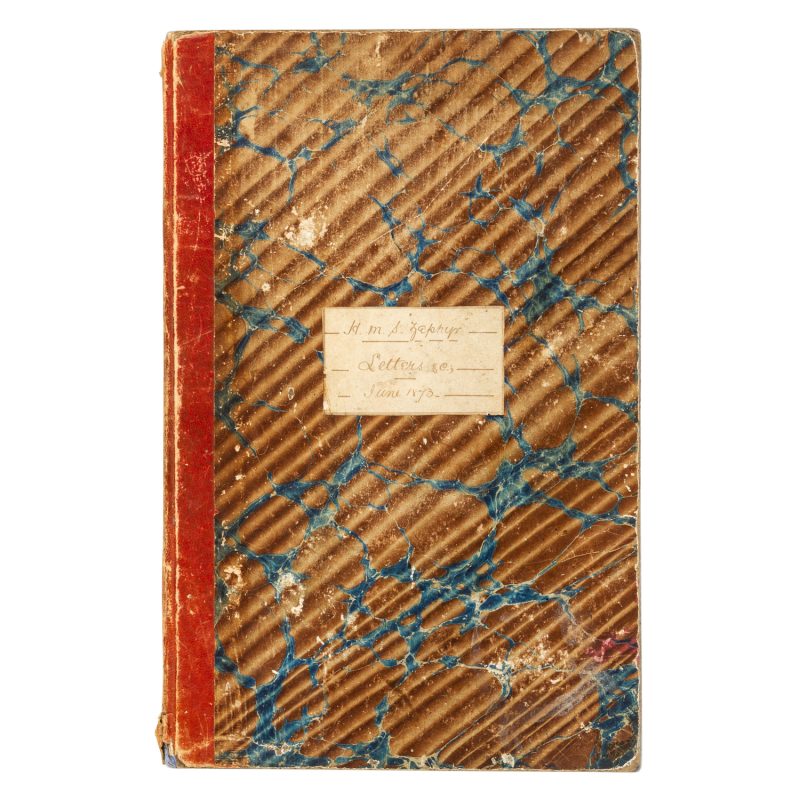
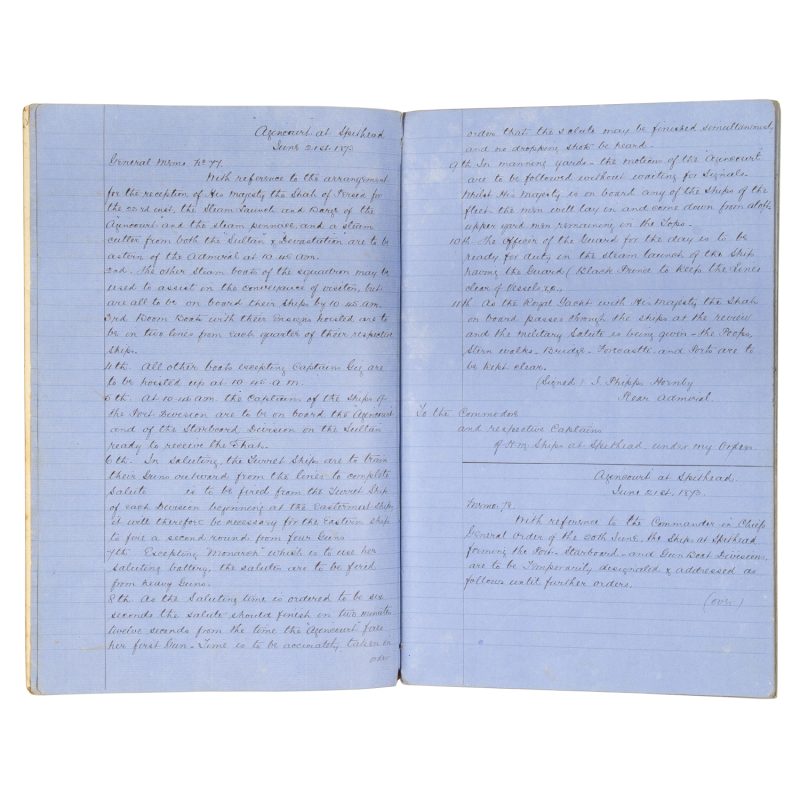
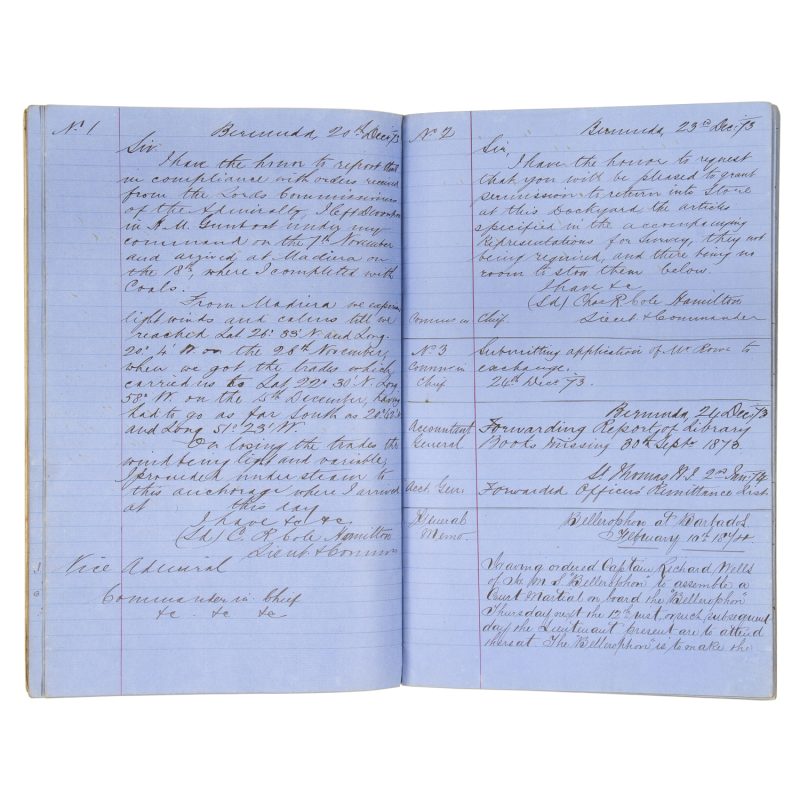
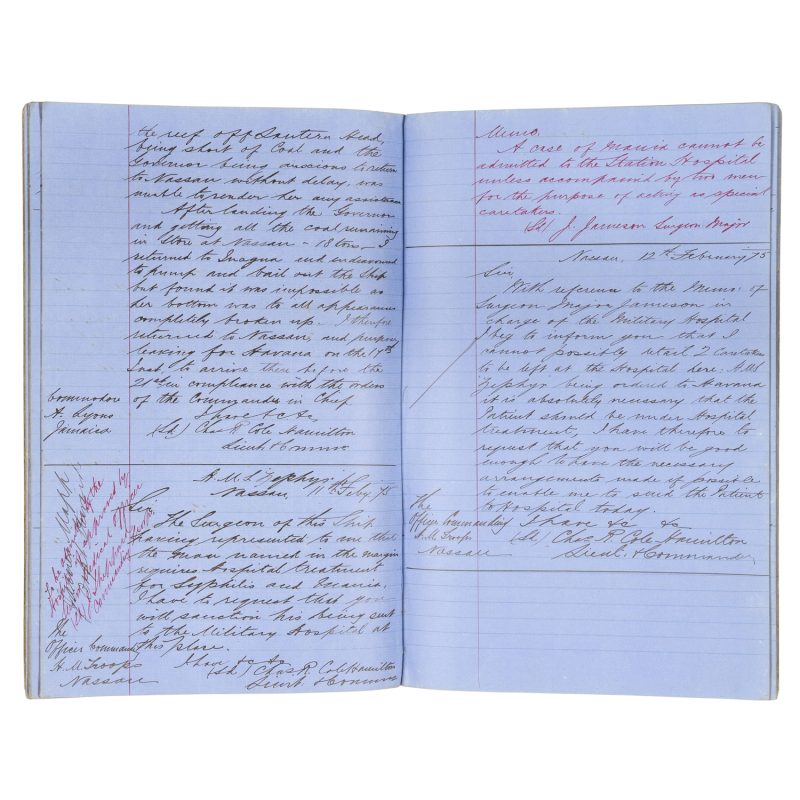
Foolscap folio (330 x 210 mm), original leather-backed marbled papered boards (somewhat rubbed and worn) with manuscript title label to each board, worded ‘HMS Zephyr, Letters &c. June 1873’ and ‘HMS Zephyr, Orders &c, June 1873’, respectively; [79] pp., manuscript in ink, with copies of letters (entered at the front) and orders (entered at the rear) relevant to Zephyr’s deployment from July 1873 to August 1876 along the Atlantic seaboard of North America and in the Caribbean, during which she visited Bermuda, Barbados, Halifax, Charlottetown, Picton, Nassau, Port au Prince, Port Royal, Santa Marta, Santa Domingo and St John’s, Newfoundland; the entries were recorded by Lieutenant Commander Charles Richard Cole Hamilton (1842-1911); clean and legible throughout; loosely enclosed are two separate original letters, one dated 30 March 1875 from an Admiralty hydrographer to HMS Zephyr commander C.R. Cole Hamilton requesting clarification for his use of a pilot, and a letter dated 3 August 1876 from a vice-admiral (signature illegible) to commander C.R. Cole Hamilton requesting clarification for HMS Zephyr’s loss of an anchor at Port Royal.
HMS ZEPHYR
HMS Zephyr was one of nine Ariel-class 4-gun composite screw gunboats built for the Royal Navy between 1871 and 1873. The first seven were built at Pembroke Dockyard in Wales; the last two – HMS Ariel and HMS Zephyr – were built at Chatham Dockyard in Kent, and were both launched on the same day, 11 February 1873. They were fitted out at Sheerness on the river Medway in Kent. Zephyr was sold in 1889 to become a salvage vessel in private ownership, and was eventually broken up in the 1920s.
Like the other Ariel-class vessels, Zephyr had a composite construction: she had an iron keel, stem and stern posts, and iron framing, but was planked with wood.
THE LOGBOOK
On completion of fitting out at Sheerness on 15 July 1873, and following a week at Devonport (Plymouth), HMS Zephyr proceeded on her maiden voyage via Bilbao and Portugalete in northern Spain to ‘show the flag’ at Britain’s colonies in Canada and the West Indies, which makes this account particularly historically interesting. On various occasions references are made to communications with or by the following senior Royal Navy vice-admirals: Sir William King Hall (1816-1886), Sir Phipps Hornby GCB (1785-1867), Sir Henry Keppel GCB (1809-1904), Sir George G.Wellesley GCB (1814-1901) and Sir George Fowler Hastings (1814-1876).
Provenance:
Collection of Charles Casamaijor Loftus Gaussen (1901-1985); thence by descent.
Charles Gaussen was a direct descendant of Peter Gaussen (1723-1788), Governor of the Bank of England from 1777 to 1779, and owner of Brookmans Park, a grand country house in Hertfordshire, which burnt down in 1891. Charles settled in Australia in the 1920s and acquired an extensive property in Victoria’s Western District. A collection of important paintings by Paul Sandby (1731-1809) which had been rescued from Brookmans Park were brought out to Australia by him and subsequently sold to the Hamilton Gallery, Victoria, in 1971, where they remain on permanent display.


