


# 49243
MARSHALL, Sir John, editor
Mohenjo-Daro and the Indus Civilization
$6,600.00 AUD
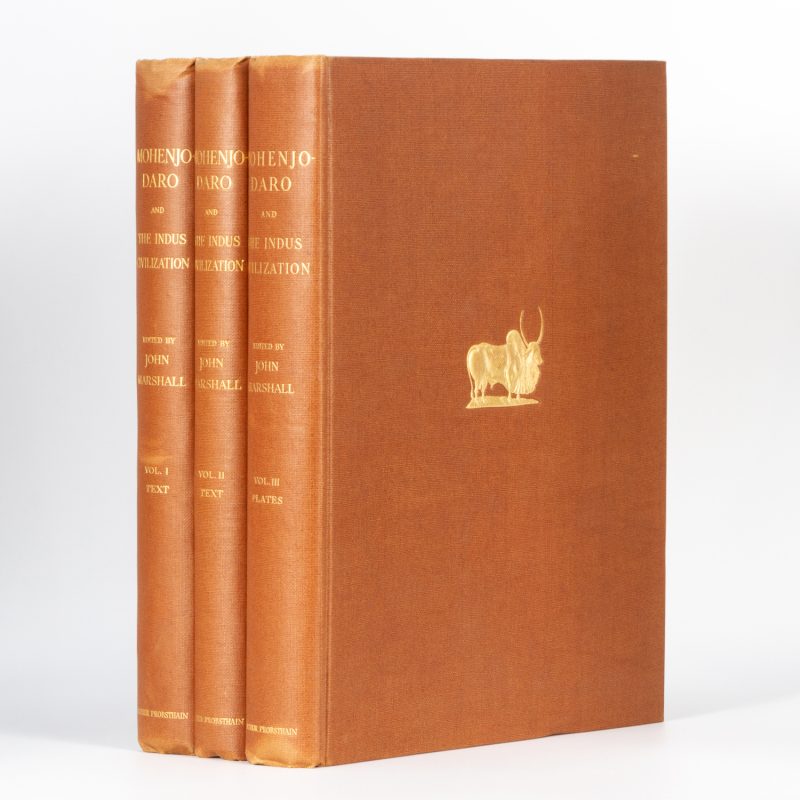
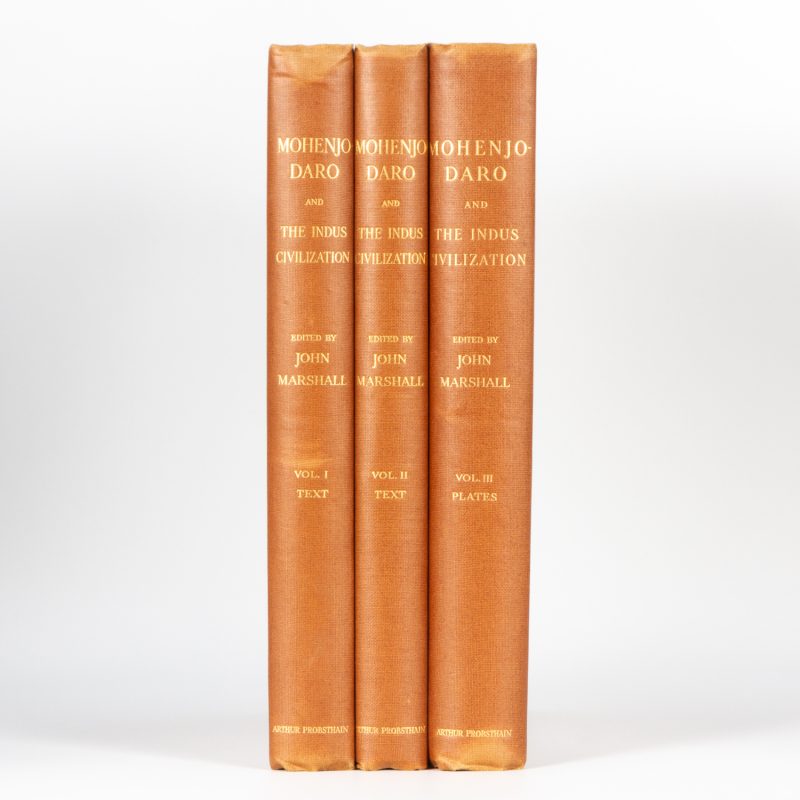
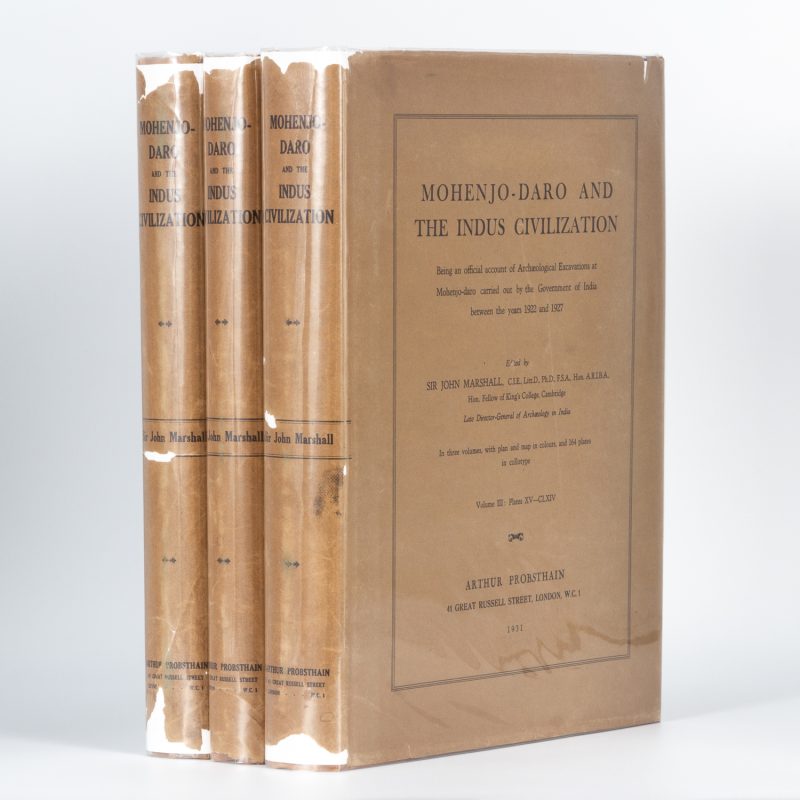
Being an official account of Archaeological Excavations at Mohenjo-daro carried out by the Government of India between the years 1922 and 1927. London : Arthur Probsthain, 1931. Three volumes, quarto, publisher’s gilt-lettered cloth with gilt designs to upper boards, in the rare original printed dustjackets (edges chipped and worn, a long tear with detached section to the third volume), vol I pp. xxvi; [blank]; 364; 14 plates, two folding maps in rear endpocket; vol. II pp. xiii; [blank]; 365 – 716; vol. III pp. xi; [blank]; 150 plates (some folding), a fine set housed in custom slipcases.
Mohenjo-Daro was one of the largest and most advanced settlements of the ancient Indus Valley Civilization (also known as the Harappan Civilization), which flourished in the 3rd millennium BCE. Located in the Larkana District of Sindh, Pakistan, the city is renowned for its remarkably sophisticated urban planning and civil engineering.
‘The ruins of the city remained undocumented for around 3,700 years until R. D. Banerji, an officer of the Archaeological Survey of India, visited the site in 1919–20 identifying what he thought to be a Buddhist stupa (150–500 CE) known to be there and finding a flint scraper which convinced him of the site’s antiquity. This led to large-scale excavations of Mohenjo-daro led by K. N. Dikshit in 1924–25, and John Marshall in 1925–26. In the 1930s major excavations were conducted at the site under the leadership of Marshall, D. K. Dikshitar and Ernest Mackay. Further excavations were carried out in 1945 by Mortimer Wheeler and his trainee, Ahmad Hasan Dani and F. A. Khan. The last major series of excavations were conducted in 1964 and 1965 by George F. Dales. After 1965, excavations were banned due to weathering damage to the exposed structures, and the only projects allowed at the site since have been salvage excavations, surface surveys, and conservation projects. In the 1980s, German and Italian survey groups led by Michael Jansen and Maurizio Tosi used less invasive archeological techniques, such as architectural documentation, surface surveys, and localized probing, to gather further information about Mohenjo-daro.[5] A dry core drilling conducted in 2015 by Pakistan’s National Fund for Mohenjo-daro revealed that the site is larger than the unearthed area.’ – Wikipedia.
The official record of the rediscovery of the Indus Valley civilisation and the unearthing of the ruins of one of the great cities of the ancient world.

