


# 51458
[PRACTICAL SHEEP-FARMING ASSOCIATION] [MACKENZIE, William Henry]
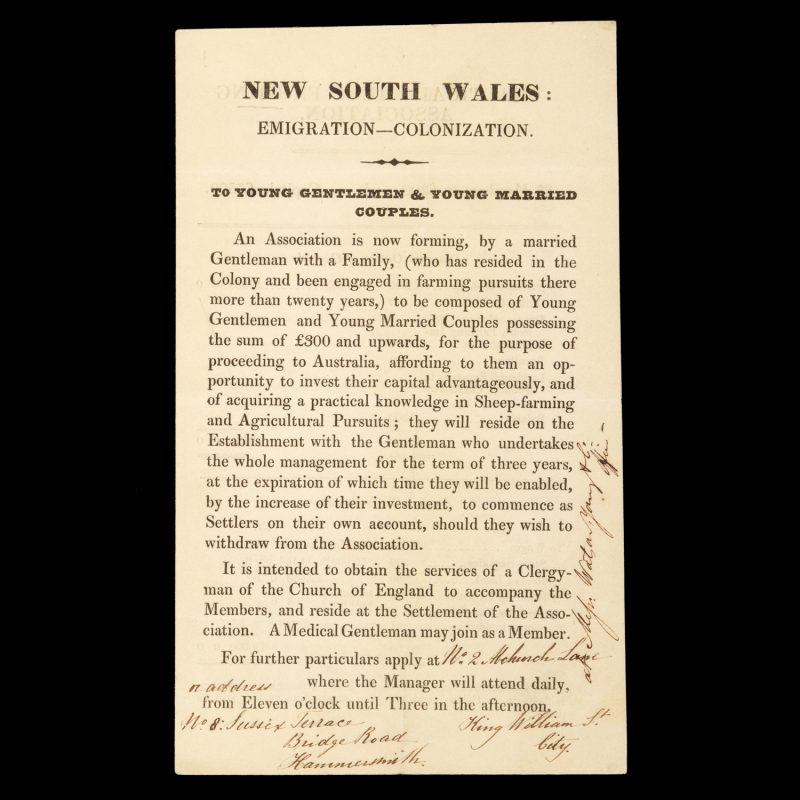
New South Wales : Emigration – Colonization. To young gentlemen & young married couples.
$3,000.00 AUD
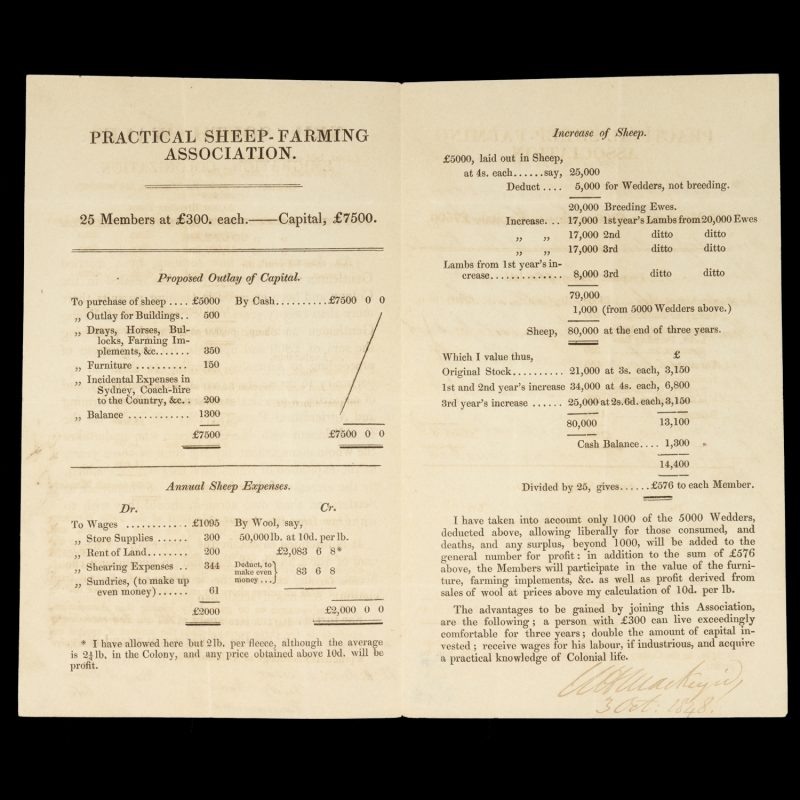
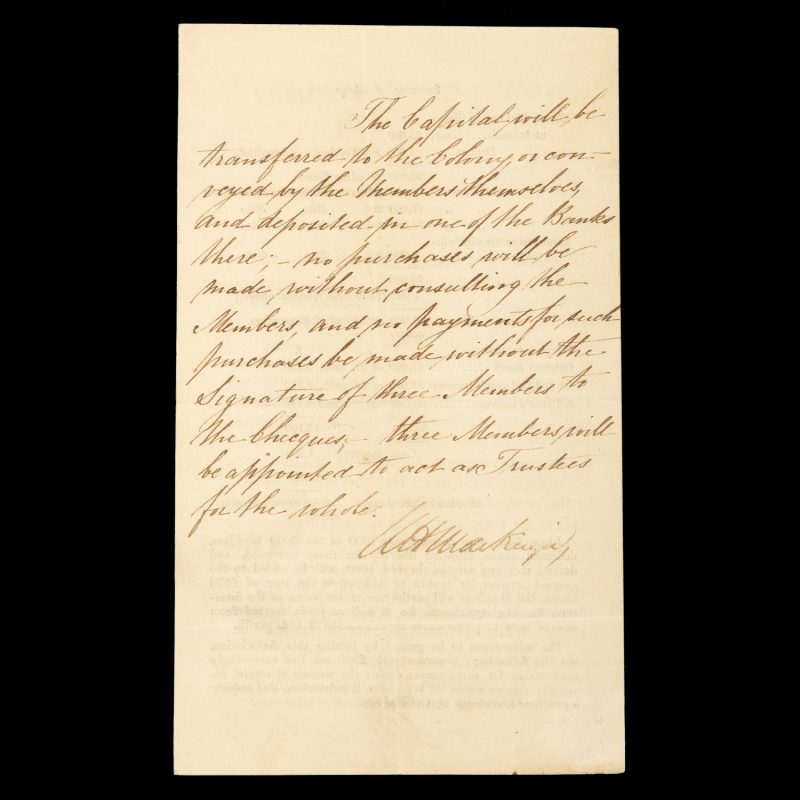
[Drophead title]. [London : W. H. Mackenzie, 1848]. Small octavo bifolium (180 x 107 mm), letterpress on the first three sides only; first side with two addresses for the Practical Sheep-Farming Association supplied in manuscript, given as ‘No. 8 Sussex Terrace, Bridge Road, Hammersmith’, and ‘No. 2 Alchurch Lane, King William St., City, at Messrs. Watson, Young & Co.’s Office’; third side signed and dated in the author/publisher’s hand ‘W. H. Mackenzie, 3 Oct. 1848’ at the foot of the printed text; the otherwise blank fourth side with a lengthy manuscript note, also signed by Mackenzie; faint vertical and horizontal folds, but very fine.
William Henry Mackenzie’s own proof copy of a prospectus produced for his private co-operative scheme for agricultural emigration to New South Wales, calling itself the Practical Sheep-Farming Association. Mackenzie had formerly held the senior positions of secretary and cashier in the Bank of Australia, Sydney.
No other copy traced.
The prospectus text opens: ‘An Association is now forming, by a married Gentleman with a Family, (who has resided in the Colony and been engaged in farming pursuits there more than twenty years,) to be composed of Young Gentlemen and Young Married Couples possessing the sum of £300 and upwards, for the purpose of proceeding to Australia, affording to them an opportunity to invest their capital advantageously, and of acquiring a practical knowledge in Sheep-farming and Agricultural Pursuits; they will reside on the Establishment with the Gentleman who undertakes the whole management for the term of three years, at the expiration of which time they will be enabled, by the increase of their investment, to commence as Settlers on their own account, should they wish to withdraw from the Association … It is intended to obtain the services of a Clergyman of the Church of England to accompany the Members, and reside at the settlement of the Association. A Medical Gentleman may join as a Member….’
On the second and third sides are provided a proposed breakdown of how the total capital of £7500 (25 members at £300 each) is to be spent – on the purchase of sheep, equipment, furniture, incidental expenses while in Sydney, wages, supplies, shearing expenses, etc. – together with a calculation of the projected increase in the value of the total stock of sheep after three years, with each member’s initial £300 investment expected to have grown to £576 by the end of that time. Following the economic depression of the early to mid 1840s, wool prices had begun to rebound by 1848, and prime livestock (both sheep and cattle) still cost only a few shillings per head, which means that Mackenzie’s investment forecast was probably not unrealistic or overly optimistic. A clear profit of around £275, which was equivalent to 10 to 15 years’ wages for the average farmhand, would have been enough to acquire substantial tracts of pastoral leasehold or multiple small colonial properties.
We have not been able to trace another surviving example of the prospectus – or indeed, of any other printed literature pertaining to this obscure venture from the immediate pre-gold rush era, aside from several Australian newspaper articles from March-Aril 1849, which appeared in The Courier (Hobart), the South Australian Register (Adelaide), and The Moreton Bay Courier (Brisbane). The Hobart notice is helpful in confirming the attribution of the prospectus to Mackenzie: it reproduces the text of the prospectus verbatim, but it adds the London contact address of 22 [sic] Alchurch Lane, King William Street, City, and also identifies W. H. Mackenzie as the author, while an editor’s footnote explains that Mackenzie was ‘formerly of the Bank of Australia, in Sydney’, and that the text in this notice had previously been run ‘in a London newspaper of September’. The Brisbane article, which also informs readers of Mackenzie’s employment at the Bank of Australia, mentions that the prospectus has recently been published in London.
What makes this unique example of the prospectus especially noteworthy is the fact that it is a proof copy printed for William Henry Mackenzie himself. It is extensively annotated by Mackenzie: on the first side, he has supplied two addresses for the Association where the printer has left a blank space; on the third side, the text is signed by him at the foot and dated 3 October 1848; and on the otherwise blank fourth side, he has added an important note on how the capital is to be transferred to New South Wales, placed in ‘one of the Banks there’, and how the funds are to be strictly controlled: they are not to be used without prior consultation of the Association’s members, and then only with the signatures of three members who are to be appointed as trustees. This lengthy note is also signed by Mackenzie.
