


# 51559
LINDSAY, Norman (1879-1969)
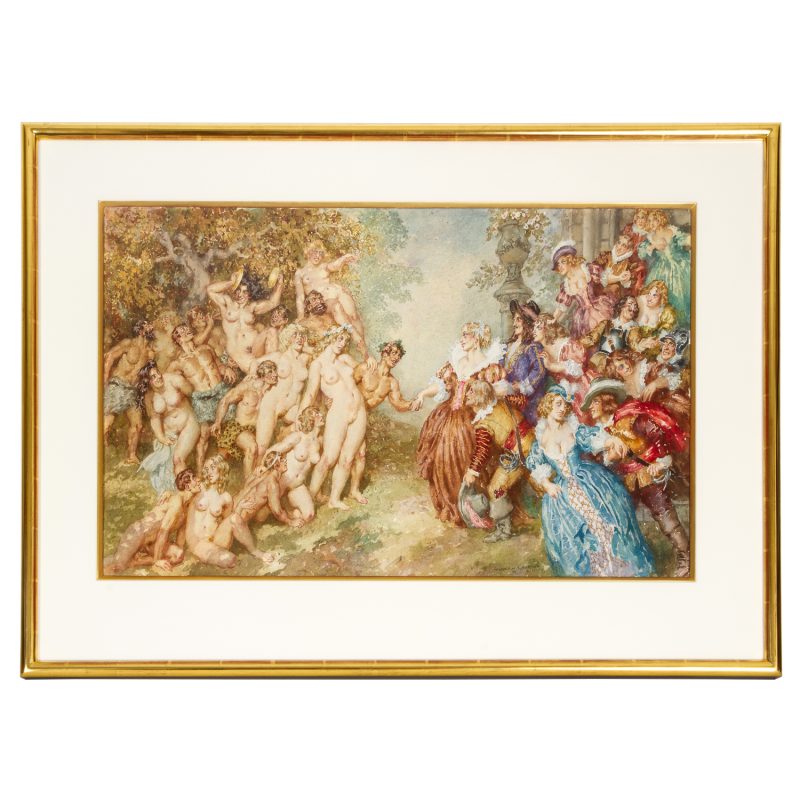
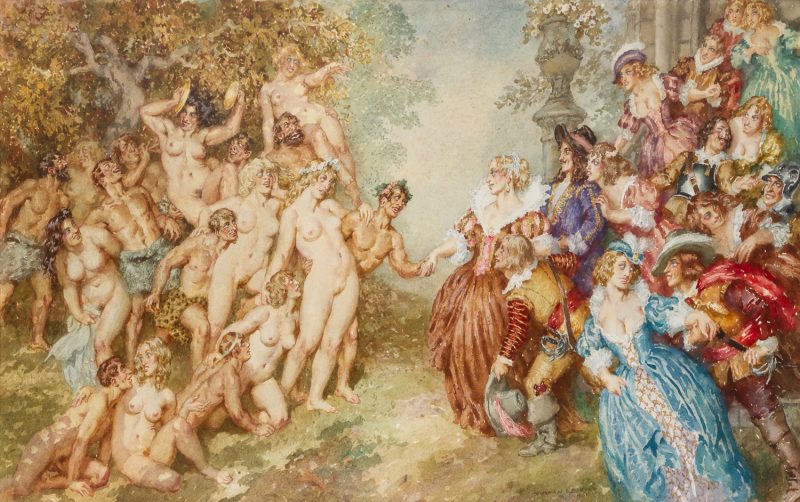
Renaissance 1961
$110,000.00 AUD
Watercolour on paper, 56.0 x 89.0 cm; 85.0 x 115.0 cm (framed), signed and dated lower right: Norman Lindsay / 1961.
One of the most ambitious watercolours ever created by Norman Lindsay, painted in epic large format. A highly complex figurative composition, in which the octogenarian painter displays a lifetime of experience in capturing the interplay of encounters and the vitality of flesh.
The following essay, written by the artist’s granddaughter, the art historian Helen Glad, is used with permission:
‘Renaissance is a fine example of Norman Lindsay’s command of watercolour. Even in his later years, Lindsay was undaunted by painting a multi-figured composition in a large format.
In a letter to his friend John Tremaine dated April 1961, Lindsay wrote:
‘I have had a sustained burst of work these last three or four months in which I have turned out a very difficult series of watercolours – difficult because involving subtleties of light and colour value. Several are large – the full size of a sheet of Whatman’s paper with masses of figures.'(1)
Whatman began papermaking in the eighteenth century at Turkey Mill in Kent, developing wove paper during the 1750s in England. Laid paper has visible vertical lines secured at several crossing wires which left an impression on the paper, whereas wove paper has a smooth, even surface as brass wires are woven closely together. A sizing agent, usually gelatine, makes the paper water resistant, suitable for watercolour.
Handmade paper was largely discontinued during the 1950s. Whatman, however, continued to produce mould-made paper until the mid-1960s. Lindsay was stimulated enough by the arrival of Full Imperial size (22” x 30”) paper to start large watercolours.
Watercolour is a difficult medium to master. The colour must be luminous, without hard edges between the different colours. A mistake cannot be removed, as it can in oil painting. Luminosity depends on coloured pigment suspended in water. Suspension illuminates the subject. From the 1920s, when Lindsay began a serious exploration of watercolour, he developed his individual technique, ensuring his watercolours were supreme examples of the medium.
A pencil drawing is transferred to the paper, using pencil blackened tissue and a needle, avoiding drawing extensively on the paper. A chart is made of where the colour is to be placed in the composition. Next an order of colours is made; a necessary step as a wash could dry in minutes. The first wash was usually an overall one in a light key. Then sections of the composition were inserted. Washes were never allowed to dry out. Colour was dropped onto a damp surface. Lindsay wrote, ‘the one perfectly legitimate excuse for murder is to be intruded upon in this excessive act of concentration. How many watercolours have I had ruined by an untimely visitor while a wash was flowing!’(2)
From the fourteenth to the sixteenth century, the Italian Renaissance revived classical Greek and Roman learning. Religious dogma was challenged by a new philosophy of individualism and humanism. In Renaissance, Lindsay depicts a City Dionysia. Citizens are seen enjoying a splendid riotous procession honouring Dionysus, the Greek god of wine, theatre, and fertility. On the right-hand side, a group is encouraged to join in the fun. In seventeenth-century England the reign of the restored Charles II, following the restrictions imposed by Oliver Cromwell, encouraged a much bawdier approach to life. Here even a Roundhead soldier appears to have joined the Cavaliers in the revelry. Perhaps this is Lindsay’s allusion to another Renaissance?
The composition of Renaissance can be compared to an earlier watercolour, Our Gods Return painted in 1924, a horizontal composition of the same scale. The two groups are the reverse of Renaissance. Instead of earthly citizens, Lindsay has the Gods of Olympus beckoning the willing mortals. Painted at the time of Lindsay’s serious exploration of watercolour, Our Gods Return shows how quickly Lindsay became entranced with this unforgiving medium. Rose Lindsay took the painting to America in 1941. It survived a fire in which many works were destroyed. Seven centimetres had to be cut from the top and bottom.
Even late in life, Lindsay was prompted to tackle a complex subject in a medium he had mastered. Renaissance exemplifies Lindsay’s control of a medium which could often be elusive and unpredictable, with all the vitality and freshness of his finest watercolours.
FOOTNOTES
1. Letter from Norman Lindsay to John Tremaine, April 1961, quoted in Bloomfield, L., Norman Lindsay: Watercolours 1897-1969, Odana Editions, New South Wales, 2003
2. Norman Lindsay, quoted in Blunden, G. & Lindsay, N., Norman Lindsay Water colour Book, The Springwood Press, Sydney, 1939
Helen Glad
Helen Glad is an art historian and granddaughter of Norman Lindsay. She is the author and co-author of several publications on Lindsay’s work, including Norman Lindsay Pen Drawings 1890-1965 (1987) and The Legendary Lindsays (1995).
Provenance:
Private collection
Christie’s, Melbourne, 1 March 1973, lot 258
Private collection, Melbourne
Estate of the above
Menzies, Important Australian & International Art, 07 May 2026, lot 50


