


# 50338
THORNE (WATKINS), Rosalie Ann (1850-1927)
Rosalie Ann Thorne (later Watkins), of Rose Bay and Parramatta : a substantial archive of unique manuscript ephemera, 1850s-1890s, including family correspondence and material relating to the homeschooling of the Thorne and Watkins children.
$6,500.00 AUD
Provenance: Rosalie Ann Thorne (1850-1927); Elizabeth Cecilia McNally, aka “The Duchess of Spring Hill” (1909-1996), legendary Brisbane antiques dealer and collector; private collection, Queensland.
As the archive is so large, we have arranged it into four main sections catalogued under alphabetical headings, A – D (see below).
ROSALIE ANN THORNE AND HER FAMILY
Rosalie (“Rose”) Ann Thorne (1850-1927) was the third daughter and fifth of ten children of prominent Sydney businessman George Thorne (1810-1891) and his wife Elizabeth Ann Bisdee (1821-1910). Her parents had married in Hobart in 1842 before moving from Tasmania to New South Wales in the mid-1840s. The Thorne family home was Claremont, a grand double-storey residence on the Wentworth estate in Rose Bay, built in 1851-52. In 1882, when Claremont was purchased by the Sisters of the Society of the Sacred Heart, it was to become the first building used by the newly established Kincoppal School.
Like her mother, Rose was a talented amateur artist. She is believed to have received lessons from Conrad Martens through her friendship with the artist’s daughter, Rebecca Martens. A number of her surviving watercolours and sketches are held in public collections (for example, her Sketches of the Flying Squadron, Claremont and Roseneath, 1869-1881, in the SLNSW). At Clontarf on 12 March 1868, Rose witnessed the assassination attempt on Prince Alfred, the Duke of Edinburgh, and saw her father wounded in the foot by a bullet fired from the gun of would-be assassin Patrick O’Farrell. (Her sister Emily’s manuscript notebook containing an illustrated eyewitness account of the infamous incident is also held in the SLNSW). On 26 August 1871, Rose married naturalist Francis Thomas Watkins and settled with her husband in Parramatta. One of the couple’s six children was Dorothy Margaret Watkins (1892-1913), who became a botanical illustrator of note prior to her tragically early death.
Rosalie Ann Thorne’s siblings were: Annie Bisdee Thorne (1843-1920); Gertrude Mary Thorne (1845-1910); George Thorne (1846-1907); Theodore Bisdee Thorne (1848-1879); Emily Nuttall Thorne (1851-1903); Melina Julia (“Millie”) Thorne (1852-1887); Ellen Elizabeth (“Eleanor””) Thorne (1855-1938); Walter Allan Thorne (1860-1939); and Arthur Edward Thorne (1862-1954). Her paternal uncles and aunts were: Charles Nuttall Thorne (1809-1864); Emily Nuttall Thorne (1823-1878); and Sophia Gertrude Thorne (1826-1914).
A. THE EDUCATION OF ROSALIE ANN THORNE AND HER SIBLINGS
In the 1850s and ’60s, Rose and her sisters, like most young ladies of the Australian colonial elite of the time, were educated at home by private tutors. This section of the archive comprises the following original manuscript material that offers fascinating insights into the curriculum that Annie, Rose, Emily, Millie and Ellen Thorne (as well as their very young brother Walter) were made to follow, and how the young children’s days were strictly structured.
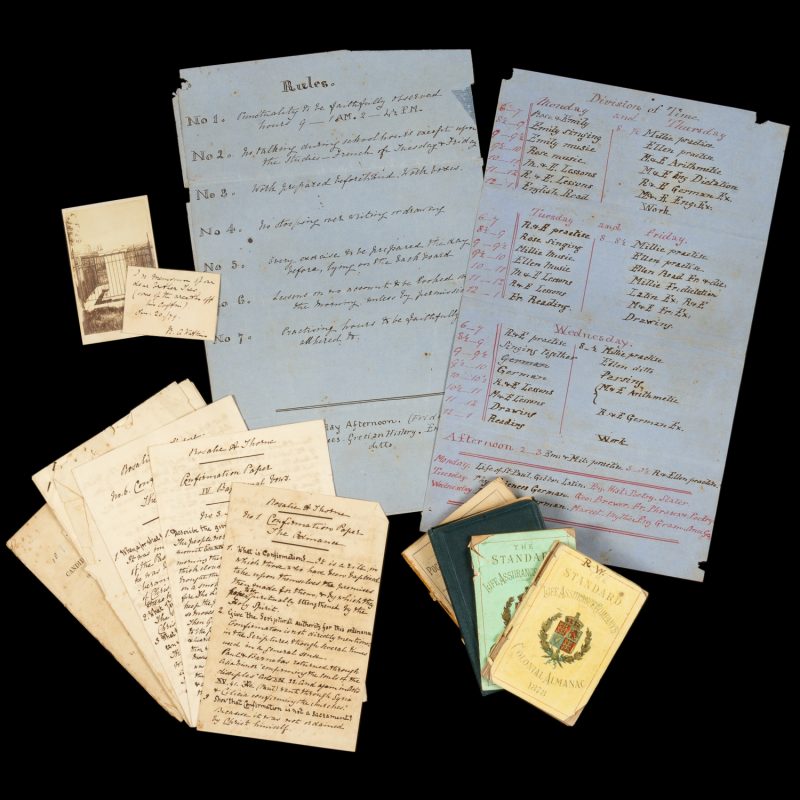
I. ‘Division of Time’ and ‘Rules’. [c.1866?]. 2 pp., foolscap folio, manuscript in black ink. A timetable outlining how the sisters’ hours of individual and group study were to be arranged between 9 am and 1 pm, and from 2 to 4.30 pm, every weekday, with one or half-hour time slots for lessons or practice in Christian evidences, Classical Greek history, reading, German, French, singing, music, geography, cartography, watercolours and drawing, and needlework (“mending”). The second page lists seven rules of behaviour which the girls must abide by, which include ‘No talking during school hours except upon the studies [and only in] French on Tuesday and Friday’; ‘No stooping over [while] writing or drawing’; ‘Every exercise to be prepared the day before…’; and ‘Practising hours to be faithfully adhered to’. Old tape repair, some short tears at edges of original folds, otherwise good condition.
II. ‘Division of Time’. [c.1868?]. 1 p., foolscap folio, manuscript in red and black ink. A timetable outlining how the sisters’ hours of individual and group study were to be arranged between 6 am and 1 pm, and from 2 to 3.30 pm, every weekday, with one or half-hour time slots for lessons or practice in singing, music, arithmetic, reading and grammar, English history, German, French, Latin, and drawing. Very good condition.
III. Ephemera associated with Rosalie Ann Thorne’s Confirmation at St. Mark’s, Darling Point, in 1869. Comprising three ‘Confirmational Papers’, in total 7 pp. (octavo) in manuscript containing Rosalie’s responses to theological questions, plus 6 pp. (octavo) of printed matter issued by St, Mark’s Church in conjunction with the Confirmation service, and two Church of England leaflets on preparation for Confirmation (one inscribed to Rosalie from her older sister Gertrude).
B. THE EDUCATION OF MRS ROSALIE ANN WATKINS’ CHILDREN
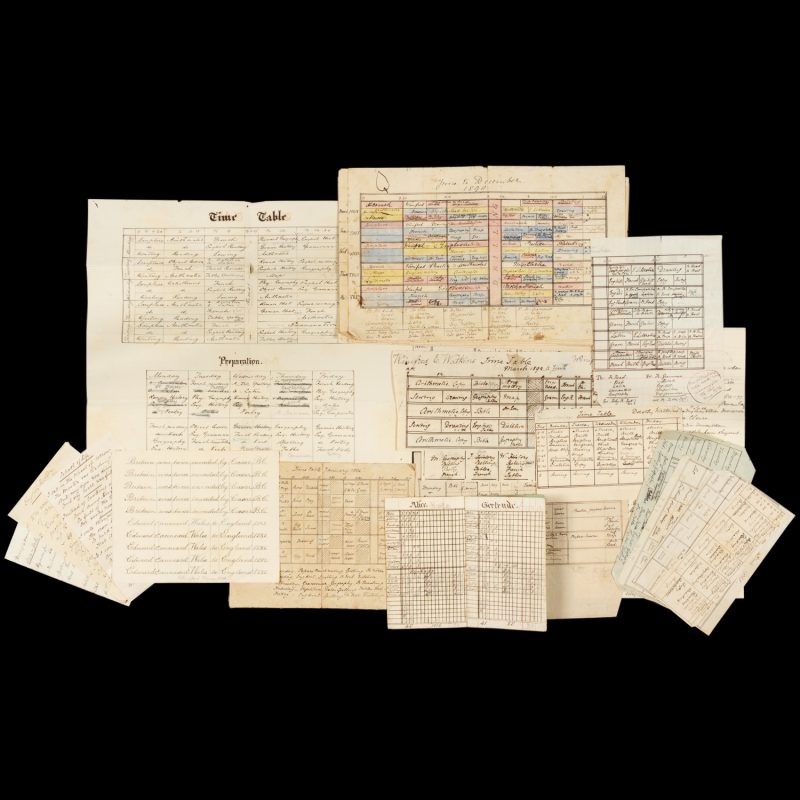
Rose married naturalist Francis (“Frank”) Thomas Watkins in 1871, and settled in Parramatta at Penrose, Marsden Street, where her six daughters grew up. Alice, Gertrude, Rose, Annie, Dorothy, and Winifred Watkins were all – like their mother – home-schooled, taught mainly by private tutors but apparently also with significant input from Rose herself. This section of the archive is quite extensive: covering the period from around 1880 up to 1897, it is a coherent corpus of manuscript material including timetables, exercises, performance reports, notes on curriculum, etc., which allows us to trace the childhood education of all six of the Watkins girls, from the oldest to the youngest. In total, approximately [30] sheets (various sizes up to 30 x 40 cm) plus a small report book.
C. CORRESPONDENCE
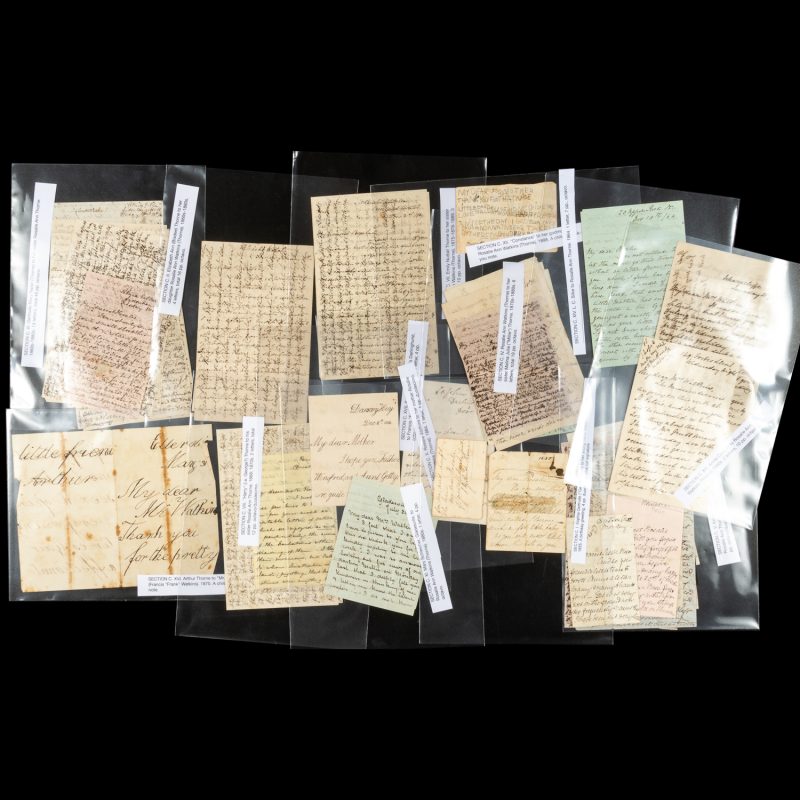
A collection of manuscript letters and notes, (most) addressed to Rosalie Ann Thorne from family members and friends, 1850s to 1890s. The content of the correspondence concerns for the most part news of intimate and extended family members – their recent experiences, movements, activities and accomplishments. There are a number of letters of a very personal nature, such as those commiserating Rose and Frank on the loss of a child (presumably through miscarriage). Other letters contain discussions of or references to the Scriptures, which reveal Rose’s deep religious faith; she was friends with both Mary Schleicher, first deaconess in the Anglican Diocese of Sydney, and Annie Pain, wife of the rector of St. John’s Darlinghurst.
I. Sophia Gertrude (“Getty”) Thorne to her young niece Rosalie Ann Thorne. 1855. A birthday greeting, 4 pp. duodecimo; plus cut signature.
II. Elizabeth Ann (Bisdee) Thorne to her daughter Rosalie Ann Watkins (Thorne). 1860s-1880s. 4 letters, total 16 pp. octavo.
III. Rosalie Ann Watkins (Thorne) to her mother Elizabeth Ann (Bisdee) Thorne. 1870s. 1 letter, 1 p., octavo.
IV. Rosalie Ann Watkins (Thorne) to her sister Melina Julia (“Millie”) Thorne. 1870s-1880s. 6 letters, total 19 pp. octavo.
V. Annie Bisdee Thorne to her sister Rosalie Ann Thorne. 1860s-1890s. 8 letters, total 32 pp. octavo/duodecimo.
VI. Gertrude Mary Naish (Thorne) to her sister Rosalie Ann Thorne. 1860s-1880s. 14 letters, total 45 pp. octavo.
VII. Emily Nuttall Thorne to her sister Rosalie Ann Watkins (Thorne). 1875-1876-1889. 3 letters, total 10 pp. octavo.
VIII. “Harry” (i.e. George?) Thorne to his sister Rosalie Ann Thorne. 1868; 1870s. 2 letters, total 12 pp. octavo/duodecimo.
IX. Gertrude Mary Lethbridge Watkins to her mother Rosalie Ann Watkins (Thorne). 1884. 1 letter, 2 pp. octavo.
X. Rosalie Watkins to her mother Rosalie Ann Watkins (Thorne). 1884. 1 letter, 4 pp. duodecimo.
XI. Mary Schleicher, Gladesville, to Rosalie Ann Watkins (Thorne). 1880s. 1 letter, 4 pp. octavo.
XII. “Constance” to her godmother Rosalie Ann Watkins (Thorne). 1898. A child’s thank-you note.
XIII. Annie Cowper to Rosalie Ann Watkins (Thorne).1880s. 2 letters, 10 pp. octavo.
XIV. L. C. Silke to Rosalie Ann Thorne. 1864. 1 letter, 7 pp., octavo.
XV. Honoria King (granddaughter of Philip Parker King) to Rosalie Ann Watkins (Thorne). 1870s-80s. 2 letters, total 6 pp. octavo.
XVI. Arthur Thorne to “Mr. Watkins” (Francis “Frank” Watkins). 1870. A child’s thank-you note.
XVII. Annie Pain, St. John’s Darlinghurst, to Francis “Frank” Watkins. [1884]. 1 letter, 4 pp. octavo.
XVIII. Emily Watkins to her brother Francis “Frank” Watkins. c.1880. 3 pp. octavo.
XIX. A small bundle of envelopes addressed to Rosalie Ann Watkins (Thorne) in both Rose Bay and Parramatta.
XX. A small bundle of letters with either an unidentified writer or recipient, or else incomplete.
D. MISCELLANEOUS EPHEMERA
I. Mourning Theodore Bisdee Thorne (1848-1879): a carte de visite photograph of Theodore’s grave in the Parramatta Cemetery, taken soon after his burial, and a small packet containing some of the wreath placed on her beloved brother Theo’s coffin, souvenired by Rose on 20 January 1879.
II. Group of four pocket diaries kept by Rosalie Ann Watkins (Thorne), including two editions of the Standard Life Assurance Company’s Colonial Almanac (1872 and 1878), the Church Missionary Pocket Almanack & Calendar for 1905, and one undated notebook.
III. A bundle of documents, both manuscript and printed, relating to Watkins and Thorne family members, including the original marriage certificate of Rosalie Ann Thorne and Francis Thomas Watkins (St. Mark’s, Darling Point, 24 August 1871), and the last will and testament of Rosalie Ann Watkins (Thorne), dated 1925.


