


# 46774
HEWITT, Charles
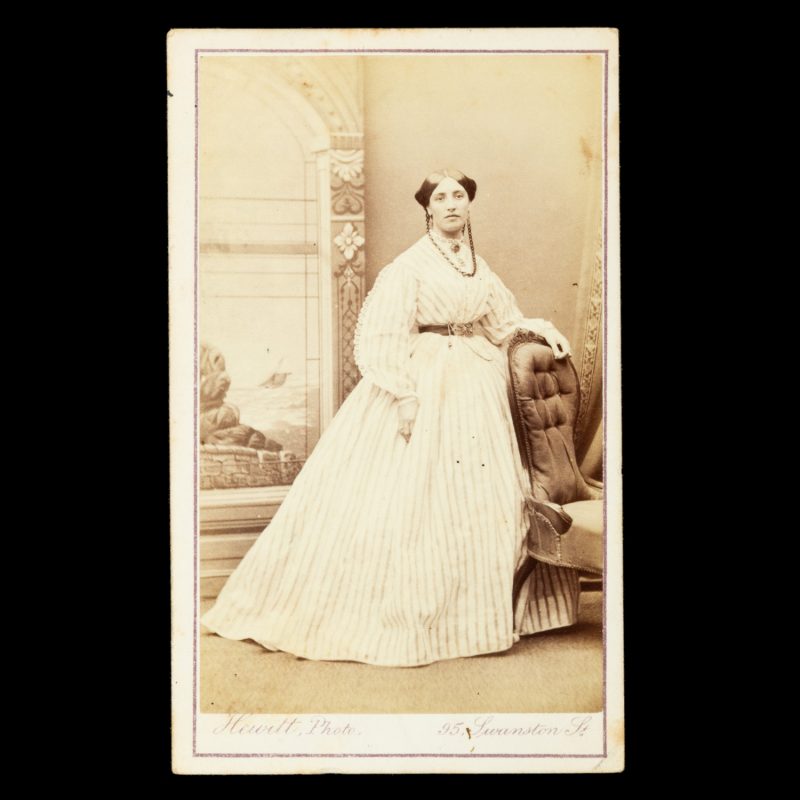
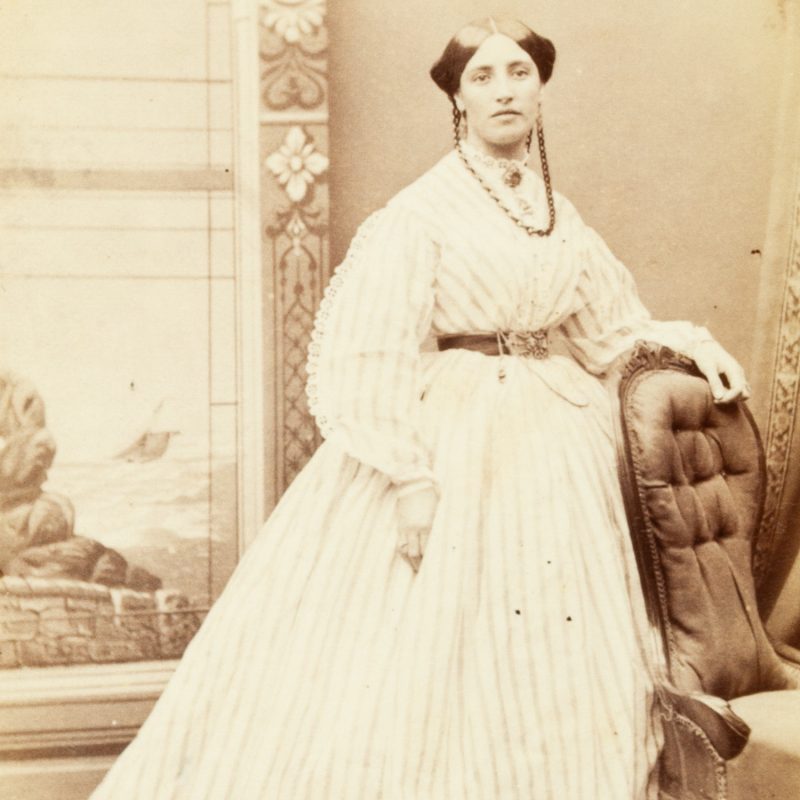
Studio portrait of opera singer Rosina Carandini (Palmer). Melbourne, late 1860s.
$500.00 AUD
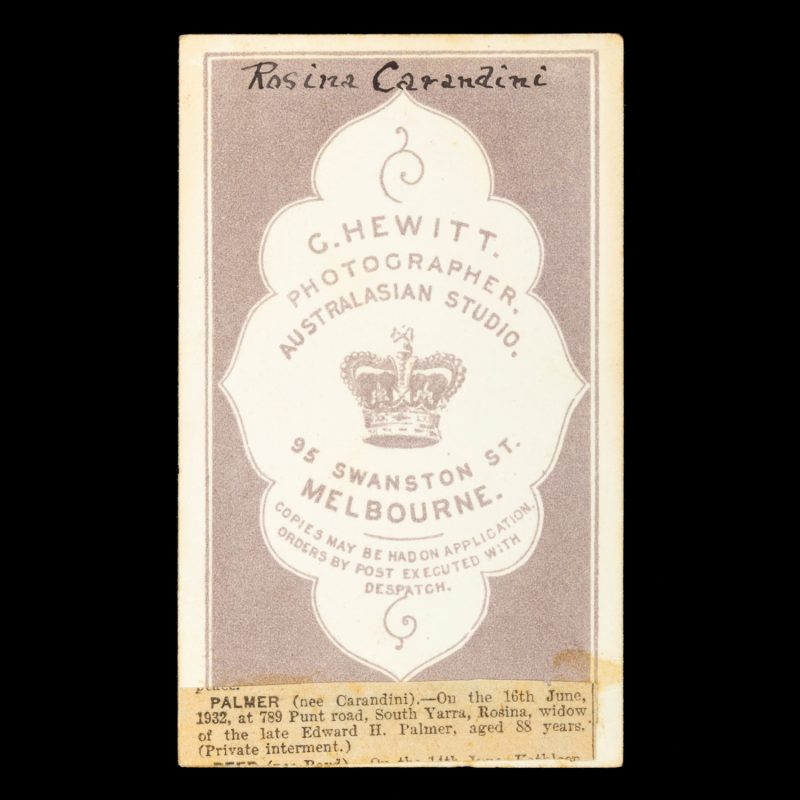
Albumen print photograph, carte de visite format, 102 x 63 mm; verso with the imprint of ‘C. Hewitt, Photographer, Australasian Studio, 95 Swanston St. Melbourne’, a fully contemporary inscription in ink identifying the sitter as ‘Rosina Carandini’, and a death notice cut from Melbourne newspaper recording her death in 1932; the print and the mount are both in excellent condition.
Rosina Martha Hosanah Palmer (née Carandini, 1844-1932) was born in Hobart Town, the eldest of five daughters of renowned Australian opera singer Madame Marie Carandini (née Burgess, 1826-1894) and her husband Jerome Carandini, Marquis of Sarzano (1803-1870). Her mother had arrived in Van Diemen’s Land from England with her family as a young girl in 1833 and had married the counter-tenor Jerome Carandini, the tenth marquis of Sarzano, in Hobart in 1843, shortly aftermaking her operatic debut. For the next few years Marie and her husband moved between Hobart and Sydney, where Marie studied under Isaac Nathan and Sara Flower and began her career in earnest under the stage name Madame Carandini. Along with Walter Sherwin, Madame Carandini formed a travelling opera company which garnered great critical acclaim in the colonies and the United States. All of her daughters became professional singers; Rosina, Lizzie and the dazzlingly beautiful Fanny were the most successful, often performing together as a group.
This portrait of Rosina, by Charles Hewitt, was probably taken around the time that she performed for the Duke of Edinburgh’s during his stay in Melbourne in 1868 (see below).
From the ADB:
‘In Hobart on 8 November 1860 Rosina married Edward Hodson Palmer, cashier and later accountant in the Bank of Australasia. In 1866 they moved to Melbourne; she exchanged her mother’s dominance for her husband’s prudery and the duty of rearing a young family. The tours were replaced with concerts in the major cities; the operatic appearances ceased in favour of oratorio. When the Duke of Edinburgh visited Melbourne he was so charmed by Rosina’s singing that he promised to provide the means for her musical education by first-rate European masters, but nothing came of it. Though it was improper for a respectable matron to appear on the always-suspect opera stage, the poorly paid solo parts with the respectable Melbourne Philharmonic Society and Liedertafels were socially acceptable.
In 1872 Rosina sang as a soprano in a travelling quartet with the American Mrs Cutter as contralto, E. A. Beaumont the blind tenor and S. Lamble as bass, visiting New Zealand and touring Australia. With Beaumont she became one of the two principal singers in the W. J. Turner series of popular concerts in the Exhibition Building in Melbourne. She was also the soprano soloist in the choir of Scots Church in 1880-1910. Her performances were legion and her income small, but fortunately she was allowed to go on singing because her husband’s income was only a little larger. Economy won consent but not approval. She became a teacher in the end with an extensive following. When she sang with visiting celebrities she was always praised by them. Charles Santley (1834-1922) in particular regretted that she could not leave her family and sing in Europe, though later she visited America and sang for a notable teacher, Mancusi, who told her that he could teach her nothing more. She might have stayed but her mother was ill and she returned to Melbourne. Predeceased by her husband on 28 June 1928, she died at South Yarra on 16 June 1932, survived by a son and two daughters of her eight children.
Undoubtedly Rosina Palmer had gifts but, like so many talented contemporaries, the demands of her social position and her married state acted as a barrier against full development. Only women of the character of her mother could successfully break through the barricades of convention, compelling respect and admiration, pushing the weaker spirits of her daughters to the sticking point and finally marrying them off to titles and fortunes, all except Rosina.’ (Thérèse Radic)

