# 50109
MOLONY, M.
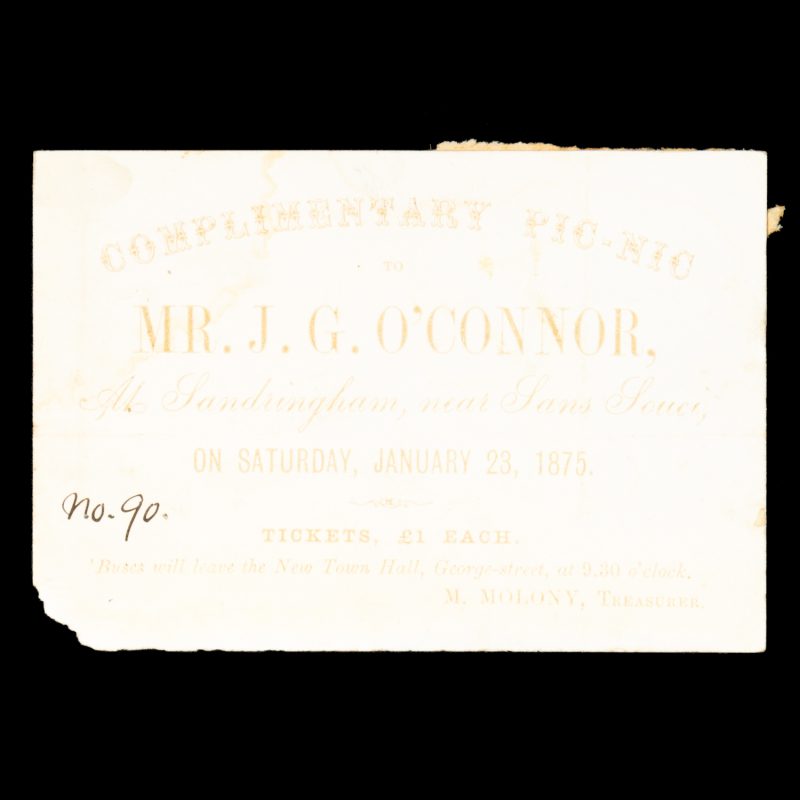
[SYDNEY] Complimentary pic-nic Mr J. G. O’Connor, at Sandringham, near Sans Souci, on Saturday, January 23, 1875.
$50.00 AUD
[Sydney : s.n.], 1875. Invitation card, 78 x 115 mm; lithograph printed recto only in gold on glossy white lightweight card stock, and annotated in ink ‘no. 90’; light staining, nicked at bottom corner, verso with residual glue and paper adhesion from where the card was once mounted in an album.
Provenance: Removed from a dilapidated album of mounted printed ephemera compiled by J. G. O’Connor (1839-1913), Irish-born Sydney journalist, printer, and politician.
From Freeman’s Journal (Sydney), 30 January 1875:
‘PICNIC TO MR. J. G. O’CONNOR, On Saturday, 23rd instant, a complimentary picnic was given by a large number of his friends to Mr. J. G. O’Connor, at Sandringham, Sans Souci. Several omnibuses were engaged, supplemented by private vehicles, to convey the friends to the scene of the festivity. The day was beautifully fine, and everything looked beautiful in that romantic region ; games of cricket, quoits, football, and other athletic amusements were engaged in with much zeal. At 2 o’clock, dinner was announced. The chair was taken by Mr. Rubie, with the guest on his right, and the Hon. John Robertson on his left. Mr. M’Girr occupied the vice-chair. After the preliminary toasts of ‘the Queen,’ ‘the Governor &c,’ the health of the honoured guest was proposed in a neat and appropriate speech by the chairman. The toast was drunk amid the most enthusiastic manifestations of applause. Mr. O’Connor in responding to the toast said, that after the enthusiastic way in which it had been received, he scarcely knew how to respond. Had such a reception been given to his honourable friend opposite, he could have understood it and even Mr. Robertson would have been taken somewhat aback by such enthusiasm. He scarcely knew upon what ground the picnic was given. It could not be on religious grounds because he saw gentlemen of various persuasions present. It could not be upon national grounds, because he saw those present who claimed the white- bound cliffs of Albion as their native home. He saw those present who loved to speak of the deeds of Bruce and Wallace, and would wish no sweeter resting place on earth than their native heather. He saw those present who delighted in proclaiming themselves as ‘ Currency Lads’ and wished for no better motto than ‘Advance Australia.’ And finally he found himself surrounded by men from the ‘ old green sod’. that sod from which his forefathers sprung— a race he would never forget, and which all the fond aspirations of his heart turned to. It could not be, he presumed to say, upon political grounds, for his services as a member of the Parliament of the country, because of his short term of office as a member of the Assembly, precluded him from performing any services for which he could claim any credit. He had merely served an apprenticeship in the Assembly, and he was sorry that when he would have useful as a legislator he had been excluded from Parliament. However, his motto was ‘ Nil Desperandum.’ He intended to try again at the next general election for a seat in Parliament ; and his great ambition was to be able to serve in some way or other the free Australia….’
From the ADB:
‘Joseph Graham O’Connor (1839-1913), journalist and politician, was born at Dareen House, King’s County, Ireland, son of Stephen O’Connor, tanner and currier, and his wife Ann, née Graham. At 2 he went with his parents to New South Wales. Educated by the Christian Brothers and at the Sydney College, he was apprenticed to a wood engraver and printer.
In the late 1850s O’Connor began business as an engraver and printer and in 1860 produced the short-lived Sunbeam for the Catholic Young Men’s Society. In 1864 he joined W. B. Dalley, W. J. Macleay and J. J. Harpur in bringing out the unsuccessful Sydney Times, devoted to ‘the promotion of Australian literature and the advocacy and encouragement of native industry’. In 1867 he began the Balmain Reporter, one of the earliest suburban newspapers. His journalistic pursuits became more exclusively Irish and Catholic. In 1870-71 he edited and printed the Catholic Association Reporter. In 1876 he had debts of over £1400, sold his press and was not discharged from bankruptcy until 1884 after paying 3s. in the £. In 1877 he had begun the Catholic Times in opposition to the Freeman’s Journal. In 1880 Archbishop Vaughan was dissatisfied with the Freeman’s independent attitude and bought the Catholic Times, changing its name to the Express. In 1884 O’Connor took it over again and began the Nation, devoted to Irish news; he incorporated it in the Express in 1887. In 1890 debts forced him to close his last newspaper venture and his estate was again sequestered. He had supported his unprofitable newspapers with a mostly successful printing business, but in 1892 his friends had him appointed chief clerk on the Water and Sewerage Board at Newcastle, from which he retired in 1909.
As a youth O’Connor had helped to collect funds to relieve the 1858 Donegal famine victims and next year became an original member of the Celtic Association. In 1869-72 he was lay secretary of the Catholic Association, founded by Archbishop Polding in 1867 to support a separate system for Catholic schools. In the 1870s and 1880s he organized several concert tours of country districts to raise funds for the Church. Active in municipal politics with various Irish Catholic factions, he was auditor of the Sydney City Council in 1870-74. After several attempts he was elected in 1873 to the Legislative Assembly for Mudgee in the Catholic interest. Defeated in 1875, he lost again in 1880. O’Connor helped to organize the annual St Patrick’s Day celebrations and did not eschew more controversial Irish causes: in 1866 he was treasurer of the Irish State Prisoners’ Fund, organized to assist the dependants of Fenian prisoners in Ireland; in 1871 he helped to welcome Fenian prisoners released from Western Australia and in 1883 he was one of the few prominent Irish Catholics to welcome William and John Redmond. Affectionately known as ‘old white hat’ from the topper he invariably wore, he chaired their first Sydney meeting and was president of the local branch of the Irish National League. He remained close friends with the Redmonds and helped later Irish delegates.
At Sydney in 1861 O’Connor had married Mary Earl (d.1903). He died of bronchitis at his Mayfield home on 22 July 1913 and was survived by a married daughter. The Irish Parliamentary Party contributed to a monument over his grave in Sandgate cemetery.’