


# 48666
EHLERS, Carl
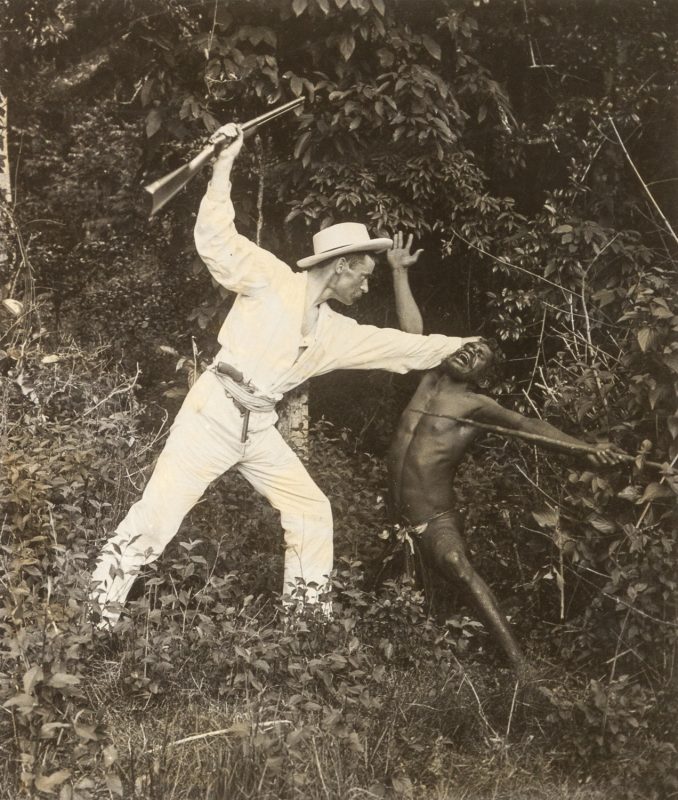
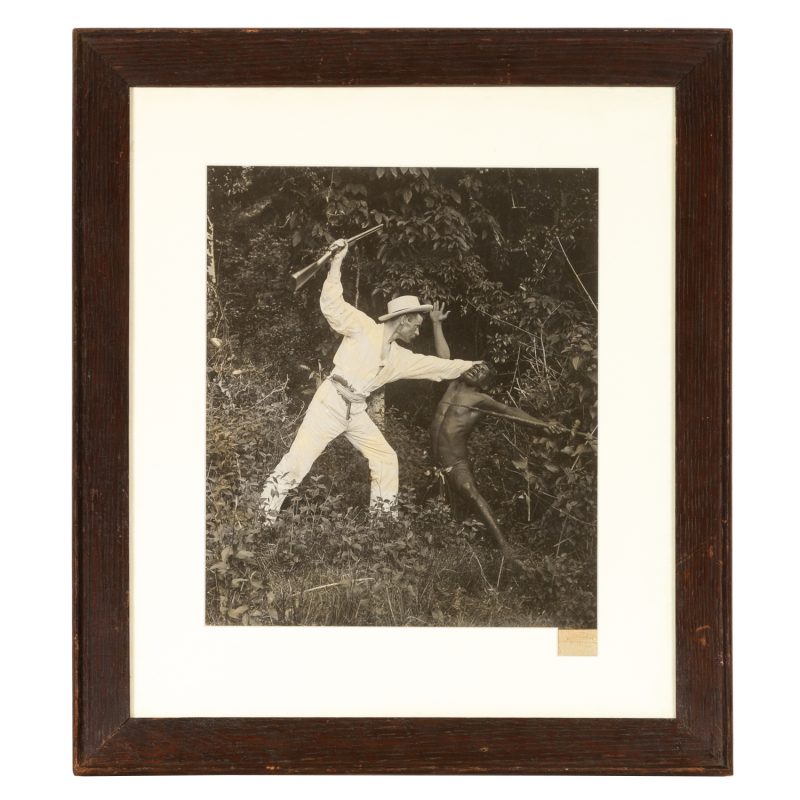
Tableau of a white settler attacking an Aboriginal man. Grafton, New South Wales, 1890s.
$8,000.00 AUD
Gelatin silver print, in uncommonly large 30 x 26.4 cm format, on original mount blind-stamped ‘Ehlers & Dalby, Grafton’; fine condition; in a later glazed frame.
Like his better-known compatriot J. W. Lindt before him, German-born Carl Ehlers was a professional photographer who worked in the New South Wales Northern Rivers township of Grafton. He operated his business in Grafton’s main commercial thoroughfare, Prince Street, between 1888 and 1902, where he took studio portraits. With his camera he also created an extensive record of the town’s civic buildings and private residences, shipping activity along the Clarence River, the floods of 1887 and 1890, the local sugar industry, social events, and the scenery of the region’s coast and hinterland.
In 1896 he brought in H. G. Dalby – about whom little else is known – as a partner in the business. Ehlers placed the following announcement in the 6 June 1896 edition of the Clarence and Richmond Examiner:
‘PHOTOGRAPHY. I have this day taken Mr. H. G. DALBY into PARTNERSHIP of the above business, which will hereinafter be carried on as “Ehlers and Dalby.” In returning thanks to the public for past support I beg to solicit a continuance of the same to the new firm. C. EHLERS. Grafton, 1st June, 1896.’
The firm continued under this name up until around May, 1902 – its last advertisement appeared in the Examiner on 10 May that year. Ehlers then left Australia and returned to Germany.
Probably inspired by Lindt’s celebrated studio portraits and tableaux of the Bundjalung – the traditional owners of the Clarence Valley district – which had been taken in the early 1870s, Ehlers took it upon himself to document, on his own terms, aspects of Bundjalung lifestyle and culture. He did this both in his studio and in several series of exterior shoots, most notably his astonishing “Corroboree” sequence (cf. The Carl Ehlers Collection, pp. 17-18), the staged “Fleeing from a bush fire” (ibid. p. 14), and the extended series of “Mock fights” (ibid., pp. 13 and 15, including a reproduction of the image offered here). Through this latter series of highly stylised (yet violent) tableaux vivants, Ehlers attempted to illustrate not only how the Bundjalung used weapons – their fighting boomerangs, clubs and spears – but also the modes of combat they supposedly employed both in internecine disputes and in confrontations with settlers. Newspaper notices of the time inform us that Ehlers and Dalby were members of the Grafton Reserve Rifle Club, and that both were champion marksmen. This suggests an interest in weaponry, and might also explain – in part, at least – the genesis of the “mock fight” series of photographs.
A number of the Ehlers and Dalby photographs of Aboriginal subjects were later published as postcards by the Star Photo Company in Sydney. It is likely no coincidence that this enterprise was owned by William Livermore, himself a former Grafton resident and photographer.
Provenance: Ex Sotheby’s, Melbourne, 25 July 2005, lot 236; private collection, Melbourne
Reference: The Carl Ehlers Collection. Clarence River Historical Society Inc., 2007. The image offered here is reproduced on p. 13, with the title “Mock fight”.


