



# 47519
[PONCELIN DE LA ROCHE-TILHAC, Jean-Charles]
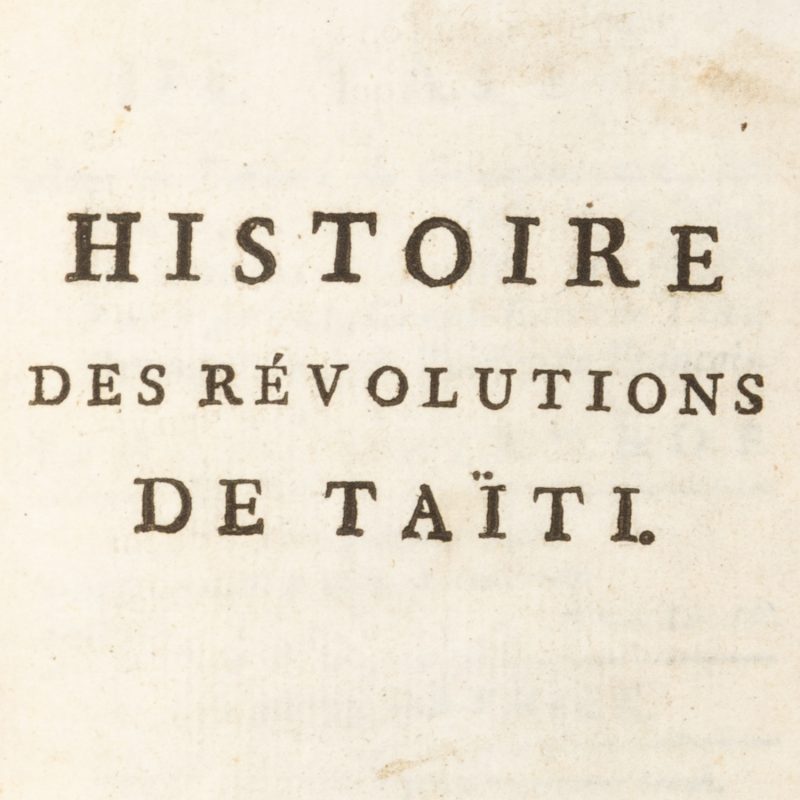
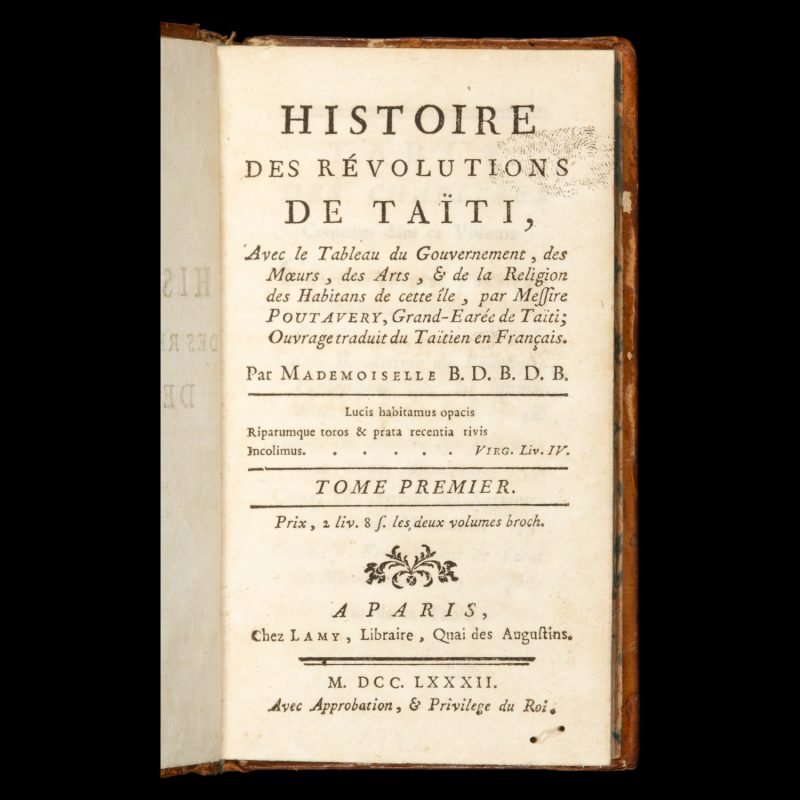
[TAHITI] Histoire des révolutions de Taïti,
$3,500.00 AUD
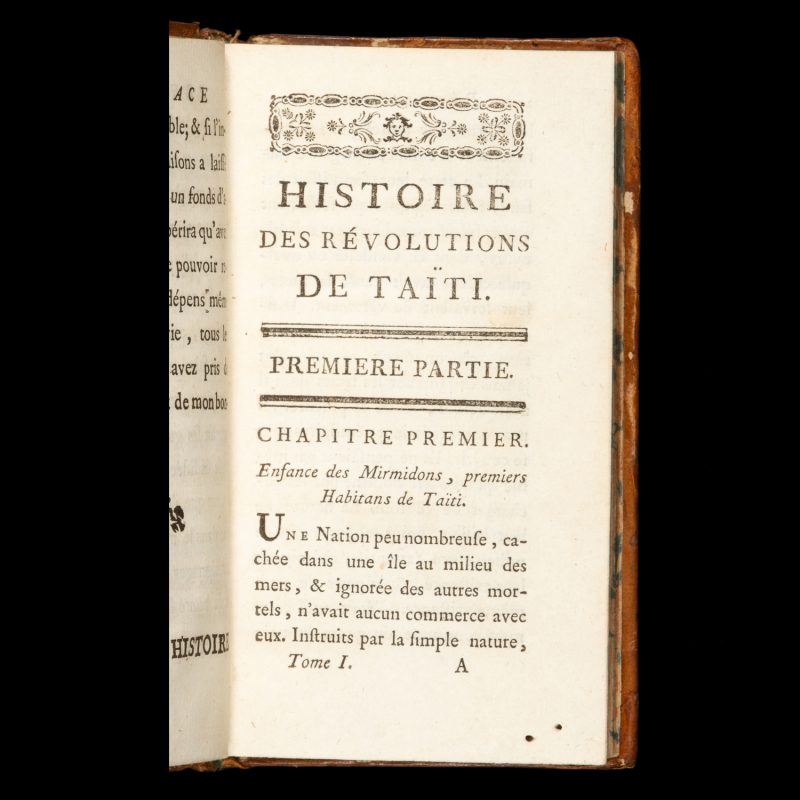
avec le Tableau du Gouvernement, des Moeurs, des Arts, & de la Religion des Habitans de cette île, par Messire Poutavery, Grand-Earée de Taïti; ouvrage traduit du Taïtien en Français par Mademoiselle B.D.B.D.B. Paris : chez Lamy, Libraire, Quai des Augustins, 1782. Two parts in one volume, duodecimo (150 x 90 mm), contemporary full calf, boards triple-ruled in gilt (lightly marked), spine in compartments with ornate gilt decoration and contrasting morocco title label lettered in gilt; original marbled endpapers, marbled edges; pp. xvi, 123, [1 blank], [4 Approbation and Privilege du Roi]; [4], 210, [1 Table des Chapitres], [1 blank]; each part with its own half title and title, the respective texts each with an engraved headpiece; first title with a light thumb mark, some very minor worming at lower margins, otherwise clean and crisp throughout; binding firm; a very good example.
Scarce first edition of a Rousseauian utopian fantasy set in Tahiti, whose pseudo-author is none other than the historical figure Aotourou Poutavery, the Tahitian who travelled to Europe with Bougainville.
On the title-page, the work’s real author, Jean-Charles Poncelin de la Roche-Tilhac (1746-1828) – clergyman, lawyer, journalist, bookseller, printer, translator and polemicist – not only disguises his own name, but also – as Mademoiselle B.D.B.D.B, the purported translator of the work – his gender. Poncelin was the author of such works as Histoire de Paris (1780), Campagnes de Louis XV (1788), and, having survived the Terror, the nine volume Le Procès de Louis XVI (1795).
O’Reilly-Reitman, 9296; Kroepelien, 1054
The work was reissued under the variant title Histoire de la naissance, du progrès et de la décadence d’un grand royaume, par M. *** (Quérard, Les Supercheries littéraires dévoilées).
‘From 1770 to 1790 (roughly the last twenty years of the ancien regime), Tahiti, as introduced to the French consciousness by Commerson and Bougainville, enjoyed a sort of literary vogue, a kind of popularity which obtained before the minuet gave way to the Carmagnole – when there was still time for philosophic dreams about the noble savage in the happy langour of his earthly Eden. This graceful time of the douceur de vie cited by Talleyrand was to be interrupted by the guns of revolution and of foreign war, and by the dramatic calls to action of the Republic and of the Empire. While it lasted, however, it formed a distinctive period of Utopian literature, one characterized by the reaction to the image of Tahiti that the navigators and their companions had presented.
French writings about Tahiti in this period were: (1) Le Sauvage de Talti aux Francais by Bricaire de La Dixmerie (1770); (2) Diderot’s review of Bougainville’s Voyage and Diderot’s Supplement au Voyage de Bougainville (the former probably written in 1771 but not published till the Assézat edition of Diderot’s complete works appeared in 1875, the latter probably written in 1772 and not published till the posthumous Opuscules philosopiques, in which it was included, appeared in 1796); (3) Voltaire’s amusing conte, Les Oreilles du comte de Chesterfield (1775); (4) An Essai sur l’isle d’Otahitl, située dans la mer du sud et sur l’esprit et les moeurs de ses habitans, by Taitbout (1779); (5) A section of the poem Les Jardins by the Abbé Jacques Delille (1782); (6) The curious fantasy Histoire des Révolutions de Taïti by Poncelin de la Roche-Tilhac (1782); (7) The pseudo-Tahitian novel Lettres taïtiennes by Madame de Monbart (1786); (8) The so-called Narrations d’Omai by the Abbé G.A.Y. Baston (1790)’ (Frederick Charles Gray, Tahiti in French literature from Bougainville to Pierre Loti. University of Arizona, Ph. D. dissertation, 1970, pp. 20-21).
‘… Histoire des Revolutions de Tahiti is divided into two parts; the first, supposedly historical, is the purest fantasy. The second, descriptive, seems largely copied from Taitbout and Bougainville. The first or historical section tells of the peopling of Tahiti by a race that the author calls Mlrmldons, the subsequent arrival of the philosopher Pantomitoul who had previously been “high priest of Atlantis” and recounts the later invasions by such imaginary peoples as the Pullgenes and the Saginotes, and finally by the Tahitians. Nothing, it may be noted, could be farther from the actual historical traditions of the Polynesians themselves. The essence of Poncelin’s story is that the Mlrmidons and other inhabitants of the island before the arrival of the Tahitians had developed towns and cities, commerce, arts and manufacturing. They also had money, metal-working, gold, silver and copper coins. All this eventually made the population effete so that they were finally conquered by the ruder Tahitians who abolished all of the above refinements and forcibly returned the islanders to a life of Spartan simplicity. In the foregoing, echoes of Rousseau’s First and Second Discourses may be readily detected. Poncelin’s fervor as a disciple of Jean-Jacques is further evidenced by the fact that in his story the Tahitian conquerors, at one blow even more sweeping than anything proposed by Rousseau himself, turn the clock firmly back to a primitivism in which the ideal of the noble savage is imposed by law’ (ibid. p. 60).

