


# 49581
LEUPE, Pieter Arend (editor); SIEBOLD, Philipp Franz von
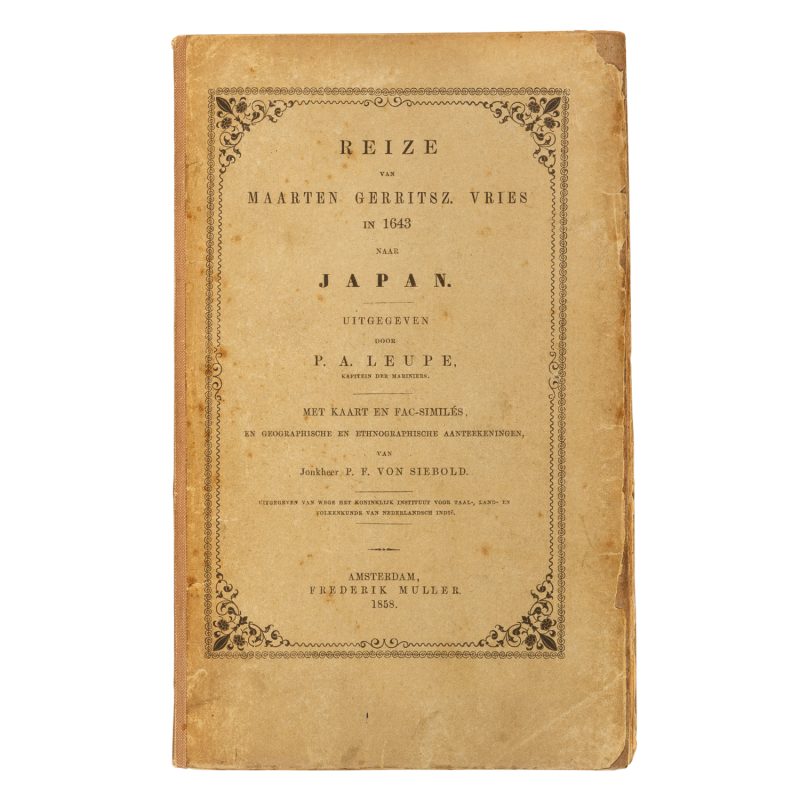
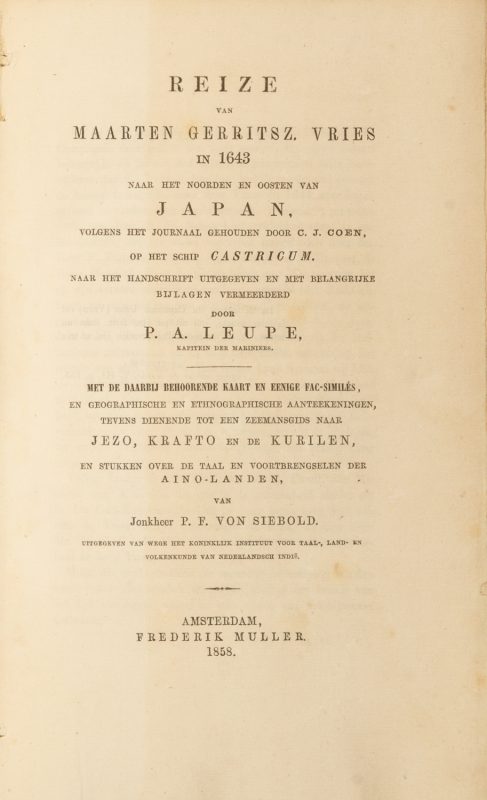
[TASMAN] Reize van Maarten Gerritsz. Vries in 1643 naar het Noorden en Oosten van Japan,
$3,000.00 AUD
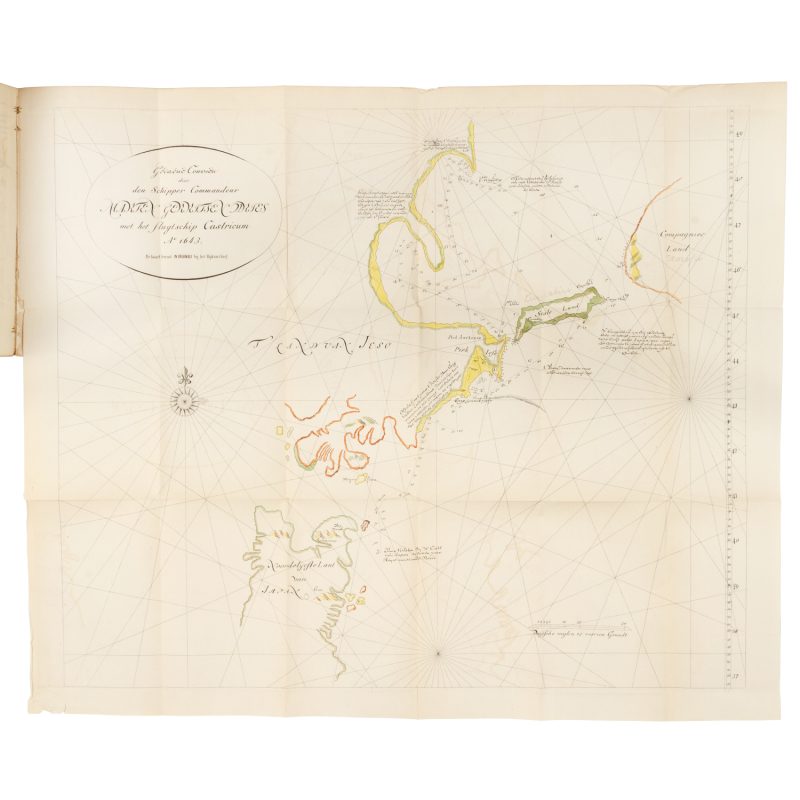
volgens het journaal gehouden door C.J. Coen, op het schip Castricum … Met de daarbij behoorende kaart en eenige fac-similés, en geographische en ethnographische aanteekeningen, tevens dienende tot een zeemansgids naar Jezo, Krafto en de Kurilen, en stukken over de taal en voortbrengselen der Aino-landen, van Jonkheer P.F. von Siebold. Amsterdam : Frederik Muller, 1858. First edition. Octavo, lettered wrappers over cards, rebacked with cloth spine, endpapers replaced, ex-libris bookplate for W. Z .Mulder to front pastedown and bookseller’s labels of Isseido, Tokyo; pp. 440, large folding map printed in colour, folding plate of signatures; text in Dutch; edges uncut; a fine copy.
The first published edition of the account of Maarten Gerritszoon de Vries’ 1643 voyage to the North Pacific, based on the manuscript journal of Cornelis Janszoon Coen rediscovered by researcher Pieter Arend Leupe (see footnote) in the Dutch East India Company Archives, having lain forgotten for more than two centuries.
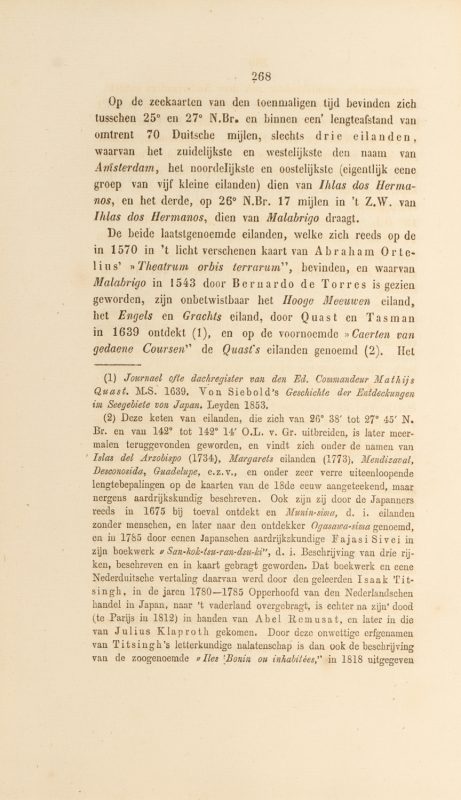
The second part of the present work, by the German natural scientist and traveller Philipp Franz von Siebold, which was published in English the following year as Geographical and ethnographical elucidations to the discoveries of Maerten Gerrits Vries…, contains references to the earlier related voyage of Quast (1639), on which Abel Janszoon Tasman had sailed as second-in-command, in charge of the Gracht – just three years prior to his becoming the first European to discover Tasmania, in November 1642. Significantly, these references to the Quast expedition are based on Quast’s own manuscript log and charts, which had, like Coen’s journal, only recently been rediscovered (this time by Siebold, not Leupe) when the present work was published in 1858 – making it, by virtue of this fact, an important source for the first voyage on which Tasman was able to amply demonstrate his skill as a navigator and commander. It includes passing references to Tasman’s later voyage in the Heemskerck and Zeehan which would result in the European discovery of New Zealand and Tasmania.
Trove locates no copies in Australian institutional collections.
Abel Janszoon Tasman was born around 1603 in Lutjegast in the Netherlands. He sailed with the VOC to Batavia in 1633, and returned to Amsterdam in 1637. The following year he again sailed for Batavia, this time accompanied by his wife. In 1639 he was appointed second-in-command on Matthijs Quast’s expedition in search of the fabled Isla Rica de Oro (“Island rich with gold”) and Isla Rica de Plata (“Island Rich with Silver”), known also as Kinshima (金島, “Island of Gold”) and Ginshima (銀島, “Island of Silver”). These phantom islands were believed to have been discovered by the Spanish, and were thought to be the home of a civilisation with untold wealth. The islands were reported to lie several hundred kilometres east of the coastline of Japan. The expedition comprised two second-rate ships from the VOC fleet (the premier ships reserved for high-value trading missions): the Engel ( “Angel”) under the command of Quast and his commander Lucas Albertsen, and the Gracht (“City Canal”), under the command of Quast’s lieutenant Abel Tasman.
The expedition left Batavia on 2 June 1639. It sailed beyond the Philippines and discovered the uninhabited Bonin Islands, roughly halfway between Guam and Japan – but no riches were to be found. The crews were being decimated by illness exacerbated by poor rations, and with the ships beginning to fail, Quast finally abandoned his fruitless search on 25 October. He directed his men to sail for Fort Zeelandia on Formosa (Taiwan) rather than attempting to continue northwest. By the time his ships arrived there on 24 November, 41 of the 90 men who had set out with Quast had died. The mission was abandoned and the journals and charts of the voyage faded into obscurity. The expedition’s secondary objective, after searching for the islands of riches, had been to sail north-westward to explore Korea and search for the possible existence of a Northeast Passage around Mongolia, Manchuria, and Siberia (“Tartary”), yet these objectives, too, remained unfulfilled.
In 1643, the governor of Batavia, Anthony van Diemen, directed the explorer Maarten Gerritszoon de Vries to resume the quest for the fabled islands of silver and gold in the North Pacific. An expedition comprised of two ships, the Castricum under de Vries and the Breskens under Hendrick Cornelisz Schaep, departed Batavia in February 1643. Like its predecessor, the De Vries expedition failed to discover the mythical islands, although it did make several important cartographic discoveries in Japan which were recorded on the Dutch charts.
During the intervening period between the Quast and the De Vries expeditions, Abel Tasman – who had been Quast’s second-in-command – was commissioned to make discoveries in the South Pacific Ocean. It was expected that these discoveries would be both geographical and lucrative in nature. On 14 August 1642, two small ships, the Heemskerck and Zeehaen departed Batavia for Mauritius, where they would catch the roaring forties east to uncharted waters. On 24 November 1642, Tasman became the first European to discover the island which he named Van Diemen’s Land, after Antonio van Diemen, Governor-General of the Dutch East Indies. It is now known, of course, as Tasmania.
Cordier, BJ, 356
Footnote:
Pieter Arend Leupe (1808-1881) was a Dutch colonial military officer who had served in both the West and East Indies. Although he was an autodidact, he was ultimately appointed to help oversee the National Archives in The Hague, assisting with the cataloguing of its enormous collection of maps and manuscripts. As a result of his constant research into Dutch maritime and colonial history he became a prolific contributor to scholarly journals on these subjects (at least 600 such articles by him are known). Leupe’s main areas of interest were the early Dutch voyages to and in Asia and the Pacific, and the history of the VOC. In his later career as an archivist he was responsible for bringing to light much important source material that had languished in Dutch archives for two centuries or more.

