


# 49441
GONÇALVES, Gaspar; GHETTINI, Agostini (translator)
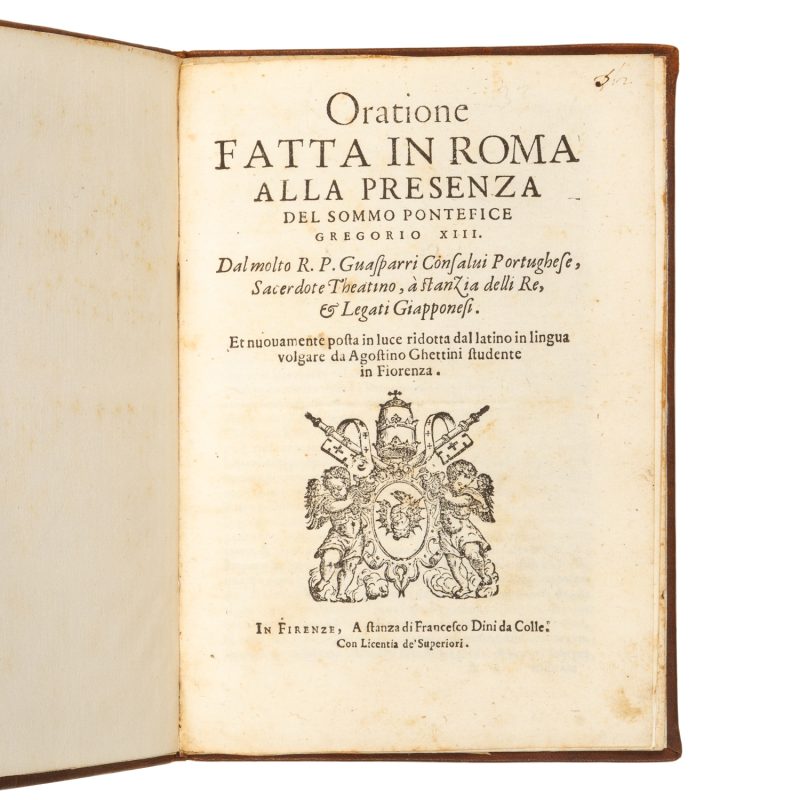
[TENSHŌ EMBASSY] Oratione fatta in Roma alla presenza del sommo Pontefice Gregorio XIII. Dal molto R. P. Guasparri Consalvi Portughese, Sacerdote Theatino, à stanzia delli Re, & Legati Giapponesi.
$12,500.00 AUD
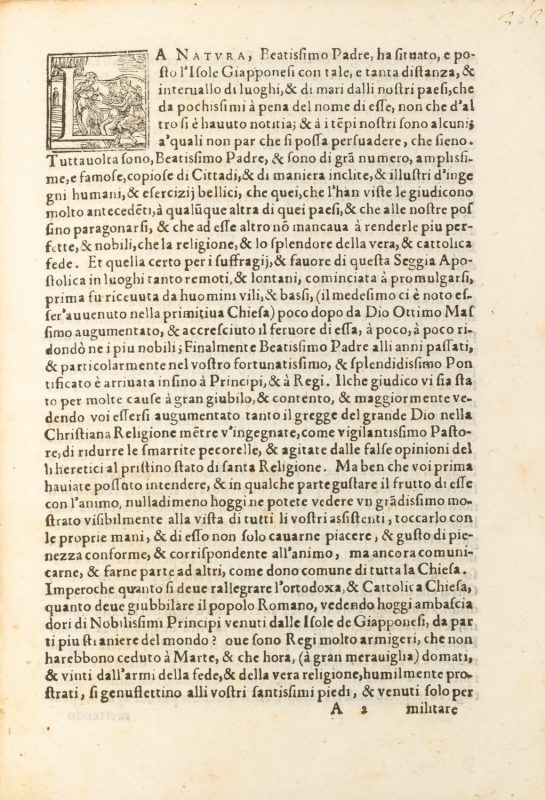
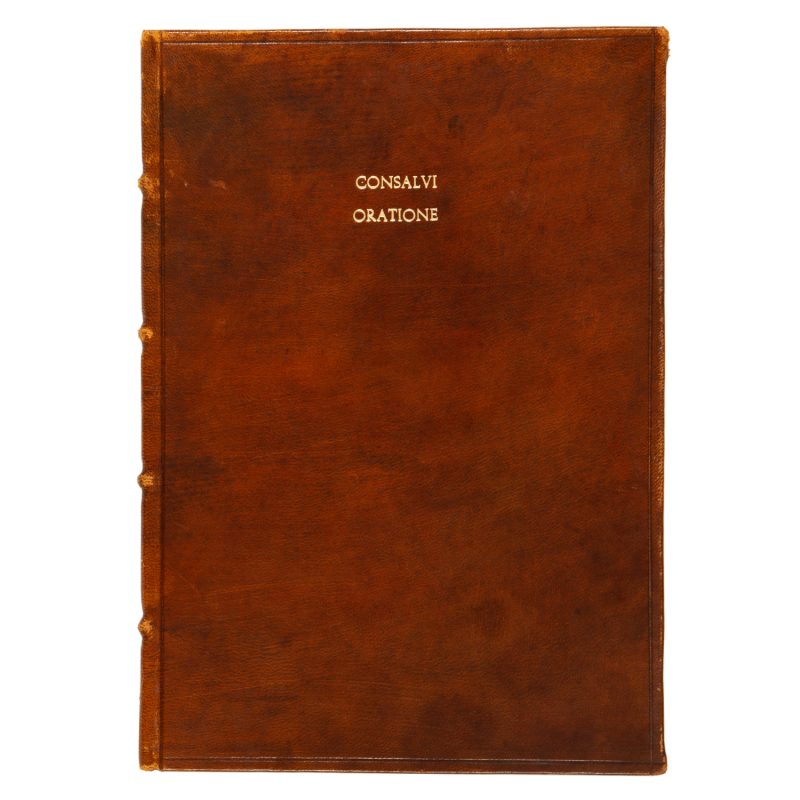
Et novamente posta in luce ridotta dal latino in lingua volgare da Agostino Ghettini studente in Fiorenza. In Firenze : A stanza di Francesco Dini da Colle, [1585]. Quarto (210 x 140 mm), old full calf with gilt lettering to upper board, spine with raised bands; [6] leaves; title with woodcut coat of arms of Pope Gregory XIII; woodcut initial; manuscript foliation at upper corners; light spotting, last leaf browned; a very good example.
The first appearance in print, in the Italian vernacular, of the text of the Oratio delivered by Gaspar Gonçalves on behalf of the converted rulers of Bungo, Arima and Omura, before Pope Gregory XIII and the Japanese envoys of the Tenshō Embassy in Rome on 23 March 1585. It had first appeared in print, in Latin, earlier in 1585 as part of the first edition of the official account of Pope Gregory XIII’s reception of the first Japanese embassy to Europe that was published in Rome by Francesco Zannetti.
The present stand-alone Italian-language edition was an all-Florentine production: the translation was made by a local student, Agostino Ghettini, and the pamphlet was printed in the city by Francesco Dini da Colle, a publisher and writer of some renown. It was reprinted in the same year (1585) in Rome by Zanetti, and in Padua by Mereff.
The Tenshō Embassy was an initiative of Alessandro Valignano, Visitador of Japan, and according to Boxer “fulfilled his double intention of attracting the attention of Christendom to the splendid progress the Jesuits were making in Japan, and of impressing the Japanese with the power and civilization of Catholic Europe.”
The embassy departed from Nagasaki in February 1582 and arrived in Lisbon in August 1584. It comprised four young envoys: Mansho Ito (c.1569-1612) and Miguel Chijiwa (1569-1632) were the ambassadors representing three warlords, or daimyō (Ōtomo Sōrin, Omura Sumitada, and Arima Harunobu); these young men were accompanied by Julian Nakaura (ca. 1568-1633) and Martino Hara (ca. 1569-1629), nobles from the cities of Nakaura and Hizen. The legation also included two Japanese Jesuit brothers, Costantino Dourado (1567?-1620) and Jorge de Loyola (1562-1589), who had studied printing in Goa and who were to acquire further proficiency in printing techniques during their European sojourn, enabling them to print books in the Japanese language, in kana script, after their return to Japan. In Madrid the embassy was received by Philip II. It also travelled throughout Italy for almost a year, receiving an audience in Florence with Grand Duke Francis I de’ Medici and in Rome with Pope Gregory XIII. A short time after the reception in Rome the pope died, and the envoys were fortunate enough to be able to attend the coronation of the new pope, Sixtus V. The return trip to Japan, by way of Barcelona and Lisbon, took four years, the embassy arriving back in Nagasaki in July 1590.
Gaspar Gonçalves (1540-1590) was a Portuguese Jesuit theolgian and teacher. On 23 March, 1585, during a public consistory, he delivered a speech in the presence of Pope Gregory XIII on behalf of the Japanese ambassadors who were present. He was subsequently elected by Gregory’s successor, Sixtus V, to collaborate on the critical edition of the Vulgate.
Cordier, BJ, 96
Rare. No sale record in the Rare Book Hub database.


