


# 51278
J. LEVY & CIE. (PARIS) (photographer)
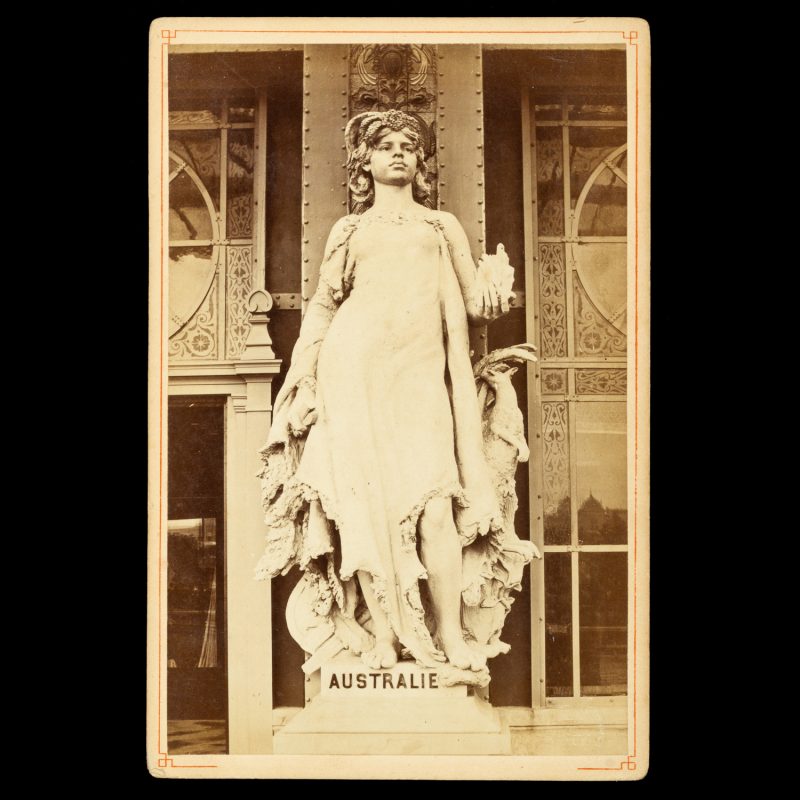
The allegorical statue “Australie”, photographed in situ at the Exposition Universelle, Paris, 1878.
Albumen print, cabinet card format, 165 x 108 mm (mount), blind stamp of the photographer J. Lévy & cie., Paris in the image lower right; verso blank; a superb print in fine condition.
This larger-than-life allegorical statue, sculpted from marble and titled Australie, was exhibited in the display of decorative arts during the Paris Exposition Universelle in 1878. It was one of numerous monumental decorative facade figures representing various nations and regions that adorned the Palais du Trocadéro. These sculptures were executed by different artists, Australie being the work of a little-known sculptor, Monsieur Roubeaux. The other statues were titled Angleterre, les Indies, Amérique du Sud, les États-Unis, la Suède, la Norwège, ltalie, Chine, Espagne, Autriche, la Hongrie, la Russie, la Suisse, la Belgique, la Grèce, le Danemark, la Perse, Êgypte, le Portugal, le Japon, and la Hollande. A colossal statue representing France surmounted the principal dome of the palace.
Well over half a million visitors attended the Exposition between May and November, 1878, and a large percentage of them would have viewed the artworks at the Trocadéro, where one of the main attractions was Bartholdi’s gargantuan bronze head for the Statue of Liberty displayed in the palace gardens, revealed to the public for the first time.
Roubeaux’s Australie is a work in the neo-classical style, and is reminiscent of depictions of the Roman goddess Ceres. The figure’s attributes express the abundant bounty of the land of Australia: her hair is adorned with a wreath of plaited ears of wheat; her lithesome body is draped in a fleece, and in her right hand she holds a pair of shears; in her left she holds what appears to be a mineral specimen, possibly a nugget of gold; the composition is completed by a small wallaby and palm fronds by her left side. Her soft-featured, compassionate countenance is possibly an idealised portrayal of an Indigenous Australian.
Isaac Georges Lévy established his own photographic firm, using the publishing name J. Lévy & cie., in Paris in 1872. He had formerly been in partnership with Moyse Léon, as Léon & Lévy. After his sons Abraham and Gaspard entered the business in 1895, J. Lévy & cie. became Lévy & fils. Lévy was the commissioned photographer for both the 1867 and 1878 Expositions Universelles.
We cannot trace any images of this significant statue in Australian institutional collections.
Reference: Études sur l’Exposition de 1878, tome IX: Les Sections Étrangères (1879), p. 39.


