


# 51604
MONTAIGNAC DE CHAUVANCE, Louis Raymond de (1811-1891)
The illustrated voyage journal of a French naval officer written during the circumnavigation of the Artémise under Captain Cyrille Laplace (1837-1840).
$275,000.00 AUD
The complete illustrated manuscript journal of French naval ensign Louis Raymond de Montaignac de Chauvance (1811-1891), covering his career at sea in the period from his entry into la Marine Royale in 1827 up until March 1840. Most significantly, it includes Montaignac’s original daily journal kept on board l’Artémise, under the command of Captain Cyrille Pierre Théodore Laplace (1793-1875), during its circumnavigation in 1837-1840. This voyage played an immensely important role in the shaping of France’s future relationship with Hawaii; but Laplace’s expedition also visited Malacca, Batavia, Cochinchina, Manila, Macao, Hobart and Sydney (reprising his visits in 1831, during his first circumnavigation in La Favorite), Tahiti, California, Peru and Brazil.
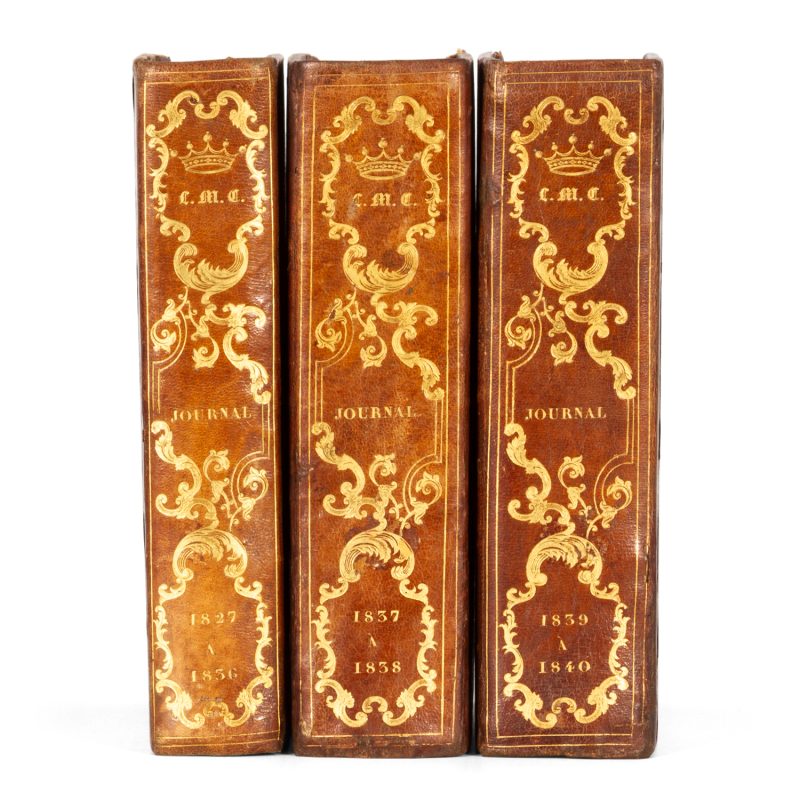
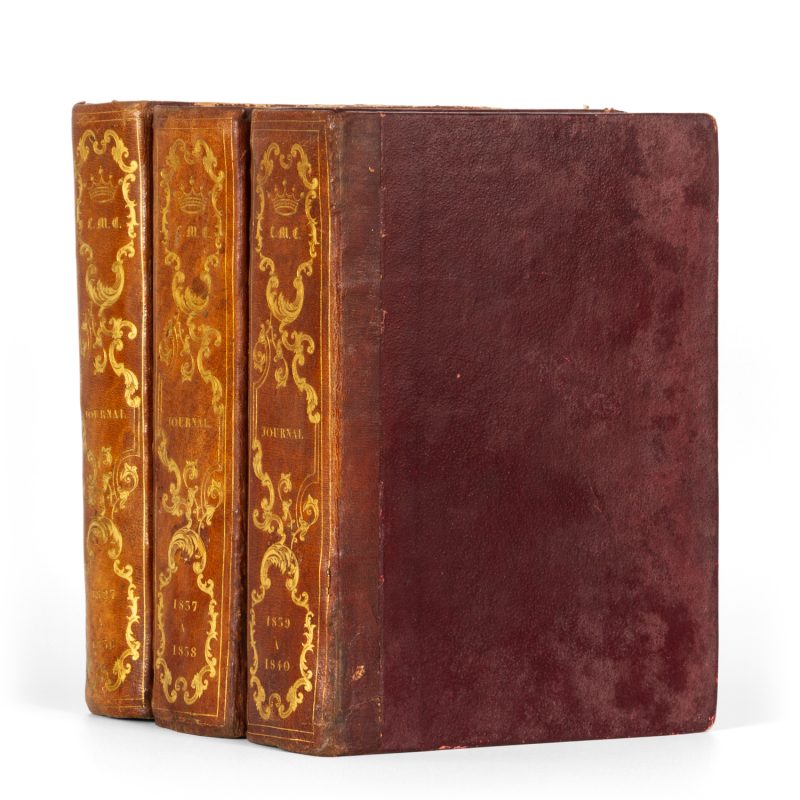
Three volumes, thick octavo (220 x 170 mm), original uniform bindings of quarter morocco over pebbled cloth (boards a little scuffed and edge-worn), spines tooled in gilt, each lettered with the author’s initials ‘L. M. C.’ and ‘Journal’, and with the dates ‘1827 à 1836’ / ‘1837 à 1838’ / ‘1839 à 1840’ respectively; pastedowns with the armorial ex libris of the Château de Vallière (see provenance section below for an explanation of this bookplate’s presence); original marbled endpapers; manuscript in ink in the hand of the author throughout; FIRST VOLUME (1827-1836): pp. [480], illustrated with 27 original drawings in watercolour, ink and pencil, music notation, plus printed ephemera; SECOND VOLUME (January 1837-October 1838): pp. [657], with over 30 original drawings and pieces of ephemera (see detailed list below); THIRD VOLUME (October 1838-March 1840): pp. [636], with 15 original drawings and pieces of ephemera, including a watercolour possibly attributable to Sydney artist John Black Carmichael (see detailed list below); the journal is complete, and clean and legible throughout.
MONTAIGNAC AND HIS JOURNAL
After his return home to Gueutteville in Normandy in 1840, Montaignac had his original shipboard journals bound into three volumes, covering the years 1827-1836, 1837-38, and 1839-40. The style of the bindings, which bear his initials and crest on the spines, suggests they were done at some point in the 1840s. Bound in at the front of the first volume is Montaignac’s own manuscript introduction – a modest statement for the benefit of his friends, in which he writes:
‘It is to satisfy your desires, my dear and best friends, that I have persevered in writing this long and sometimes tedious journal, but it has given me some pleasure in doing so [and I trust] it will be the same for you. And for that I must tell you how to read it, or what amounts to the same thing, tell you how it was made. On a journey full of interest, and in which the stops followed one another with extreme rapidity, it would have been impossible for me to keep up with the news if I hadn’t used my briefest moments of respite to do so. From this necessity to write, willingly or unwillingly, arises a multitude of inconveniences. The carelessness of style … is something to which I attach little importance, [and] I believe, without being vain, that I could not have written it any better….’ (our translation).
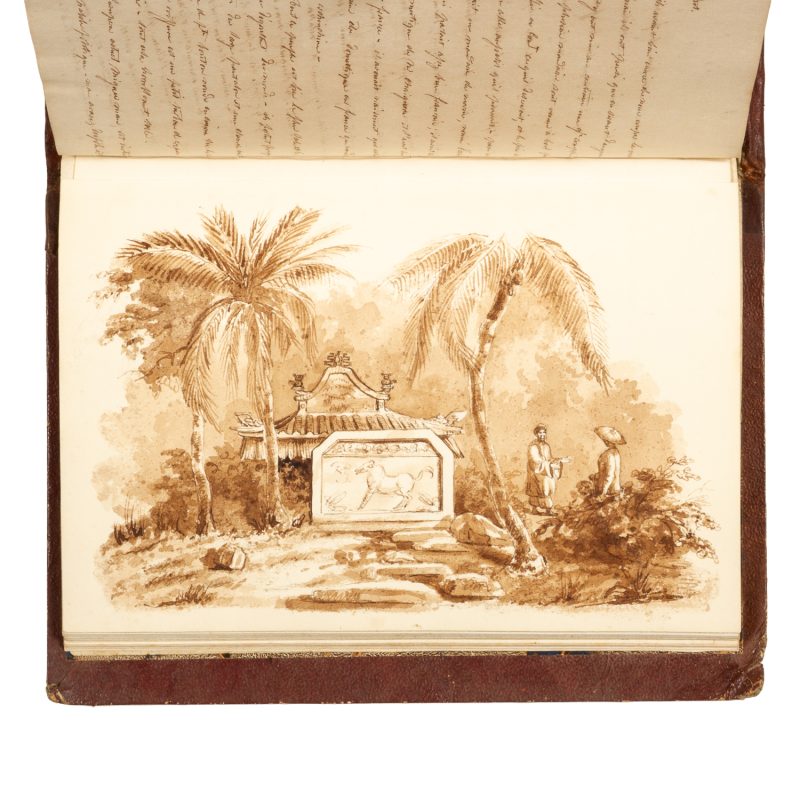
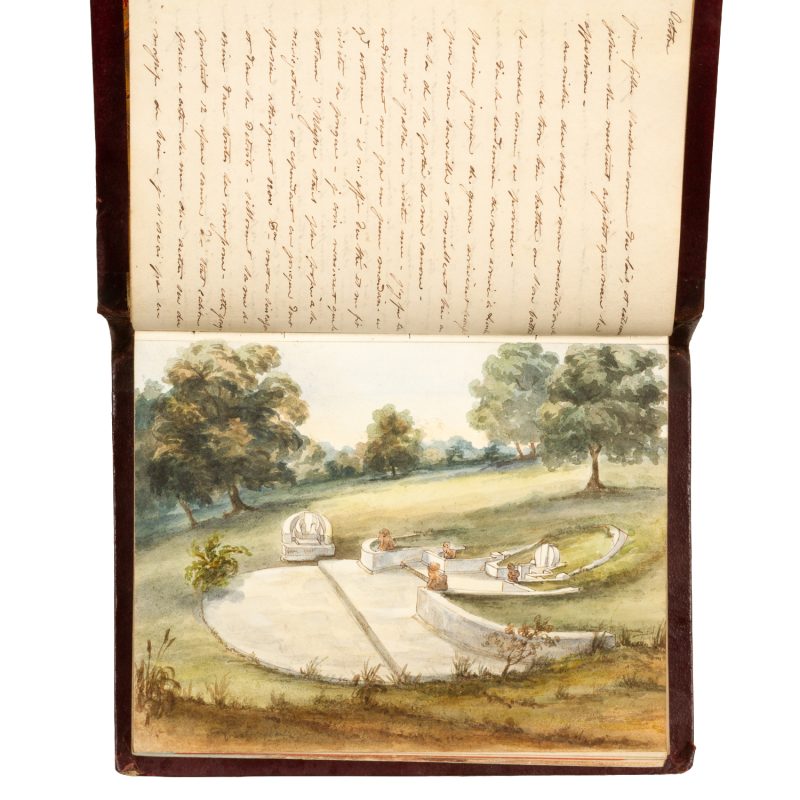
He then goes on to describe his journal as a sort of kaleidoscopic draft (‘une mosaïque ébauchée’), advising his friends that it is now up to them to make something of this ébauche by allowing it to become the canvas for their conversations, and to supply any conclusions that it may be lacking, through their ‘learning, intellect, and judgement’. He continues: ‘Some drawings and good maps will, I think, be a useful accessory. The sketches included in my journal are all drawn from life’ (‘Les croquis joints à mon journal sont tous d’après nature’) … [and I have given their locations] to give you an exact idea of each country.’ Montaignac’s highly accomplished sketches, completed during his time at sea, are all stub-mounted and bound in at appropriate places in the journal, as one would expect.
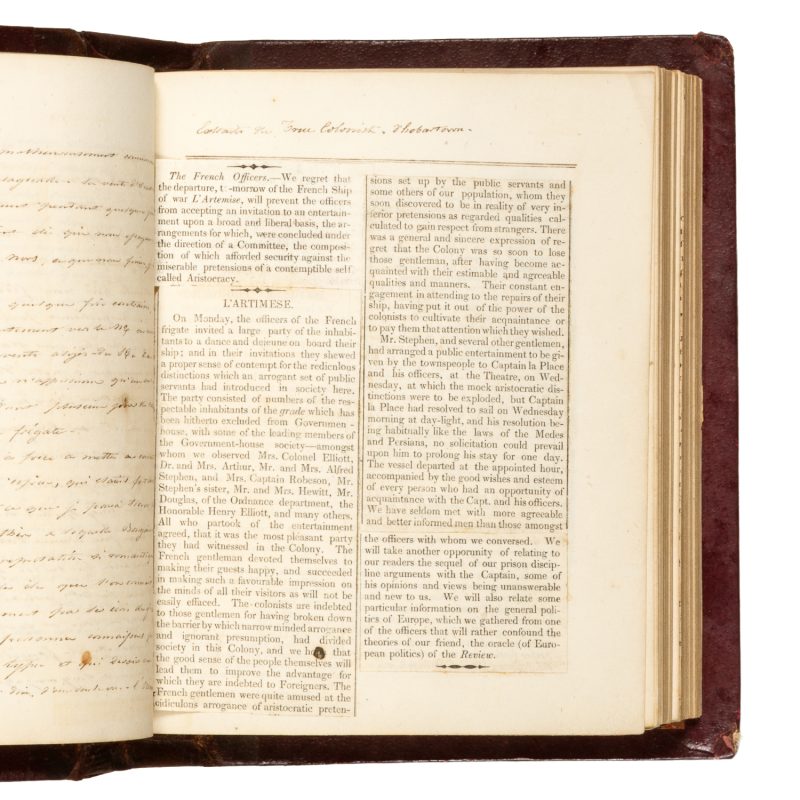
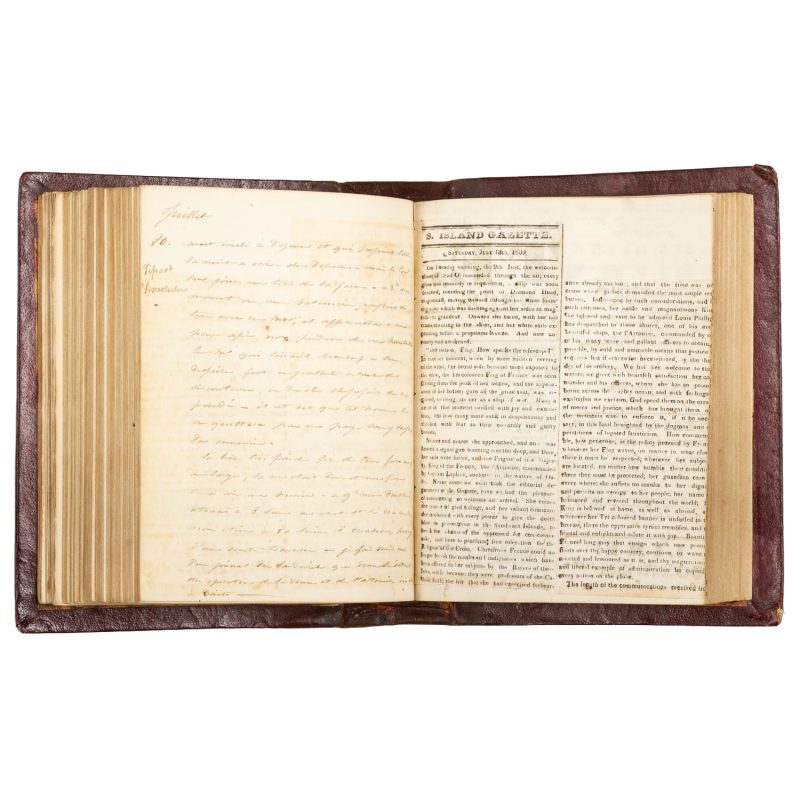
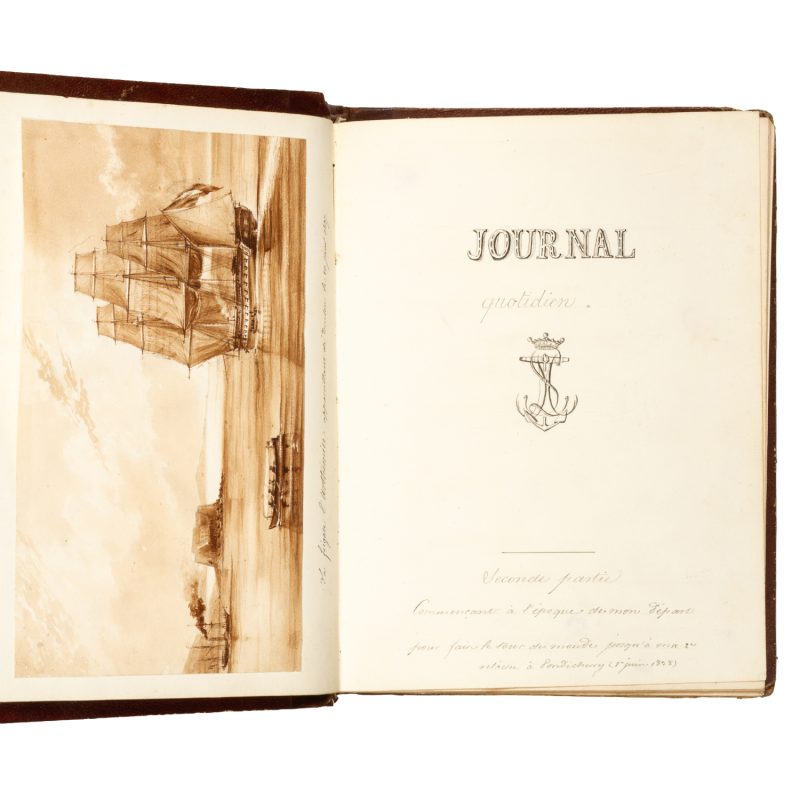
Montaignac then explains that, ‘Not having commenced my daily journal until after embarking the frigate Artémise, in 1835, I have placed at the beginning, under the title of Summary Journal (‘Journal Sommaire’), a sort of analytical table of events in my life since 1827 [when I entered] into the Royal Navy.’ After this summary of Montaignac’s early career on board various vessels serving in West and North Africa, as well as the West Indies, the bulk of the first volume (the final thee-quarters of it) contains Montaignac’s original shipboard journal kept on board l’Artémise from the time he joined the ship on 16 August 1835, up until the end of 1836; this includes his account of the ship’s visit to New York during its diplomatic mission to the United States (there are several mounted clippings from New York newspapers relating to this). The second and third volumes contain, in its entirety, the all-important daily journal kept by Montaignac during Laplace’s second circumnavigation in l’Artémise, which commences on 1 January 1837 while the ship was still at Toulon ready for her departure on 20 January, and finishes with the expedition’s return to France at the end of March 1840.
THE SECOND CIRCUMNAVIGATION OF LAPLACE IN L’ARTÉMISE
Captain Cyrille Laplace completed two circumnavigations: the first, in La Favorite (1829-1832), is described by him in the official voyage account Voyage autour du Monde par les Mers de l’Inde et de la Chine: executé sur la Corvette de l’État la Favorite, pendant les Années 1830-32, which was published toward the end of 1833. The second was undertaken in l’Artémise (1837-1840), the official account of which was published between 1841 and 1854 as Campagne de circumnavigation de la frégate l’Artémise, pendant les années 1837, 1838, 1839 et 1840. Laplace, through his diplomatic efforts, helped lay the foundations for French trade in Oceania. He also played a key role in the establishment of the Hawaiian Catholic Church.
Laplace’s second circumnavigation, in the fifty-two gun frigate l’Artémise, has a significant place in the history of European colonial relations with Hawaii. When Laplace arrived there in July 1839, having a little earlier visited Hobart (23 January-20 February) and Sydney (2-18 March), where in both ports the stated mission of l’Artémise was reported by the local press to be the protection of French whaling interests in the Pacific, he became the first Frenchman to visit the islands with ‘specific instructions from Paris to enter into official diplomatic relations with the Hawaiian government. The French minister of the navy, Ducampe de Rosamel, sent Laplace to Honolulu to make it unmistakably clear to the Hawaiian king and chiefs that if they wanted to maintain good relations with major international powers such as France, they must not take lightly promises made in treaties with those powers’ (Mary Ellen Birkett, The French perspective on the Laplace Affair, Hawaiian Journal of History, Volume 32, 1998). The so-called Laplace Affair, also known as the French Incident, was a classic case of gunboat diplomacy and refers to the French military intervention in 1839 intended to curtail the persecution of Catholics in the Kingdom of Hawaii that had up to that point been promoted by Protestant ministers, and to force the Hawaiians to lift their prohibitive tariff on French products. Faced with the threat of war, King Kamehameha III acceded to French demands to cease the detention of Catholic citizens, reduce import tariffs, and for reparations to be paid.
THE SECOND VOLUME OF MONTAIGNAC’S JOURNAL
Contents: Ensign Montaignac’s daily journal kept during the first part of the circumnavigation of l’Artémise, covering the period 1 January 1837 (departure from France) – 15 October 1838 (Manila); approximately 100,000 words in total. In addition to the manuscript itself, there are many beautifully executed original watercolours and pen and ink drawings by Montaignac – a talented draftsman – as well as items of printed or manuscript ephemera souvenired by him during the voyage, all mounted on stubs, over 30 in total. These include:
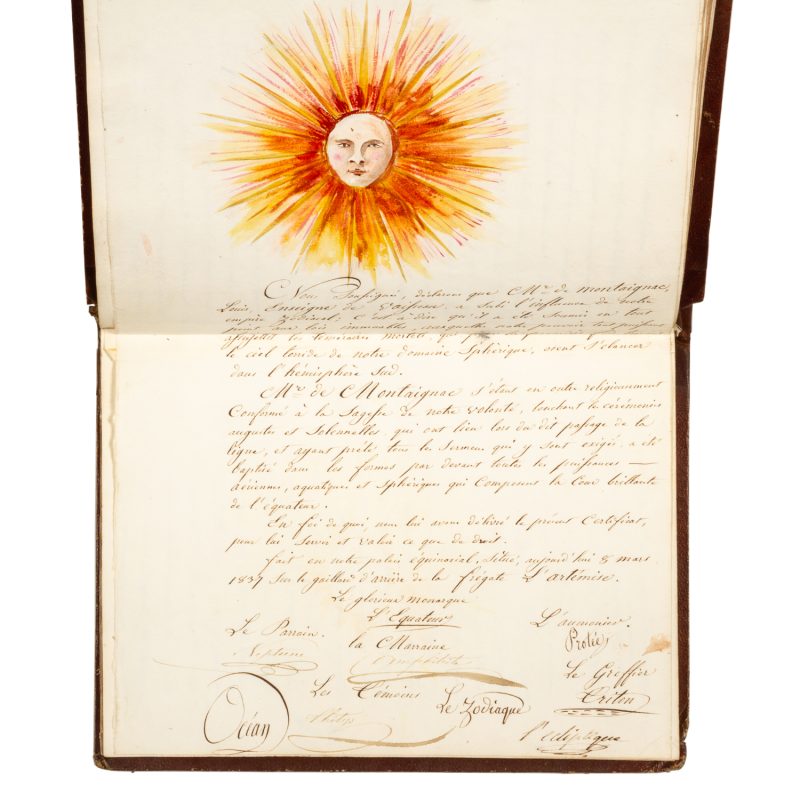
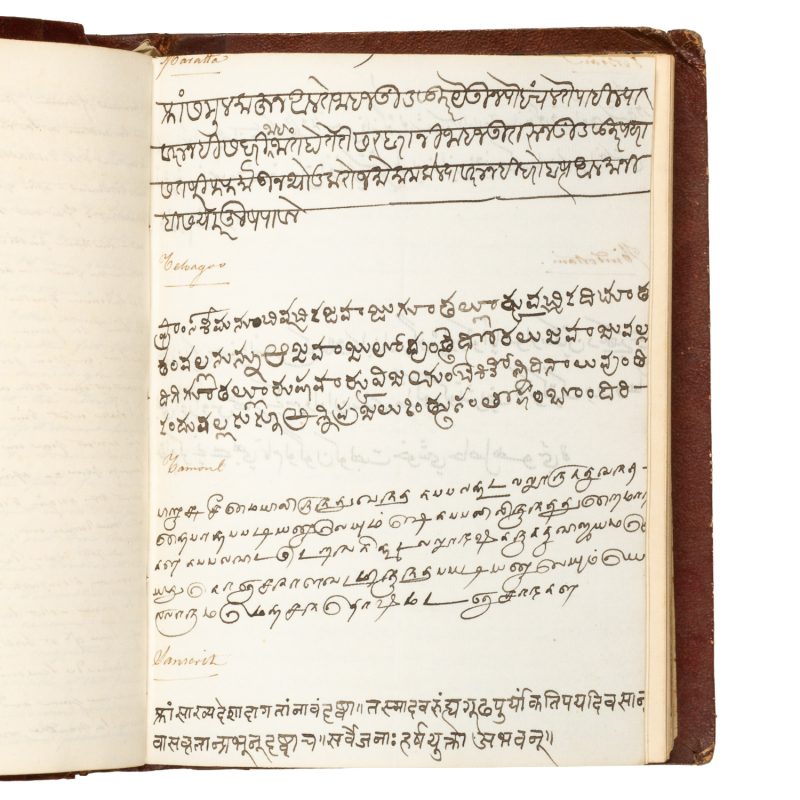
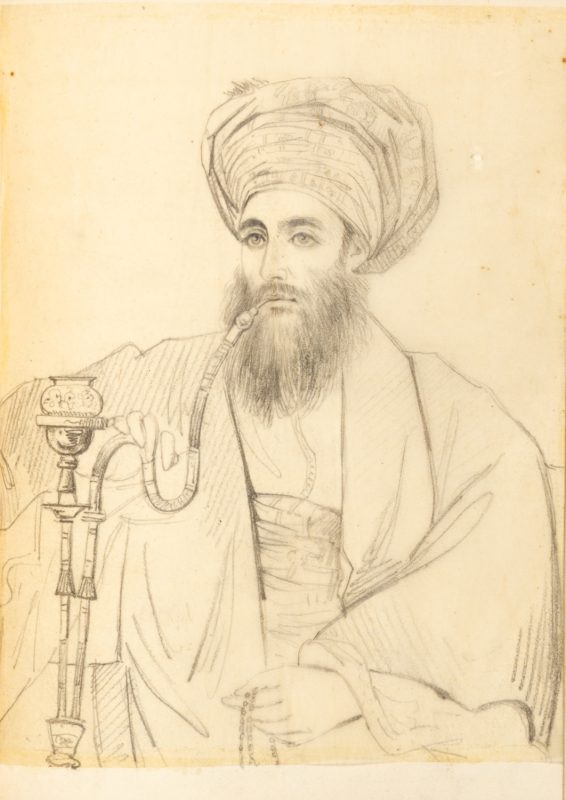
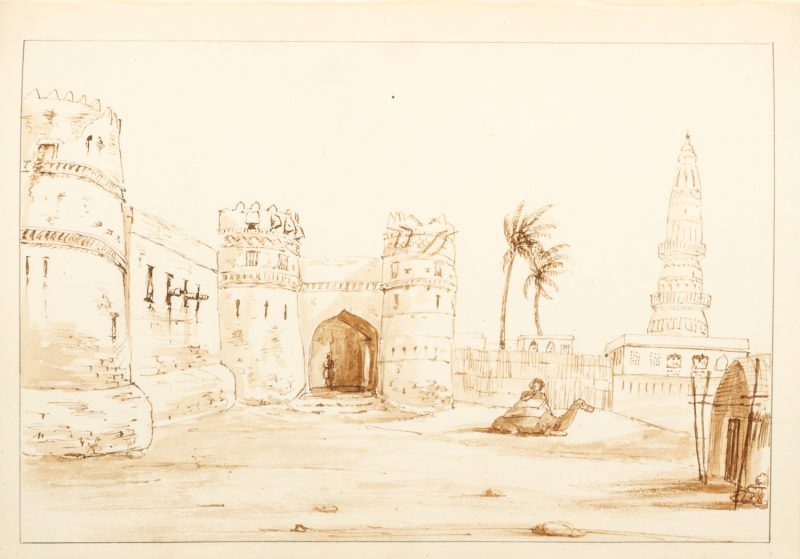
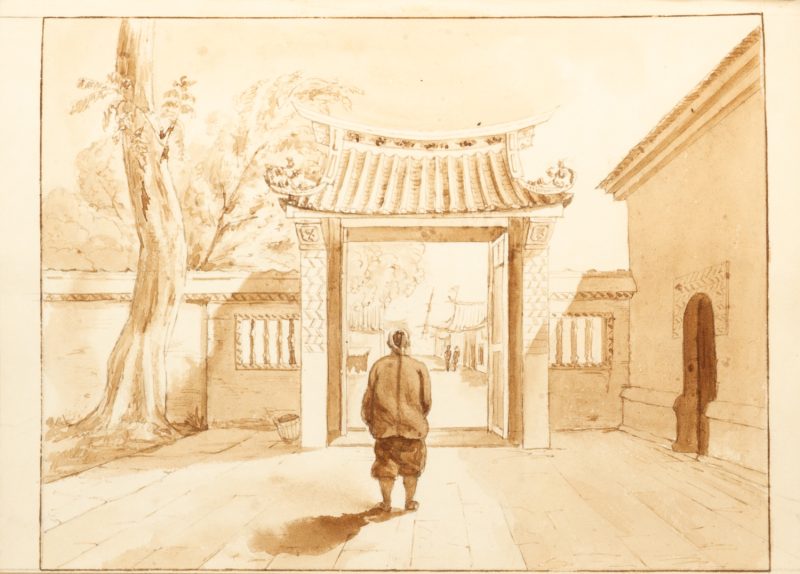
Watercolour of the Artémise on the day of her departure from Toulon; watercolour view at Gorée; a manuscript “crossing the line” certificate with watercolour embellishment (double-page); music notation for a piece entitled Valse hottentote (2-pages); watercolour view at St. Denis, Île Bourbon; clipping from a Port Louis (Mauritius) newspaper with an account of the visit of the Artémise; watercolour technical drawing of a piece of machinery for extracting coconut oil at Agaliya (Ceylon); watercolour of a mosque at Karkal (India); extremely detailed ink drawing of the gate of the pagoda at Tranquebar; Christian pamphlet in Malagasy Ny lalana roa (4 pages); 2 pages of manuscript examples of various Indian languages/scripts, including Telugu, Tamil, Sanskrit, Persian, and Hindustani (Urdu, in Perso-Arabic script) – these appear to be translations of the same passage, and were possibly written by one informant; ink drawings of a pleasure boat of a Babu, and of a British East India Company vessel with native oarsmen; watercolour view of an island near Pulo Riah (Sumatra); watercolour view of a vessel transporting teak wood (Cochinchina); clipping from the Bombay Gazette with an account of the Artémise‘s activities; watercolour view of Old Goa; watercolour view of the gate and minaret of al-Shadhili in Mocha (Yemen); pencil portrait of Ruben Ben Aslam sketched by (?)Greslier (done at Mocha); coloured lithograph of French naval uniforms, taken from the Journal des Tailleurs, September 1837; double-page lithograph map of Africa, the Indian Ocean, China, Southeast Asia, and the west coast of Australia, with manuscript track of the Artémise added in red ink; watercolour view of a residence in (?)South India; architectural ink drawing of an Indian temple; watercolour of an Indian noble’s conveyance; watercolour view of a Chinese street; pen drawing of a civic building (Penang?); watercolour of a pagoda (Penang?); watercolour of the mangosteen, showing the outside of the fruit and the white centre; watercolour view of a bungalow in Malacca; watercolour view of a Malay temple (Malacca?); watercolour view of a Chinese cemetery (Malacca?); watercolour view of a traditional dwelling on stilts (Philippines).
THE THIRD VOLUME OF MONTAIGNAC’S JOURNAL
Contents: Ensign Montaignac’s daily journal kept during the last part of the circumnavigation of l’Artémise, covering the period 17 October 1838 (departure from Manila) – 26 March 1840 (return to France); approximately 100,000 words in total. In addition to the manuscript itself, there are numerous original drawings in watercolour and pen and ink, plus numerous pieces of printed and manuscript ephemera, all mounted on stubs, around 15 total. These include:
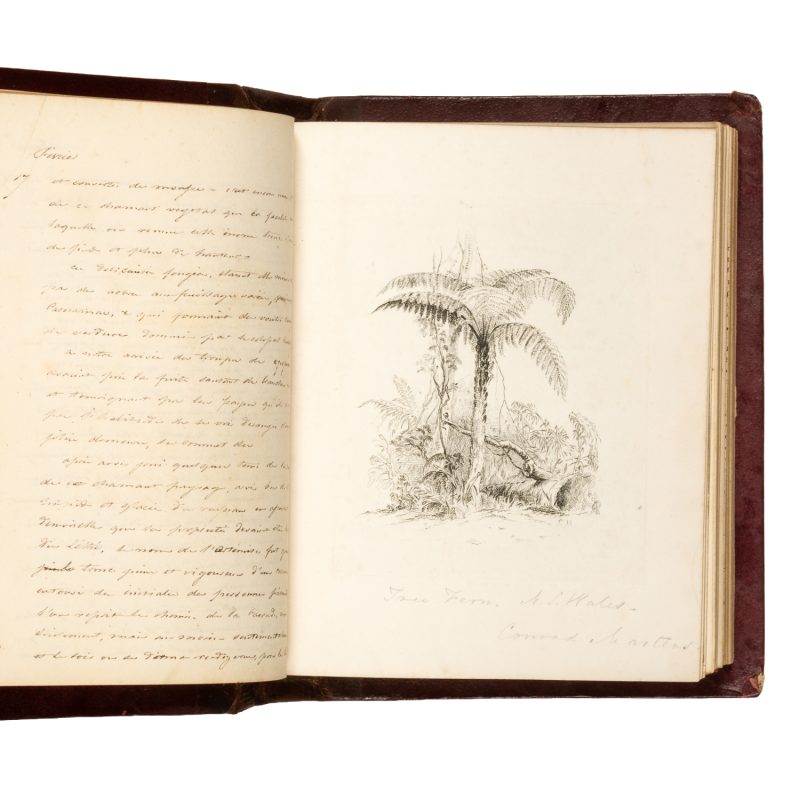
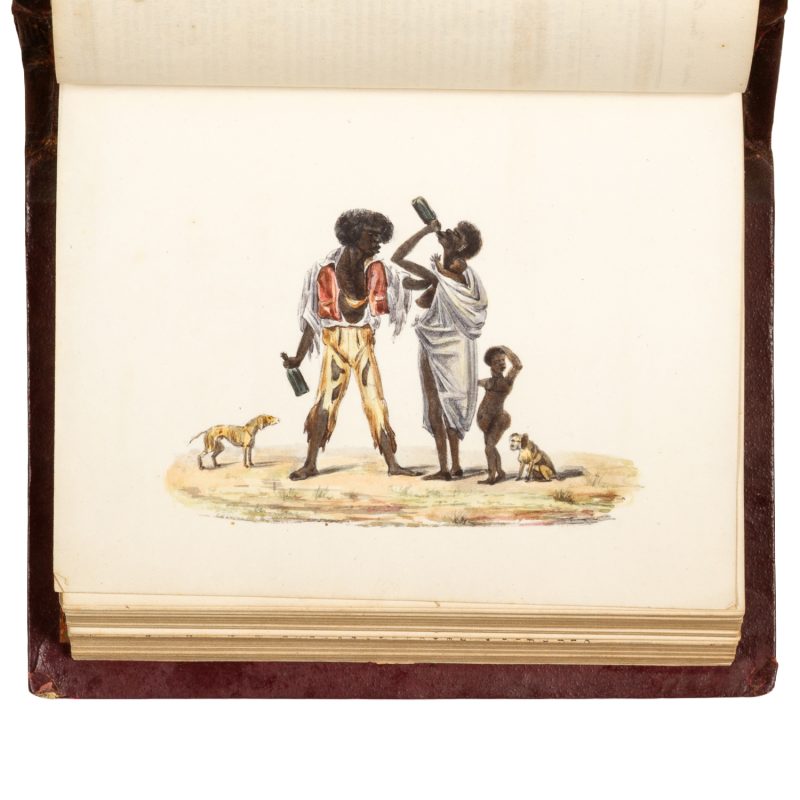
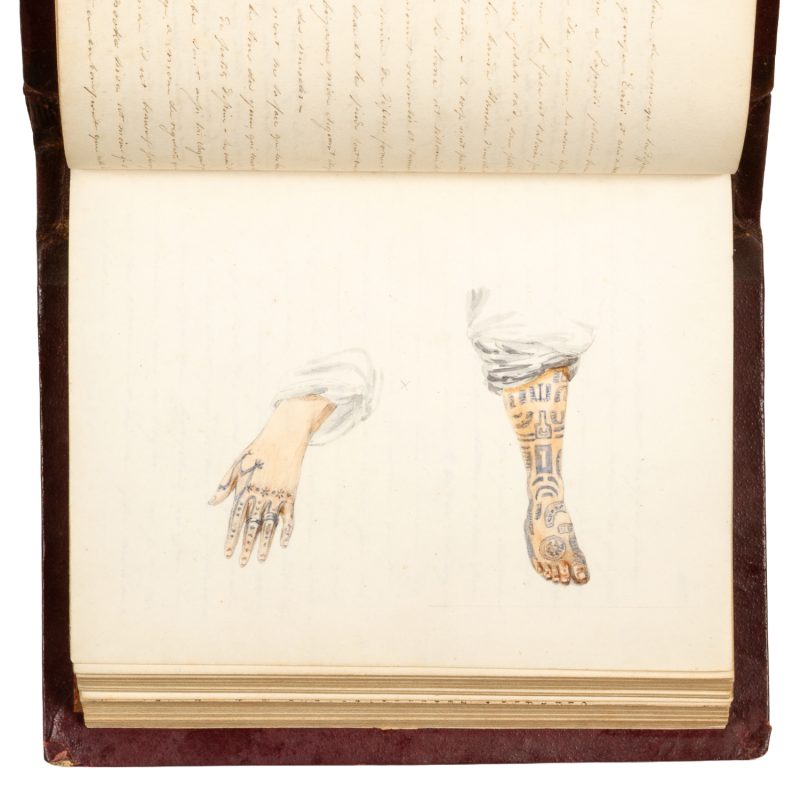
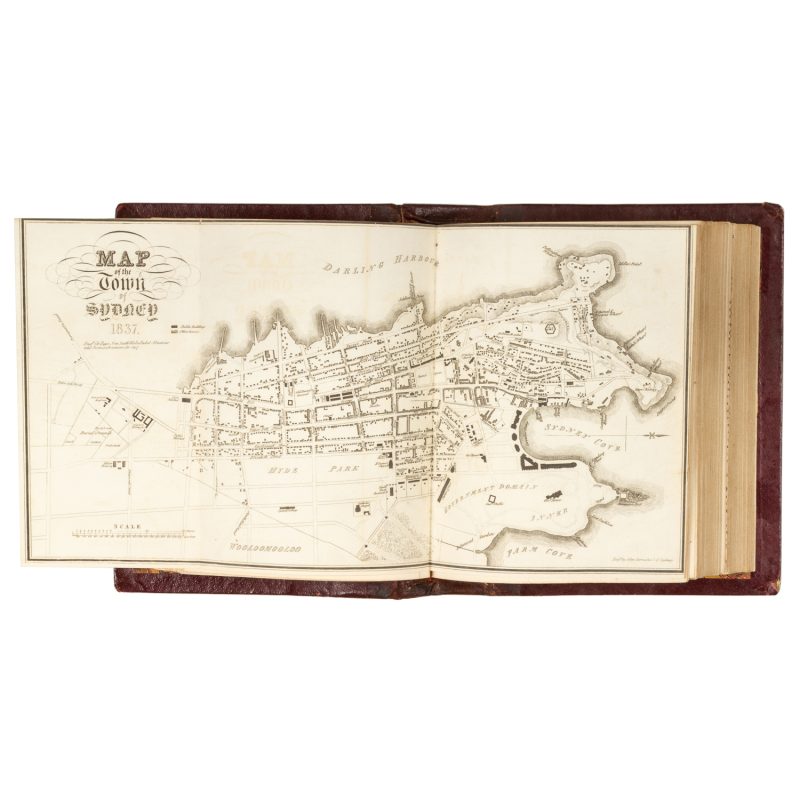
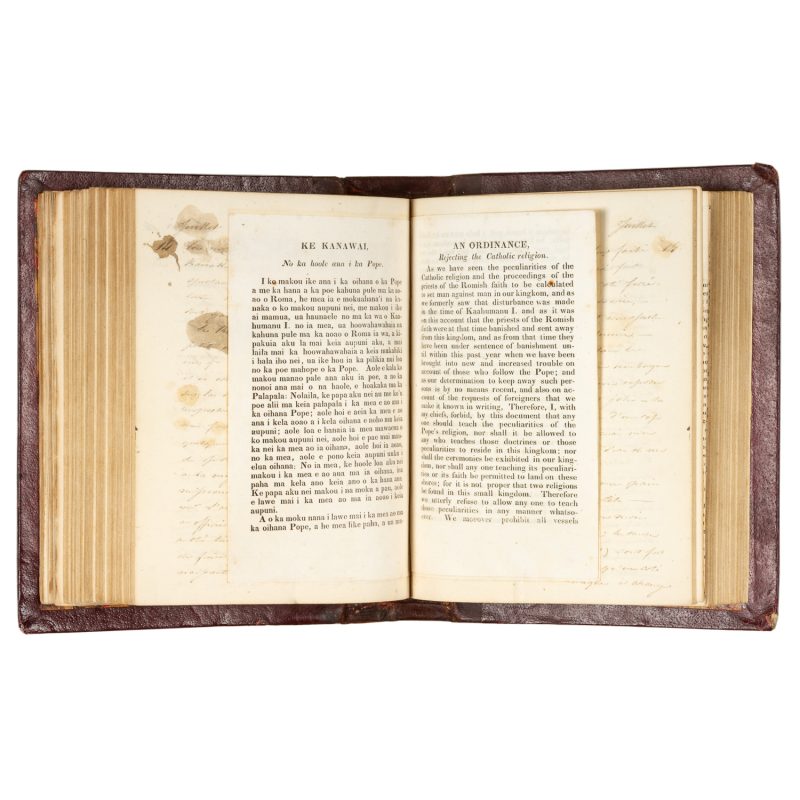
Specimens of Chinese calligraphy (including a phonetic rendering of ‘Montaignac’!) and Southeast Asian scripts; watercolour of a Chinese fisherman’s sampan; watercolour of Macau; etching of a tree fern, New South Wales by Conrad Martens, captioned and signed in pencil by the artist; clippings from Hobart newspapers relating to l’Artémise; Carmichael’s folding engraved ‘Map of the Town of Sydney, 1837’ (taken from Tegg’s New South Wales Pocket Almanac and Remembrancer for 1837); watercolour of Aborigines (one wearing a king plate) drinking alcohol (unsigned, but after the engraving Male & Female Black Natives New South Wales, designed and etched by the deaf artist John Black Carmichael and published in James Maclehose’s The picture of Sydney and stranger’s guide in New South Wales, for 1838; we believe this original watercolour is attributable to Carmichael himself, such is the uncanny level of accuracy with which the anonymous artist has replicated the style, scale and detail of the engraving); watercolour studies of Tahitian tattooing (hand and lower leg); Kamehameha III’s printed pamphlet An Ordinance rejecting the Catholic religion (Ke Kanawai No ka hoole ana i ka Pope), Lahaina, Maui, December 18 1837; clippings from Hawaiian newspapers relating to l’Artémise; partial engraved map of the Pacific with manuscript track of l’Artémise added in red ink by Montaignac; watercolour of Puna Island near Guayaquil; watercolour of an unidentified Peruvian(?) town. Note: the last four watercolours in this volume, including the one which so faithfully reproduces Carmichael’s engraving, are all on the same type of lightweight sheet that is different to the thicker paper used by Montaignac earlier in the voyage. This suggests Montaignac acquired a new sketchbook either in Hobart or Sydney. Significantly, this may point to John Black Carmichael – for if he was not the artist responsible, who else in Sydney could have been? – having executed the watercolour of New South Wales Aborigines directly onto a page of Montaignac’s new sketchbook. This is not an entirely implausible scenario, as Eaton notes that in 1827, when working from 21 Castlereagh Street, Carmichael ‘accepted assignments “on the shortest notice and the most reasonable terms”‘ (Karen Eaton, John Black Carmichael (1803-1857), artist and engraver, in Australiana, Nov. 2015, vol. 37 no. 4, 8). Furthermore, Carmichael was acknowledged as a supremely skilful copyist, readily capable of forging a banknote (ibid., 10).
Montaignac’s diary entries during his time in Hobart occupy over 30 pages, and those made in Sydney approximately 20. The Sydney entries include physical descriptions of the harbour and surrounds; commentary on recent developments in Tahiti; socialising with the family of Elizabeth Street merchant Frederick Manton and his Mauritian wife Marie Émilie Blanchard, and her brother Julien Blanchard (Manton’s business partner), through whom he meets a number of women including Elizabeth Chambers, “Isabelle from Parramatta”, and Miss Pritchard (“Jolie femme…”); socialising with the family of John Hubert Plunkett (Attorney-General), whose wife was educated in Paris, “dined, danced and passed a charming evening”; socialising with Colonial Secretary Edward Deas Thomson and his wife Anna Maria (daughter of Governor Bourke), Colonel Henry Croasdaile Wilson, First Police Magistrate of Sydney, Miss O’Connell (daughter of Captain Maurice Charles O’Connell, commander of forces in Sydney), John Edye Manning, lawyer who had spent a long time in Paris, barrister Sydney Stephen and his “fille charmante…”; comparison with Hobart Town, which Montaignac believes had more variety; makes the acquaintance of the artist Conrad Martens through Mr. Lempriere, mentions his “admirable aquarelle”, and visits his studio at the house of Martens’ father-in-law [North Sydney]; mentions Mr. George William Evans, bookseller and artist, of Bridge Street; mentions that Martens was artist on the Beagle with Captain King, and made the drawing of St. Croix (Santa Cruz) River in Patagonia, and that on his arrival in Sydney Captain Philip Parker King became his patron; extended commentary on Martens’ work and talent.
Louis Raymond de Montaignac de Chauvance (1811-1891) was a French naval officer and later a politician of the Third Republic. Born in Paris, he was the son of Raymond de Montaignac de Chauvance and Anne Raffin d’Hauterive. He would marry Sabine Gaillard d’Auberville (1826-1913) on May 22, 1844. He began his naval career as a second-class cadet (October 1827), serving in the Levant campaign aboard the Bayadère (1828-1829) and then off the coasts of Africa and in the West Indies aboard the Diane and the Marne (1829-1832). In 1832 he was on the Émeraude where he was appointed ensign (January 1833). He was made second-in-command of the Castor (1834) on the Algerian coast, before serving from January 1837 to April 1840 on Laplace’s Artémise during its circumnavigation voyage. He was promoted to lieutenant in December 1840. He then conducted studies on propeller propulsion and analysed new types of warships, which were built under his supervision in Lorient and Le Havre (1841-1842). He undertook a study of marine machinery in England and Holland, then received command of the steam vessel Corse, which he developed (1842-1844). In 1845, he was appointed to the Special Commission for Steamships, and in 1846 he commanded the Moustique and the Granville station. He was placed in command of the Rôdeur (1847), then promoted to frigate captain (July 1848). He commanded the Pélican (1850) and the North Sea station. He again commanded the Corse in 1851, and became a member of the Works Council in November 1853. He was appointed Chief of Staff of the Baltic Squadron (1854), and served in Crimea where he distinguished himself on October 17 1854, during the attack on Sevastopol. As Commander of the Dévastation floating battery, he again distinguished himself at the Battle of Kinbourn. He commanded the Newfoundland station in 1859-1860 on the Gassendi and then in 1860-1861 on the Pomone. In 1862 he joined the Admiralty Board, and in 1864 commanded the Bisson and the northern coastal division. He was then promoted to rear admiral (September 1865), major general at Cherbourg, and member of the board of directors of the École Polytechnique (1869). He participated in the defence of Paris in 1870, commanding the Auteuil and Vaugirard sectors. In February 1871, he was elected deputy to the National Assembly for Seine-Inférieure and Allier, opting to represent the latter department. He was then appointed president of the Naval Commission and vice-president of the Army Reorganization Commission. He retired from the navy in March 1873, with the position Inspector of the fleet and ports of the English Channel. He served as President of the Higher Commission of the National Institution for Disabled Veterans and of the Central Society for the Rescue of Shipwrecked Persons (1881-1890), then was appointed Minister of the Navy (May 1874-March 1876). During his time in office, he supported the organization of the first exploratory mission to Africa, led by Pierre Savorgnan de Brazza, whose family he had known since a trip to Rome in 1865. He produced studies on improvements to nautical charts, on coal trade in England, and on coastal defence in France and England. In December 1875 he was made a permanent senator. He died on June 9, 1891 in Paris and was buried in the Gueutteville cemetery (Seine-Maritime), in the Montaignac de Chauvance family plot.
Provenance: Louis Raymond de Montaignac de Chauvance (1811-1891); his daughter, Marthe de Rorthays (1846-1913); thence by descent.
Below is a translation of the manuscript note, written by a later family member, which is mounted on the front free-endpaper of the first volume. It not only explains the ownership history of the journals, but also accounts for the presence of the Vallière ex libris at the front of each volume. (It contains at least one inaccuracy: Louis Raymond de Montaignac de Chauvance in fact had seven children, not four).
‘Explanation of this bookplate.
[Great-]Grandfather Louis Raymond de Montaignac, who married Sabine d’Aubervile, had four children with her:
I. Renaud, who died without issue in a motoring accident in 1898, during a race between Marseille and Nice.
II. Pierre, who married Mademoiselle de Rocheboüet (divorcee of M. de Robineau). She owned [the Château-la-] Vallière, in Maine-et-Loire, where they [both] lived until their death. This marriage caused a scandal, and was the reason for the ostracism through which Pierre was deprived by his two sisters.
III. Marie, who married Maurice de Vernouillet, a diplomat in Morocco, [with whom she had] two daughters.
IV. Marthe, who married Alfred de Rorthays, and had issue [i.e. Anne-Marie de Rorthays 1872-1907; Raymond de Rorthays 1874-1951; Isabelle de Rorthays 1878-1905]
On the death of [Great-]Grandmother Bisa [i.e. Sabine], widow of Louis Raymond de Montaignac, protracted negotiations took place between Pierre and his sisters. He had seized control of everything which was of interest to him at Gueutteville, but following his sisters’ protests, he returned certain things to them, including these accounts of their father’s memories [i.e. the present three manuscript journals], to Grandmother Marthe de Rorthays, but during the time he had kept them at Vallières [sic], the bookplate of the Rocheboüet Library had been affixed to them.’


