


# 51454
MANSFIELD, Ralph (proprietor)
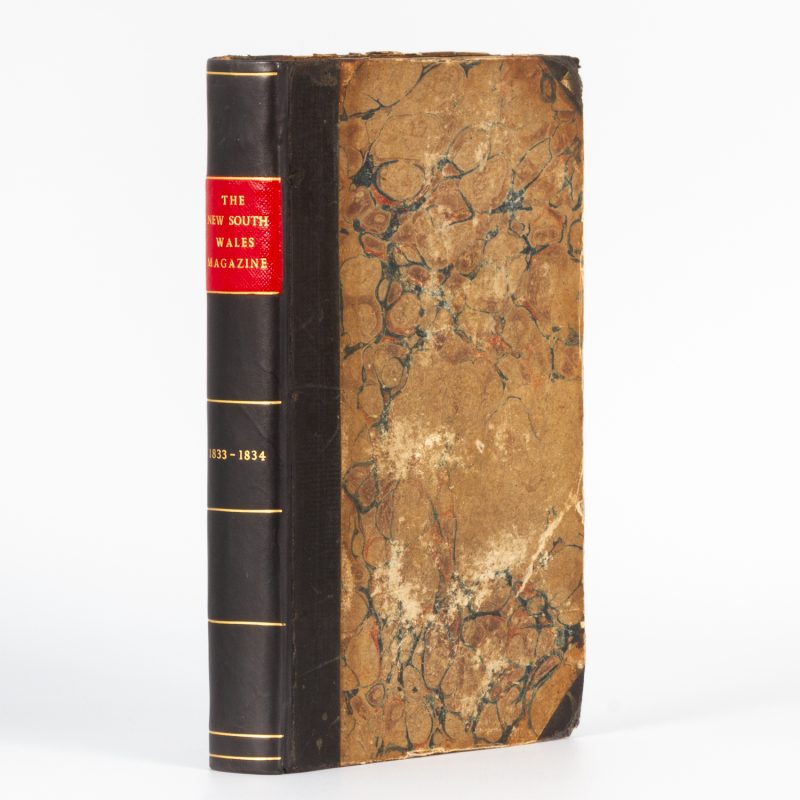
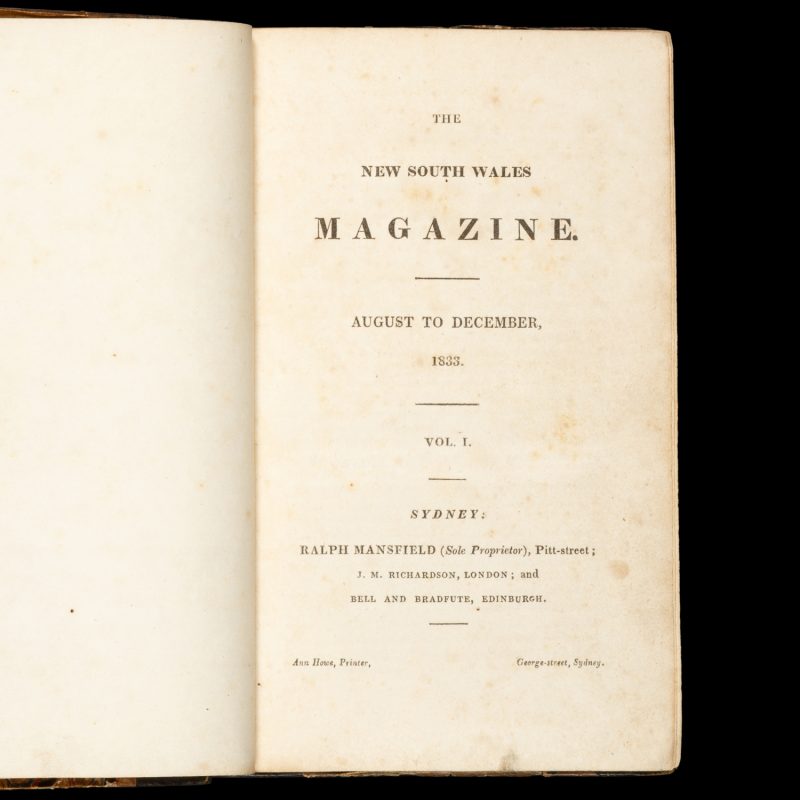
The New South Wales Magazine. August to December, 1833 & January to February 1834.
$5,000.00 AUD
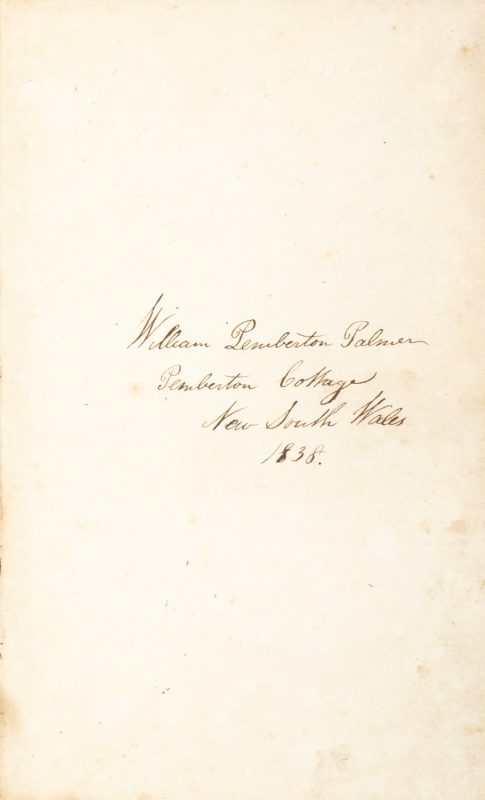
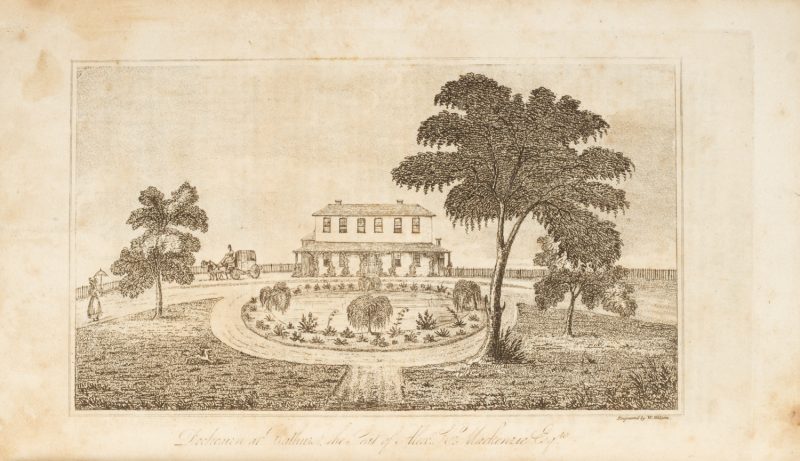
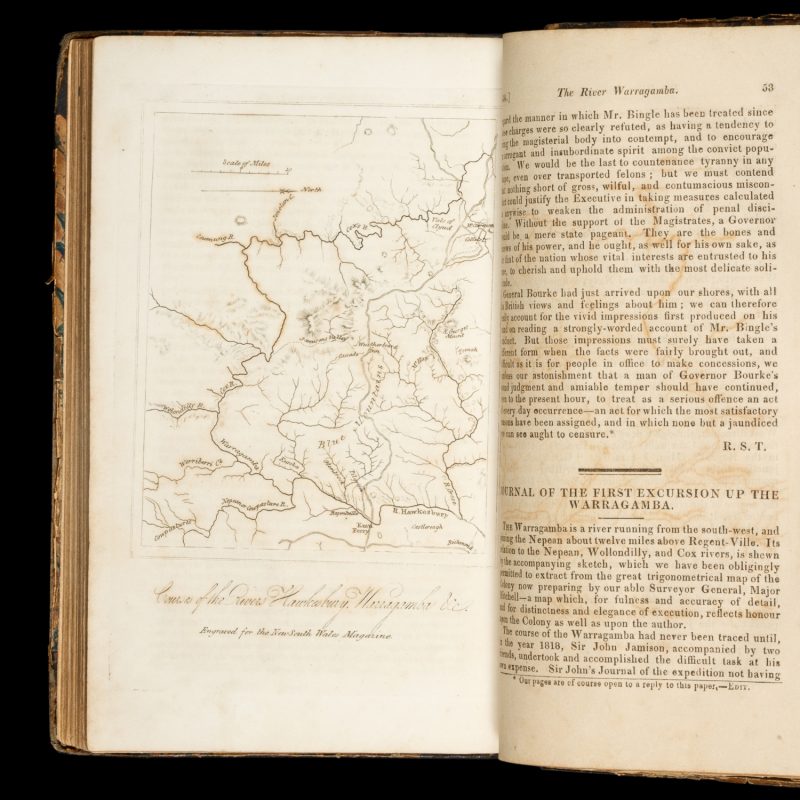
Sydney : Ralph Mansfield, 1833-1834. Numbers I-VII (of VIII). Octavo (220 x 140 mm), contemporary half leather over marbled boards (spine replaced); front free-endpaper with early ownership inscription of ‘William Pemberton Palmer, Pemberton Cottage, New South Wales 1838‘; pp. ix, [1 blank], [1 Description of Dockcairn, Bathurst], [1 blank], [2 Contents], 1-64, [2 Contents], 65-128, [2 Contents], 129-192, [2 Contents], 193-256, [2 Contents], engraved plate Dockcairn at Bathurst, 257-328; [2 Contents], 72 (with a full-page engraved map Course of the River Hawkesbury, Warragamba &c. at p. 53), [2 Contents], 148; the August 1833 issue lacking pp. 3-6, one leaf in the January 1834 issue with a closed marginal tear, scattered browning and light foxing; front pastedown with bookplate of Dr. Frank Hobill Cole (1863-1934).
A rare near-complete run of The New South Wales Magazine, a short-lived monthly periodical published in Sydney from August 1833 to March 1834. The Magazine was owned by former Wesleyan missionary and noted Sydney bookseller of the time Rev. Ralph Mansfield (who in 1829 had succeeded the Howe dynasty in the management of the Sydney Gazette) and was printed by Ann Howe, widow of Robert Howe. It contained articles on a wide range of subjects including literature (with original poems by colonial writers Henry Halloran and John Newcome), colonial exploration, Australian Aborigines, Sydney current affairs, transportation, law, politics, economics, religion, Busby on vine cultivation, and natural history.
Ferguson 1690 (not calling for any illustrations)
The original owner of the present volume, William Pemberton Palmer, was born in Parramatta on 11 Oct 1810, and died at Warialda on the North West Slopes of New South Wales in 1864. He was the son of prominent Macquarie-era figure and Parramatta colonist George Thomas Palmer (1784-1854), who had married Catherine Irene Pemberton at Malta in 1805; the couple arrived in Sydney as free settlers on the Albion in 1806. From the ADB entry on George Thomas Palmer:
‘Between 7 May 1810 and 7 November 1811 he acted as provost-marshal while William Gore was absent in England. When Governor Lachlan Macquarie dismissed John Jamieson from the position of superintendent of government stock, he appointed Palmer in his place from 1 May 1813 at an increased salary which he thought more commensurate to responsibility for government property valued at £40,000, and recommended Palmer at this time as ‘a Young Man of good Education, high Honor & Integrity, active diligent & intelligent’. However, Palmer resigned the position within a year, set up his home at Pemberton Grange near Parramatta, and acquired extensive lands and stock, including 700 acres (283 ha) at Bringelly granted in August 1812. By 1828 he held Ginninderra Station in County Murray, where nearly 4000 (1619 ha) of its 13,200 acres (5342 ha) had been cleared and he ran almost 2000 head of cattle and 6000 sheep. He was a shareholder in the Australian Agricultural Co.
He was notably active in colonial public life. He was a magistrate for many years and, though one of those who preferred dismissal in August 1822 by Governor Sir Thomas Brisbane to association on the bench with Henry Grattan Douglass, was reinstated in November 1825. He was a member of the managing committee of the Female Factory in the late 1820s. In July 1829 he signed the address of landed proprietors and merchants in support of Governor (Sir) Ralph Darling and in August 1836 served on the committee in opposition to the establishment of National schools. In 1829 his name was included in the list of those who might be nominated to the Legislative Council should there be a vacancy in that body. Later he returned to England and he died on 26 October 1854 at Bath, where he was buried. His wife and nine children survived him.’
William Pemberton Palmer married Rosezeatte Durham Durden (1815-1865) in London on 14 November 1831, and the couple had two children after returning to New South Wales. At the time he inscribed this volume in 1838, William and his young family were still living at Pemberton Cottage on William’s father’s Parramatta farm, Pemberton Grange; they would later settle on the Gwydir River on the North West Slopes.


