


# 50583
[MORETON, John]
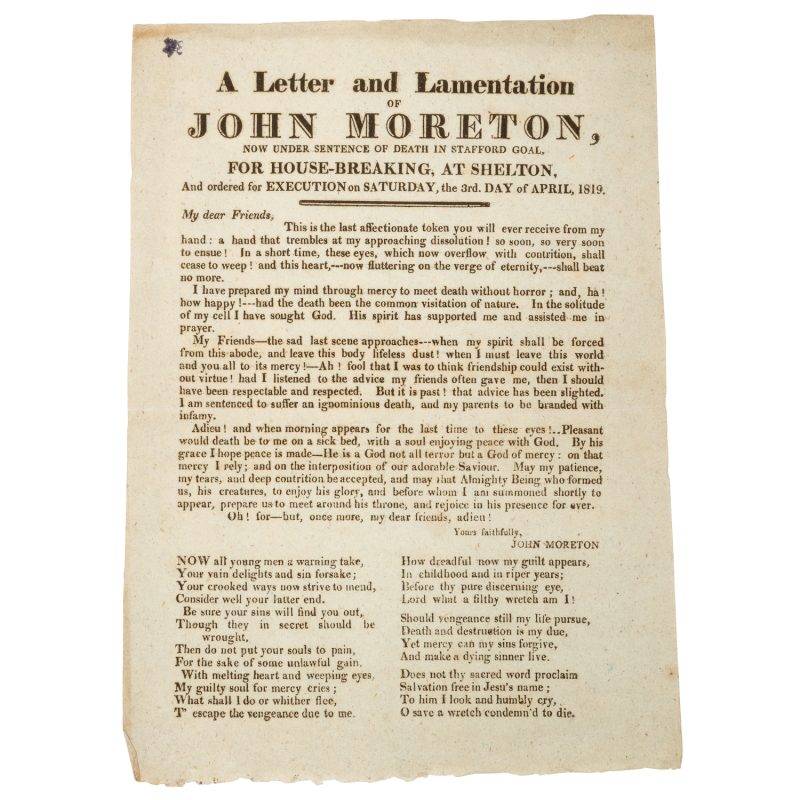
[TRANSPORTATION] A Letter and Lamentation of John Moreton, now under sentence of death in Stafford Gaol. For house-breaking, at Shelton, and ordered for Execution on Saturday, the 3rd. day of April, 1819.
$7,500.00 AUD
[Stafford? Newcastle-under-Lyme?] : [s.n.], [1819]. Broadside, 250 x 180 mm, printed on the recto only; edges uncut; some very minor creasing, but a fine example.
A rare printing associated with repentant convict John Moreton, a Staffordshire potter who had worked with Josiah Wedgwood. Moreton was transported to New South Wales, where he was placed in charge of the Government Pottery in 1820 and then established one of Australia’s earliest commercial potteries in Sydney’s Surry Hills, in 1823.
This appears to be the only edition of this broadside, and we can trace only two other examples of it (Bodleian Library; Harvard Law Library). It made available to the Staffordshire (and wider) public the last ‘letter and lamentation’ of John Moreton (1777-1847), a potter from Newcastle-under-Lyme convicted of house-breaking and silverware theft alongside an accomplice, fellow potter Jonathan Leak, on the 3 April 1819. Moreton and Leak were initially sentenced to death for their crimes and held in Stafford Gaol on death row. This is the text of Moreton’s emotional and melodramatic appeal against that severest of penalties, which was almost certainly penned by an amanuensis. In it, Moreton expresses his remorse, apologises to his ‘dear friends’ for his transgressions, and makes evident his rapid pivot towards devout Anglican piety. The main text is followed by a short piece of admonitory verse, addressed to ‘all young men’, warning them of the perils of ‘vain delights and sin’ in youth, that so soon can lead to ‘death and destruction’ at the gates of Heaven.
Within just two weeks after their initial convictions at the start of April 1819, both Moreton and his collaborator Leak had their sentences commuted to transportation for life. They both arrived in Sydney on the Recovery in December of the same year. Both men were stationed at the Government Pottery on Brickfield Hill, Sydney – of which Moreton had been placed in charge by the end of 1820 – and began to produce a range of early Anglo-Australian earthenware. By 1822, both had received tickets of leave and were permitted to re-enter employment. Leak, who had been joined by his wife, established his own earthen-works, one of the earliest potteries in Australia, off Elizabeth Street, near the Brickfields. He continued to work as a potter up until his death in 1838; his two sons were both listed as ‘brickmakers’ during this period. Meanwhile Moreton, having already been joined by his three sons in 1821, now established his own pottery in Surry Hills. By the 1828 census Moreton’s sons, now aged 22, 19 and 17, were also all listed as potters residing at Brickfield Hill. All four Moretons worked in the Surry Hills area, where John Moreton died in 1847.
The convict potters John Moreton and Jonathan Leak, whose story is so entwined, were the most prominent and significant of the handful of potters working in Sydney in the 1820s and 1830s, and extant examples of their work hold pride of place in museum and private collections.


