




# 48772
THUNBERG, Carl Peter (1743-1828); LAMARCK, Jean-Baptiste de Monet de (1744-1829)
Travels in Europe, Africa, and Asia, made between the years 1770 and 1779.
$1,800.00 AUD
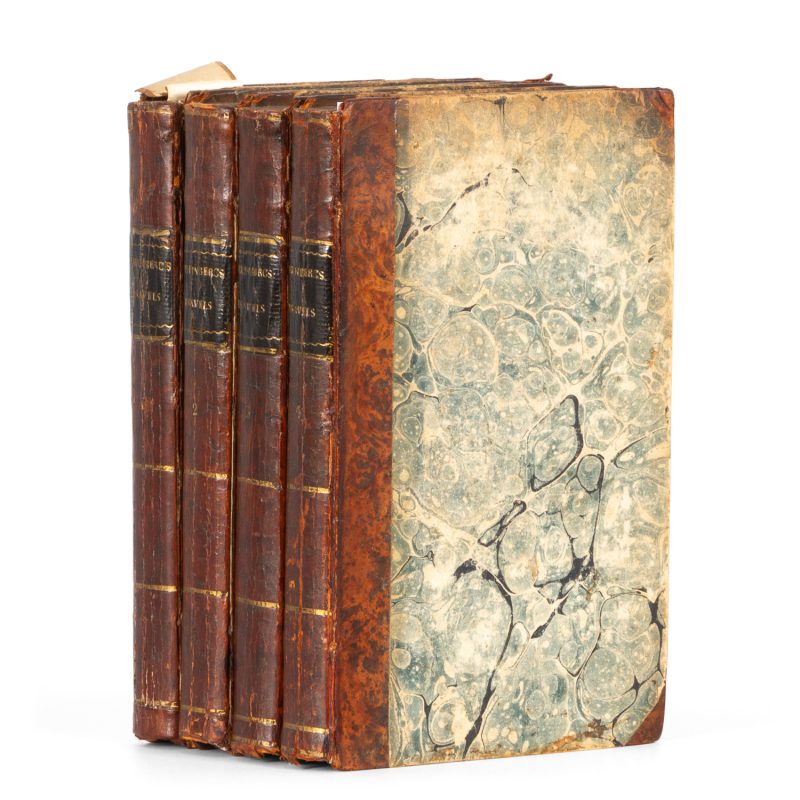
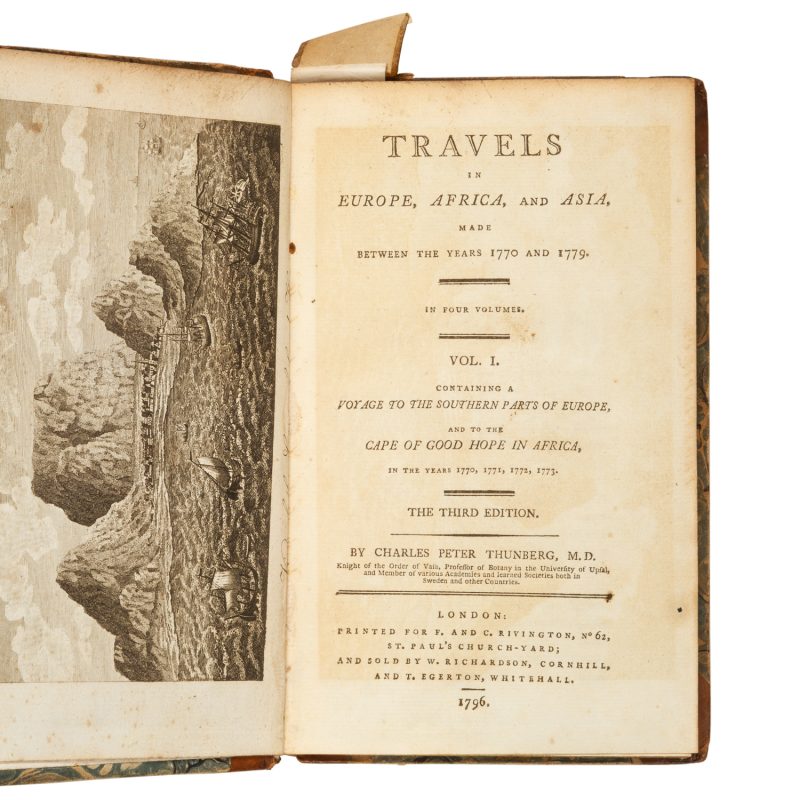
London : Printed for F. and C. Rivington, 1796. Third edition. Four volumes, octavo, handsome uniform early bindings of half calf over marbled papered boards, spines with leather title-pieces lettered in gilt; speckled edges; bookplates to pastedowns, Vol 1: A Voyage to the Southern Parts of Europe, and to the Cape of Good Hope in Africa; Vol 2: Two expeditions to the interior parts of the country adjacent to the Cape of Good Hope and a Voyage to the Island of Java; Vol 3: A Voyage to Japan and travels in different parts of that Empire; Vol 4: Travels in the Empire of Japan and in the island of Java and Ceylon, together with the Voyage Home; pp. 317 + 316 + 285 + 293; index in each volume; Vol. I with engraved frontispiece (View of the Cape of Good Hope) and a folding plate (Arms and Implements of the Hottentots); Vol. II with 4 plates; Vol. IV. with 4 plates; a very good set
The Swedish naturalist Carl Peter Thunberg (1743-1828), a disciple of Linnaeus, spent some seven years travelling in Europe, the Cape of Good Hope, Ceylon, the East Indies, and – most significantly – Japan, recording his scientific and cultural observations as well as collecting natural history specimens. He arrived at the Dutch factory at Dejima in the Bay of Nagasaki in August, 1775, where he was soon appointed head surgeon of the trading post. He was diligent in his gathering of knowledge about Japanese plants and animals from local informants, with whom he exchanged information about Western medicine. He was later able to conduct classes in Western medicine – notably, introducing the use of mercury as a treatment for syphilis – as well as in European horticulture and the Dutch language. The exchange of ideas between Thunberg and Japanese physicians resulted in the development of a new acupuncture point called shakutaku. After his return to Europe, Thunberg’s ability to impart his immense knowledge of Japanese culture meant that he played an important role in fostering an understanding and appreciation of Japanese society in the West.

