# 50507
RUDD, Charles
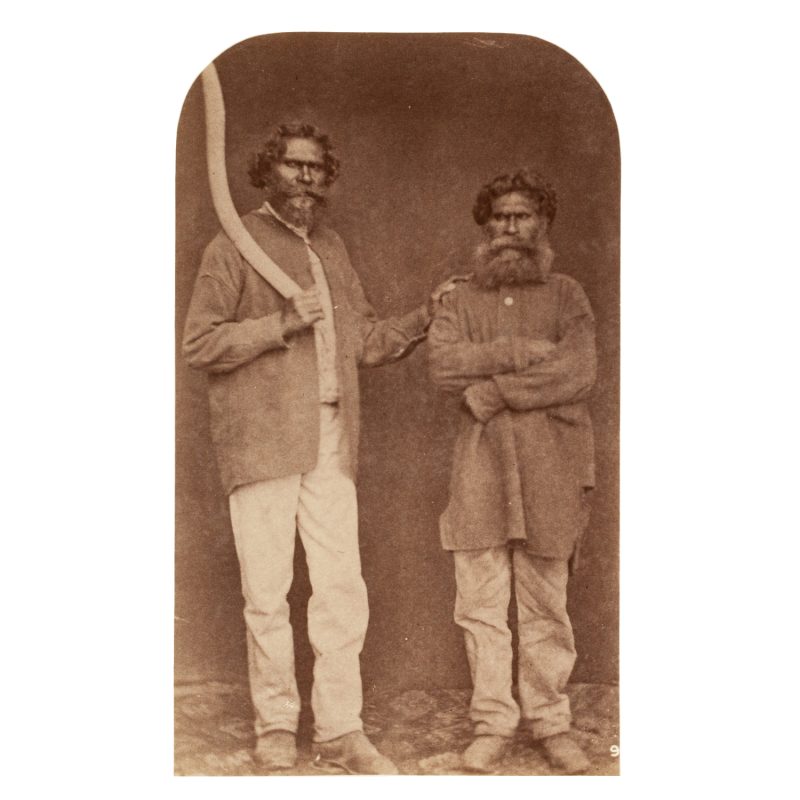
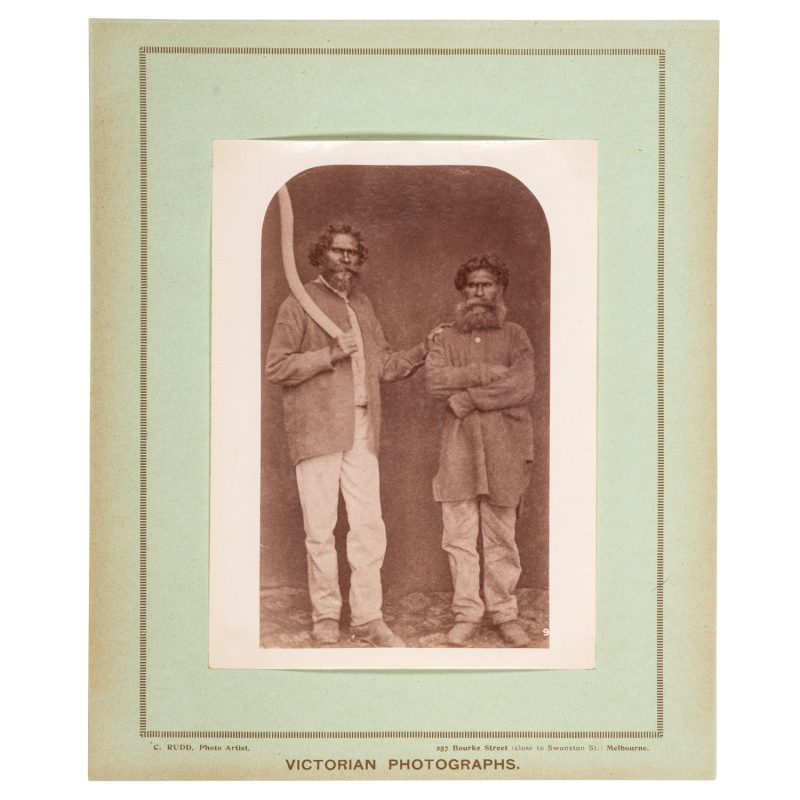
William Barak and (?)Simon Wonga (holding boomerang). Coranderrk, c.1872.
[Melbourne : Charles Rudd, between 1891 and 1901]. Albumen copy print (from an earlier albumen print dating to around 1872), 160 x 120 mm; mounted on the photographer’s paper backing sheet, 230 x 190 mm, with series title ‘VICTORIAN SCENERY BY C. RUDD’ printed in the upper margin, the studio imprint in lower right margin ‘C. Rudd, Photo. Artist, 257 Bourke Street’, and ‘Photographed on Baker’s “Austral” Plates’ printed at lower left; both the print and mount are in fine condition.
‘We Aboriginals all wish and hope to have freedom … we should be free like the White Population’ (1886 Coranderrk Petition).
An extremely rare and significant portrait photograph of William Barak (1824-1903), revered Wurundjeri lore man, artist, and statesman (standing on the right); we believe the man posed beside him, holding a boomerang and with his hand placed affectionately on Barak’s shoulder, is his cousin, Wurundjeri ngurungaeta (senior man) Simon Wonga (1824-1874). The photograph was taken by Charles Rudd at Coranderrk Aboriginal Station around 1872. Barak would become the next ngurungaeta on Wonga’s death in December, 1874. We have not been able to trace another example of this image in any institutional collection or published source.
Based on the appearance of both men, the photograph appears to have been taken in a makeshift studio at Coranderrk a few years after 1866, when both were photographed by Charles (Carl) Walter as part of his important series of portraits of Coranderrk residents.
While the Coranderrk photographs of Walter, Fred Kruger, and Nicholas Caire are well known, those of Melbourne-based photographer Charles Rudd (1849-1901) are not. One plausible explanation for this is that Rudd’s glass plate negatives recording his visit(s) to Coranderrk and Lake Tyers in Gippsland were destroyed relatively early on: examples of his photographs of these locations that have survived seem to be his own copy prints made in the 1890s from older albumen prints, as they all exhibit the tell-tale slight loss in definition always associated with this type of image reproduction. If Rudd still had access to his original negatives from which to print, he surely would have used them.
Newspaper notices inform us that Rudd moved into his premises at 257 Bourke Street in July 1891, and that he remained there up until his death on Wednesday, 16 October 1901 – when he died whilst at work in his own studio. These dates fix a very definite time frame for when this important portrait of Wonga and Barak must have been printed; the date range is also corroborated by the fact that Baker’s Austral Dry Plate Company was active in Melbourne throughout this entire decade.
Provenance: from a Charles Rudd commercial sample album that contained hundreds of window-mounted 1890s prints in identical format (including a number of other Coranderrk and Gippsland images taken by Rudd in the 1870s-80s).